Why Is a Colonoscopy So Expensive? A Full Cost Breakdown
A colonoscopy looks like one procedure — but your insurance company sees it as five separate billable events. That’s the core reason the total can hit $4,000 without a single thing going wrong.
The American College of Gastroenterology (ACG) estimates that more than 19 million colonoscopies are performed in the US each year, and the billing complexity is baked into how healthcare facilities are reimbursed. Here’s what you’re actually paying for.
The Five Separate Bills You Should Expect
When you have a colonoscopy, the following providers bill independently — even though they’re all in the same room:
- The facility (hospital or surgery center)
- The gastroenterologist (the physician doing the procedure)
- The anesthesiologist or CRNA (whoever gives you sedation)
- The pathologist (if any tissue is sent to the lab)
- Your primary care or referring physician (sometimes, if they submitted a referral)
Each one files a separate claim. Each one can be in-network or out-of-network. Each one has its own billing department. That’s four to five EOBs arriving in your mailbox over several weeks.
| Bill Component | Typical Range | Billed By |
|---|---|---|
| Facility fee (hospital) | $1,200 – $2,800 | Hospital or surgery center |
| Facility fee (ASC) | $500 – $1,200 | Ambulatory surgery center |
| Gastroenterologist | $250 – $600 | GI physician’s practice |
| Anesthesia | $400 – $1,200 | Anesthesiology group |
| Pathology (per specimen) | $200 – $800 | Independent pathology lab |
The Facility Fee Is Usually the Biggest Driver
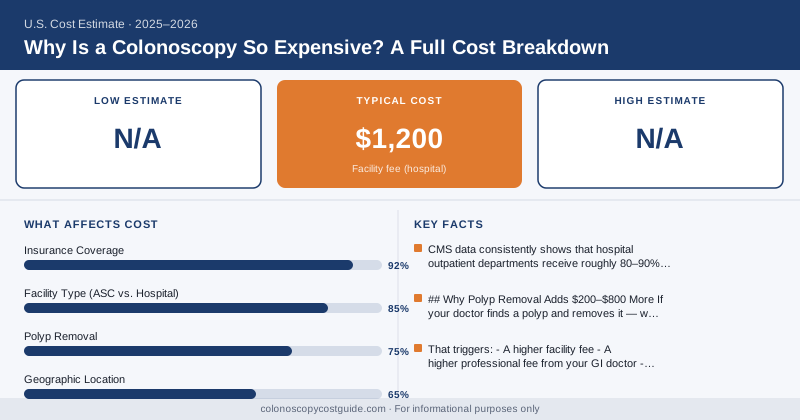
The facility fee — what the hospital or surgery center charges just to provide the room, equipment, nurses, and recovery area — is typically 50–70% of the total bill. And hospital-based outpatient departments charge dramatically more than freestanding ambulatory surgery centers (ASCs) for the identical procedure.
CMS data consistently shows that hospital outpatient departments receive roughly 80–90% higher Medicare reimbursement than ASCs for colonoscopy services. That gap passes directly to commercially insured patients.
Hospital vs. ASC: What the Difference Looks Like
Hospital outpatient colonoscopy (facility fee only): $1,200 – $2,800
Freestanding ASC (facility fee only): $500 – $1,200
Same GI doctor. Same CPT code. Different setting — roughly double the cost at a hospital. If your GI physician has privileges at both, asking specifically for an ASC-based procedure is the single most impactful cost decision you can make.
Anesthesia Bills Separately — and Can Be Out of Network
Most colonoscopies use propofol sedation, which requires a separate credentialed provider. The anesthesiology group working at your facility often isn’t part of your insurance network — even if the facility and your GI doctor are both in-network.
The No Surprises Act (effective 2022) provides some protection for emergency services, but it has limitations for scheduled outpatient procedures. A CRNA or anesthesiologist at an in-network facility can still bill out of network in some circumstances. Always call your insurer and ask specifically whether the anesthesiology group at your facility participates in your plan.
Why Polyp Removal Adds $200–$800 More
If your doctor finds a polyp and removes it — which happens in roughly 40% of screening colonoscopies according to ACG data — the procedure code changes from CPT 45378 (diagnostic colonoscopy) to 45380 or 45385 (colonoscopy with removal). That triggers:
- A higher facility fee
- A higher professional fee from your GI doctor
- A pathology bill ($200–$800 per specimen) when the tissue goes to the lab
- Potential reclassification from “preventive” to “diagnostic,” which may remove your $0 cost-sharing status under the ACA
| Scenario | Total Estimated Bill | Out-of-Pocket (insured, typical) |
|---|---|---|
| Screening, no polyps, ASC | $1,000 – $2,000 | $0 – $200 |
| Screening, no polyps, hospital | $1,800 – $3,200 | $0 – $600 |
| Screening with polyp removal, ASC | $1,500 – $2,800 | $200 – $800 |
| Screening with polyp removal, hospital | $2,500 – $4,800 | $400 – $1,500 |
Why the Same Procedure Costs Different Amounts
Three main factors swing the price outside of which facility you use:
Geographic location. CDC health expenditure data shows wide regional variation. A colonoscopy in Manhattan or San Francisco runs 40–60% higher than the same procedure in Indianapolis or Memphis. Urban academic medical centers bill more than suburban community hospitals.
Your insurance plan. The “allowed amount” your insurer negotiates is the price that actually matters. A hospital’s billed charge of $3,500 might be adjusted down to $1,800 by your plan — and your cost-sharing applies to the $1,800, not the $3,500.
Whether it stays preventive. Under ACA rules, a screening colonoscopy is covered at 100% by most insurance plans. But 26 states and many plans still allow a polyp finding to flip the billing code from preventive to diagnostic. Ask your insurer — before the procedure — exactly how they handle polyp removal coding.
The Bottom Line on Colonoscopy Pricing
A colonoscopy is expensive because it bundles multiple professional services at a regulated healthcare facility using specialized equipment and sedation. The system is designed so that each professional and each facility bills independently. For most insured patients, the out-of-pocket cost of a straightforward screening at an ASC with no polyps is $0–$200. Every complication, finding, or billing decision (hospital vs. ASC, preventive vs. diagnostic) pushes that number higher.
Understanding the components is how you catch billing errors, negotiate cash prices, and avoid unexpected bills. For step-by-step cost-reduction strategies, see how to reduce colonoscopy cost.