Why Are Colonoscopy Prices So Different Between Hospitals?
Two people, same city, same procedure, same week. One pays $1,100. The other pays $4,900. Neither did anything wrong — they just walked into different buildings.
Colonoscopy pricing is one of the most inconsistent in all of American healthcare, and almost none of the variation reflects medical quality. Once you understand the four levers that move the price, you can shop it like any other purchase.
Lever 1: Facility Type Is the Biggest Single Factor
Where you have the procedure matters more than almost anything else. A hospital outpatient department and a freestanding ambulatory surgery center (ASC) can perform the identical colonoscopy — same doctor, same code — for wildly different prices.
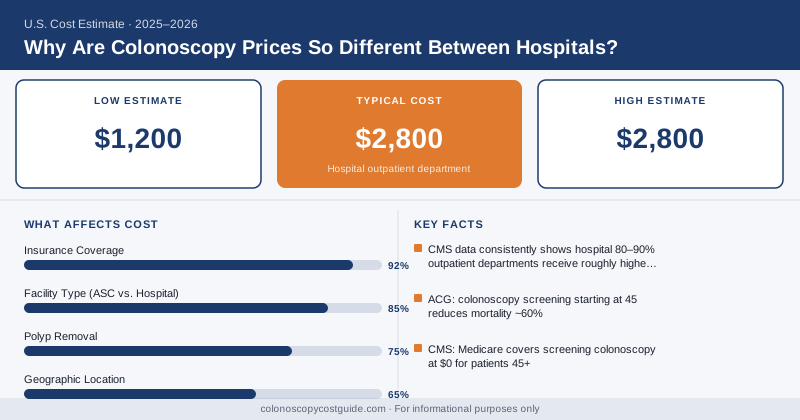
CMS data consistently shows hospital outpatient departments receive roughly 80–90% higher reimbursement than ASCs for colonoscopy services. That gap passes straight through to commercially insured patients.
| Facility Type | Facility Fee Range | Why |
|---|---|---|
| Hospital outpatient department | $1,200 – $2,800 | Higher overhead, regulated reimbursement |
| Freestanding surgery center (ASC) | $500 – $1,200 | Lower overhead, leaner operation |
| Office-based endoscopy suite | $400 – $900 | Lowest overhead |
If your gastroenterologist has privileges at both a hospital and an ASC, asking specifically for the ASC is the most powerful cost decision you can make. See our hospital vs. surgery center breakdown for the full comparison.
Lever 2: Your Insurer’s Negotiated Rate
The price you see on a hospital bill — the “chargemaster” sticker price — is mostly fiction. What actually matters is the “allowed amount” your insurance company negotiated with that facility.
A hospital might charge $3,500. Your insurer’s allowed amount might be $1,800. Your deductible and coinsurance apply to the $1,800, not the $3,500. Different insurers negotiate different rates with the same hospital, which is why two patients at the same facility can pay different amounts.
The One Number That Actually Predicts Your Cost
Forget the sticker price. The number that determines what you pay is the negotiated “allowed amount” between your plan and the facility, combined with where you stand on your deductible.
Use your insurer’s online cost-estimator tool, or call and ask: “What’s the allowed amount for CPT 45378 at [facility], and how much of my deductible is left?” That two-part answer is your real estimate.
Lever 3: Geography
Location swings the price more than most people expect. National cost data shows the same colonoscopy can run 40–60% higher in expensive metros like Manhattan or San Francisco than in lower-cost cities like Indianapolis or Memphis. Urban academic medical centers bill more than suburban community hospitals. If you live near a market border, crossing it can save real money.
Lever 4: Screening vs. Diagnostic Coding
How the visit is coded changes everything about what you owe. A screening colonoscopy under an ACA-compliant plan is covered at $0 for average-risk adults 45–75. A diagnostic colonoscopy — for symptoms or a positive stool test — is subject to your full deductible and coinsurance. Same procedure, same room, totally different bill.
| Scenario | Typical Total Billed | Out-of-Pocket (Insured) |
|---|---|---|
| Screening, ASC, no polyps | $1,000 – $2,000 | $0 |
| Screening, hospital, no polyps | $1,800 – $3,200 | $0 |
| Diagnostic, ASC | $1,500 – $2,800 | $300 – $1,200 |
| Diagnostic, hospital | $2,500 – $5,000 | $600 – $2,500 |
Frequently Asked Questions
Can price transparency rules help me shop? Yes, somewhat. Federal hospital price transparency rules (2021) and the insurer transparency-in-coverage rule (2022) require published negotiated rates. The data is messy, but cost-estimator tools built on it are the closest thing to a shoppable price.
Why is the hospital so much more expensive for the exact same thing? Higher overhead, regulated reimbursement structures, and chargemaster inflation. The medical care is the same — you’re paying for the building and its billing model, not better outcomes.
Does a higher price mean a better doctor? No. Price tracks facility type, location, and contracts — not skill. Many of the same gastroenterologists work at both expensive hospitals and cheaper surgery centers.
How do I get the lowest price? Choose an ASC over a hospital, confirm everyone is in network, use your insurer’s estimator, and negotiate the cash rate if you’re uninsured. Our how to reduce colonoscopy cost and cost negotiation tips guides walk through each step.
The takeaway: colonoscopy prices vary because of facility type, negotiated rates, geography, and coding — not medical quality. Pull those four levers in your favor and you can often cut the bill in half.