10 Questions to Ask Before Your Colonoscopy to Avoid Surprise Bills
42% of Americans report being surprised by a medical bill they didn’t expect — and colonoscopy is one of the procedures most likely to produce them. A 2022 Health Affairs study found that surprise billing in outpatient GI procedures affects millions of patients annually, largely due to out-of-network anesthesiology and unexpected coding changes.
Ten questions. That’s all it takes to prevent most of them. Ask these before your procedure date — not after.
Question 1: Is the Facility In-Network With My Insurance Plan?
This is the first call you make. Not all facilities that accept your insurer are in-network — and even being “in-network” doesn’t mean your cost-sharing is the same at every in-network facility.
Who to ask: Your insurance company (not the facility — facilities sometimes misrepresent their network status).
What to say: “Is [facility name] an in-network provider for my plan for outpatient GI procedures — specifically CPT 45378?”
Don't Trust the Facility on Network Status
Question 2: Is My Gastroenterologist In-Network?
Your GI physician is a separate provider from the facility. They bill independently. A physician in-network at one hospital may be out-of-network at another location where they also practice.
Who to ask: Your insurance company.
What to say: “Is Dr. [name] in-network for my plan? Their NPI is [number, if available].”
If your GI doctor is out-of-network, you have options: request a referral to an in-network GI physician, or ask your insurer about the No Surprises Act’s cost-sharing limits for scheduled care.
Question 3: Is the Anesthesiologist or CRNA In-Network?
This is the most common source of surprise colonoscopy bills. The anesthesiologist assigned to your procedure is often an independent contractor, not an employee of the facility. Even if your facility and GI doctor are in-network, the anesthesiology group may not be.
Who to ask: The GI facility’s scheduling team AND your insurance company.
What to say: “What anesthesiology group does your facility use? Is [group name] in-network with [your plan]?”
If the group is out-of-network, ask: “Can I request an in-network anesthesiologist?” or “Does your facility offer conscious sedation as an alternative to anesthesiologist-administered propofol?”
Question 4: Will My Colonoscopy Be Billed as Screening or Diagnostic?
This question can be worth $500–$1,500. A screening colonoscopy for an average-risk adult is covered at $0 under the ACA preventive benefit. A diagnostic colonoscopy — for symptoms, positive stool test, or family history evaluation — is subject to deductibles and copays.
Who to ask: The GI scheduling office AND your insurance company.
What to say (to the GI office): “What CPT and diagnosis code will you use for my procedure? I want to confirm it’ll be billed as a screening colonoscopy.”
What to say (to insurer): “If this is billed as a preventive screening colonoscopy — CPT G0121 or 45378 with Z12.11 diagnosis — will it be processed at $0 cost-sharing?”
| Billing Classification | Typical CPT/Dx | Typical Patient Cost |
|---|---|---|
| Screening (ACA preventive) | G0121 or 45378 + Z12.11 | $0 (ACA-compliant plans) |
| Diagnostic (symptoms, positive test) | 45378 + K-code or symptom code | Deductible + coinsurance |
| Surveillance (post-polyp follow-up) | 45378 + Z86.010 | Deductible + coinsurance |
Question 5: What Happens to My Billing If a Polyp Is Found?
About 40% of screening colonoscopies find a polyp. When a polyp is found and removed, the procedure code changes — and your cost-sharing may change along with it. Some insurers reclassify the procedure as diagnostic; others maintain the preventive status (as required by the 2023 federal guidance for ACA plans).
Who to ask: Your insurance company.
What to say: “If a polyp is found and removed during my screening colonoscopy, will the procedure remain covered as preventive with no cost-sharing? Or will cost-sharing apply?”
Question 6: Will I Receive a Separate Anesthesia Bill?
Yes — almost always. But you should confirm what to expect.
Who to ask: The GI facility.
What to say: “Will anesthesia be billed separately from the facility fee? Will I receive a separate bill from the anesthesiology group?”
If you’re getting conscious sedation (where the GI nurse administers the sedative), there’s typically no separate anesthesia bill. If you’re getting propofol administered by an anesthesiologist or CRNA, expect a separate bill of $400–$1,200.
Question 7: Will There Be a Separate Pathology Bill If Tissue Is Removed?
If your doctor removes a polyp or takes a biopsy, the tissue goes to a pathology lab. That lab files a separate claim — often arriving 3–6 weeks after your procedure bill.
Who to ask: The GI facility.
What to say: “If any tissue is biopsied or removed, does your facility use an in-network pathology lab? Or will pathology bill separately?”
Important: Some pathology labs are out-of-network even at in-network facilities. The No Surprises Act provides limited protection here for certain scenarios. Verify your pathology lab’s network status if possible.
Question 8: Can I Get a Good-Faith Estimate?
Under the No Surprises Act (effective January 2022), you have the right to request a good-faith cost estimate for any scheduled healthcare service — including colonoscopy. This estimate must include the expected charges from each provider involved in your care.
Who to ask: The GI facility (they’re responsible for coordinating the estimate).
What to say: “I’d like to request a good-faith estimate for my colonoscopy under the No Surprises Act. Can you provide an estimate that includes the facility fee, physician fee, and anesthesia fee?”
The estimate isn’t a binding price, but it’s a useful baseline. If your actual bill exceeds the estimate by $400 or more, you can dispute it through the Patient-Provider Dispute Resolution process.
Question 9: Should I Schedule at a Hospital or ASC?
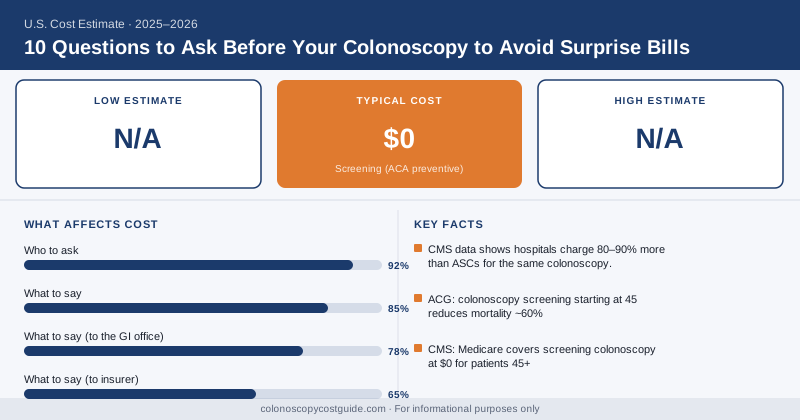
CMS data shows hospitals charge 80–90% more than ASCs for the same colonoscopy. If your GI doctor has privileges at both, asking this question before scheduling could save you $500–$1,500.
Who to ask: The GI scheduling office.
What to say: “Does [GI doctor’s name] perform colonoscopies at a freestanding ambulatory surgery center as well as the hospital? If so, can we schedule at the ASC to minimize my out-of-pocket cost?”
Watch Out for Hospital-Affiliated ASCs
Question 10: What Is My Deductible Status and How Will That Affect My Cost?
If you haven’t met your annual deductible, you’ll pay a significant portion of the colonoscopy cost out of pocket — even if the procedure is “covered” by insurance. If you’ve already met your deductible, you may pay only coinsurance (typically 10–30%).
Who to ask: Your insurance company.
What to say: “How much of my annual deductible have I met so far? And what is my coinsurance percentage for outpatient GI procedures at an in-network facility?”
Knowing your deductible status lets you decide whether to schedule before year-end (if you’re close to meeting it) or use an HSA/FSA to reduce your effective cost.
The Takeaway
Surprise colonoscopy bills happen because patients don’t know what to ask. Most of the risk is eliminated by a few targeted phone calls to your insurer and the scheduling office. The 10 questions above cover the most common billing pitfalls: out-of-network providers, coding changes at polypectomy, separate anesthesia and pathology bills, and the hospital-vs-ASC facility fee gap.
For full strategies to reduce what you pay, see how to reduce colonoscopy cost and colonoscopy cost negotiation tips.