What Happens If Polyps Are Found During Colonoscopy? The Step-by-Step Cost Impact
{ if eq .Lang "zh" }{ else }{ end }Your gastroenterologist just called. They found polyps. They removed them. Good news: that’s the job. Less obvious news: your bill is about to look different than what you expected for a “standard screening.”
Let’s walk through exactly what happens — financially — from polyp removal through your next colonoscopy.
Step 1: The Polypectomy Fee (Same Day)
When your doctor finds a polyp and removes it, the procedure code on your claim changes. A clean screening colonoscopy without polyp removal is billed under CPT 45378. Once a polyp is removed, the code shifts to:
- CPT 45385 (polypectomy by snare technique) — most common for standard polyps
- CPT 45380 (biopsy only, no removal) — for small polyps sampled but not fully excised
- CPT 45346 (endoscopic mucosal resection) — for large, flat polyps
The facility fee and physician fee both increase with these codes compared to a standard screening.
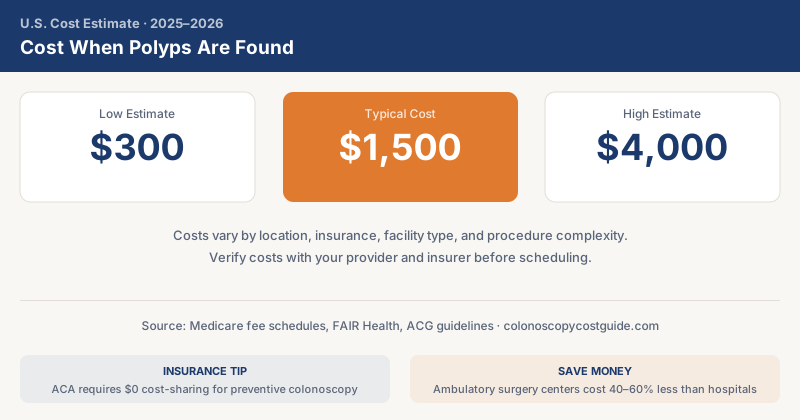
Typical polypectomy bill increase over standard screening:
- Facility fee: +$200 to $600
- Physician fee: +$50 to $150
- Total procedure: roughly $400 to $800 more than a clean screening
| Procedure | Facility Fee (ASC) | Physician Fee | Total (Insured, Deductible Met) |
|---|---|---|---|
| Screening only (no polyps) | $500 – $1,200 | $250 – $500 | $0 – $300 (often $0 as preventive) |
| 1 polyp removed | $700 – $1,600 | $300 – $600 | $200 – $600 |
| 2–3 polyps removed | $800 – $1,800 | $350 – $700 | $300 – $800 |
| Large polyp, EMR | $1,200 – $3,000 | $500 – $1,200 | $500 – $1,500 |
Step 2: The Pathology Bill (Arrives Weeks Later)
Every polyp removed goes to a pathology laboratory. The pathologist examines each specimen and issues a report. This generates a separate bill — often from a lab you don’t recognize — under CPT 88305.
The charge is per specimen. Two polyps = two pathology charges. Five polyps = five charges.
- Medicare-approved rate: approximately $60 to $90 per specimen
- Private insurer rates: $100 to $200 per specimen (contracted)
- List price (uninsured): $150 to $350 per specimen
For insured patients, the pathology bill applies toward your deductible (if not met) or triggers coinsurance. The lab may be out-of-network even if your GI center is in-network — see endoscopy biopsy cost for how to prevent surprise pathology bills.
Step 3: The Pathology Result — What It Means for Your Future Schedule
This is the step that determines your next several colonoscopies. The ACG and USMSTF (US Multi-Society Task Force on Colorectal Cancer) have specific follow-up recommendations based on polyp findings:
| Pathology Finding | Follow-up Interval | What This Costs You Long-Term |
|---|---|---|
| No polyps found | 10 years | 1 colonoscopy per decade |
| 1–2 small tubular adenomas (< 10mm) | 7–10 years | Modest increase from average risk |
| 3–4 adenomas, OR any 10mm+ adenoma | 3 years | Significant cost increase |
| 5+ adenomas, OR any villous/tubulovillous, OR high-grade dysplasia | 1 year | Major ongoing surveillance cost |
| Sessile serrated polyp(s), 10mm+ or with dysplasia | 1 year | Major ongoing surveillance cost |
| Hyperplastic polyps only (left colon) | 10 years | No change from average risk |
The Real Financial Impact of Polyp Type
Step 4: The Follow-Up Colonoscopy (3–10 Years Later)
Once you’ve had polyps removed, your next colonoscopy is almost always billed as a surveillance colonoscopy rather than a preventive screening. This matters because:
- Preventive screening: ACA-compliant plans cover at $0
- Surveillance colonoscopy: Treated as diagnostic, deductible and coinsurance apply
For a patient in the 3-year follow-up group, that means:
- Year 0: Screening colonoscopy (possibly $0 with ACA-compliant plan)
- Year 3: Surveillance colonoscopy ($500 to $2,500 out of pocket depending on plan)
- Year 3+: Pathology for any new polyps found
If the Year 3 colonoscopy finds additional polyps and resets your timeline to another 3-year follow-up, the ongoing surveillance cost accumulates quickly.
Total Cost Scenario: The Average Polyp Finding
Let’s run through a realistic scenario for a 52-year-old on an employer health plan with a $2,000 deductible:
Year 0 — Screening colonoscopy:
- Screening colonoscopy at ASC: $1,400 billed, $0 patient cost (preventive)
- 2 polyps found and removed: Polypectomy changes billing — may now apply to deductible
- 2 pathology specimens at $200 each (contracted rate): $400 toward deductible
- Year 0 patient cost: $400 (the polypectomy/pathology portion)
Year 3 — Follow-up colonoscopy (intermediate risk):
- Diagnostic colonoscopy at ASC: $1,500 facility + $400 physician + $400 anesthesia = $2,300 total
- Patient pays $2,000 deductible, then 20% coinsurance on remaining $300: $60
- Total Year 3 patient cost: ~$2,060
- Plus pathology for any new polyps found
5-year running total: Approximately $2,500 to $4,000 in out-of-pocket costs vs. $0 for a patient who had no polyps and waits 10 years.
What to Do Right After You Get the Pathology Result
When you receive your pathology results (usually within 1 to 2 weeks), ask your GI physician two specific questions:
“What is my follow-up colonoscopy interval based on these results?” — Get the specific recommendation documented in writing.
“Will my next colonoscopy be billed as preventive or diagnostic?” — This tells you whether your ACA $0 benefit applies or whether you’ll face cost-sharing.
Then call your insurer and ask: “Based on a prior colonoscopy finding of [polyp type/number], what is the billing classification for my recommended [X-year] surveillance colonoscopy?”
For an overview of how follow-up intervals and cumulative lifetime costs work by risk category, see colonoscopy follow-up cost.
{ if eq .Lang "zh" }