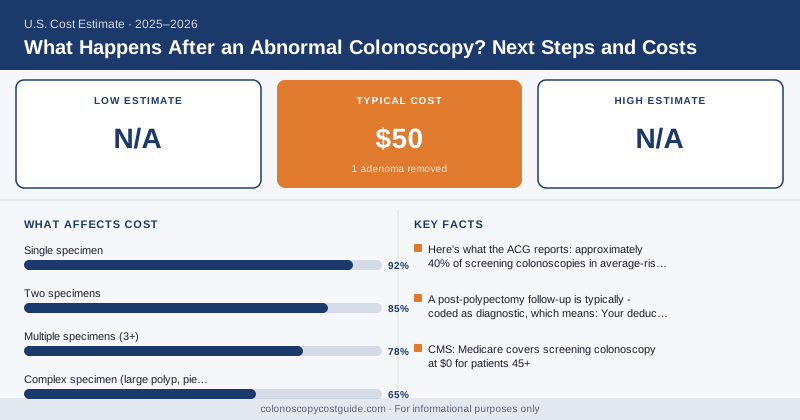
What Happens After an Abnormal Colonoscopy? Next Steps and Costs
Your colonoscopy found something — and now the bills are just beginning. An “abnormal” result can mean anything from a benign hyperplastic polyp to early-stage colorectal cancer, and the financial path forward depends entirely on what was found.
Here’s what the ACG reports: approximately 40% of screening colonoscopies in average-risk adults find at least one polyp. Most are benign. But “benign” still means pathology fees, follow-up scheduling, and a new surveillance interval. Here’s what happens next — clinically and financially.
Step 1: The Pathology Bill ($200–$800)
When your gastroenterologist removes a polyp or takes a tissue biopsy, the specimen goes to a pathology lab. That lab is often a separate entity from the facility and your GI doctor — meaning a separate bill.
Pathology bills arrive 3–6 weeks after your procedure, typically after you’ve already settled with the facility. Costs:
- Single specimen: $200 – $400
- Two specimens: $350 – $600
- Multiple specimens (3+): $500 – $800 or more
- Complex specimen (large polyp, piecemeal removal): $600 – $1,200
Insurance often covers pathology, but your cost-sharing (deductible, coinsurance) applies. If your colonoscopy was coded as preventive and a polyp finding shifts it to diagnostic, your pathology bill may arrive with full deductible responsibility if you haven’t met your deductible yet.
| Pathology Scenario | Estimated Cost (billed) | Typical Patient Cost (insured) |
|---|---|---|
| 1 adenoma removed | $200 – $400 | $50 – $200 |
| 2–3 adenomas removed | $350 – $700 | $100 – $350 |
| Large polyp, complex removal | $600 – $1,200 | $200 – $600 |
| Biopsy for IBD surveillance | $150 – $350 | $50 – $175 |
Step 2: Understanding the Pathology Report
The pathology report classifies what was found. This classification directly determines your next step and cost:
Hyperplastic polyp: Non-precancerous. No intervention beyond removal. Follow-up colonoscopy in 10 years (same as average-risk screening).
Tubular adenoma (< 10mm): Low-grade precancerous. Most common finding. Follow-up colonoscopy in 3–5 years depending on count and size.
Villous or tubulovillous adenoma: Higher-risk. Follow-up colonoscopy in 3 years.
High-grade dysplasia: Significant precancerous change. Follow-up in 1 year.
Adenocarcinoma (cancer): Requires oncology referral and staging workup. Triggers a very different clinical and financial pathway.
Ask for a Copy of Your Pathology Report
You have a legal right to your pathology report. Request it directly from the lab or through your patient portal. Understanding exactly what was found — adenoma vs. hyperplastic polyp, low-grade vs. high-grade dysplasia — helps you verify that your follow-up colonoscopy interval is appropriate and that your insurance is billing correctly.
A hyperplastic polyp doesn’t shorten your colonoscopy interval, but a biller might schedule a 3-year follow-up anyway. If your pathology report says “hyperplastic polyp only,” ask your GI doctor if a 10-year interval is appropriate.
Step 3: The Follow-Up Colonoscopy
If your pathology shows adenomas, you’ll need a surveillance colonoscopy before the 10-year standard interval. Surveillance colonoscopy cost depends on your insurance and setting — it’s the same procedure as a screening colonoscopy, but the billing code changes.
Key difference: surveillance colonoscopies are not automatically covered as preventive care under ACA rules. A post-polypectomy follow-up is typically coded as diagnostic, which means:
- Your deductible applies (if not already met)
- Coinsurance applies
- Out-of-pocket costs of $200–$800 are common even for insured patients
| Adenoma Finding | Follow-Up Interval | Approximate Procedure Cost (insured) |
|---|---|---|
| 1–2 small tubular adenomas | 3–5 years | $200 – $600 |
| 3–4 small tubular adenomas | 3 years | $200 – $600 |
| Adenoma ≥ 10mm or high-grade | 1 year | $200 – $800 |
| 5+ adenomas | 1–3 years | $200 – $800 |
Step 4: If Cancer Is Found — What Comes Next
Colorectal cancer is diagnosed in roughly 8% of patients with adenomas found on colonoscopy, according to data from the National Cancer Institute. If your pathology shows adenocarcinoma, the clinical pathway accelerates significantly.
Staging workup: CT scan of the chest, abdomen, and pelvis to determine if cancer has spread. Cost: $1,500–$4,000 per scan depending on insurance and facility.
Surgical consultation: Depending on stage, surgery may be the primary treatment. Colon resection costs range from $25,000–$60,000 for the procedure alone.
Oncology consult: Medical oncology involvement for chemotherapy evaluation. Initial consultation: $300–$800.
Radiation therapy: Used for some rectal cancers. See colorectal cancer radiation cost for a full breakdown.
Managing the Aftermath Financially
A few things that help with post-colonoscopy billing:
Dispute unexpected pathology bills. If your colonoscopy was supposed to be preventive (ACA-covered) and the pathology lab is billing you directly, call your insurer to verify whether pathology for a preventive-coded colonoscopy is covered.
Track all bills from all providers. You’ll receive separate bills from the facility, GI physician, anesthesiologist, and pathology lab. Each can have its own billing error.
Ask your GI office for an itemized bill. Match CPT codes to what actually happened. Polypectomy codes (45385) shouldn’t appear if only a biopsy (45380) was taken.
Check your EOB carefully. Your Explanation of Benefits should show how each charge was processed. Discrepancies between what was billed and what your insurer paid can reveal coding errors.
For the full breakdown of what a colonoscopy costs when polyps are removed, see colonoscopy biopsy polyp removal cost.