Virtual Colonoscopy (CT Colonography) Cost: What to Expect in 2025–2026
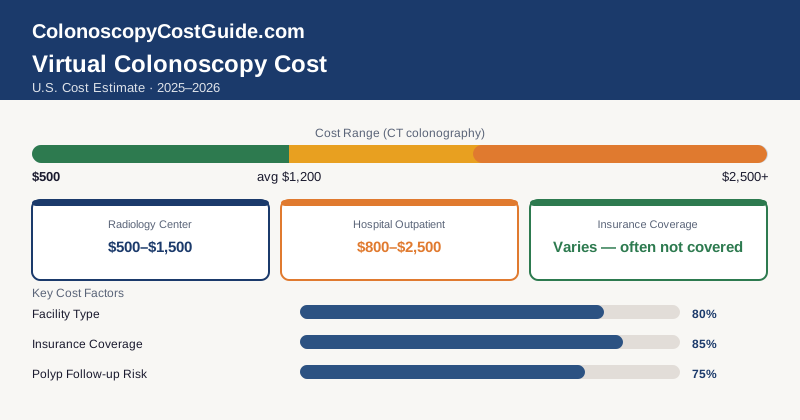
The radiologist’s quote was $1,200. The hospital billing office quoted $2,800 for the same procedure. That gap — for a CT scan lasting about 15 minutes — is exactly what catches patients off guard with virtual colonoscopy. Here’s how to navigate it.
What Is CT Colonography?
CT colonography (CTC), also called virtual colonoscopy, uses a CT scanner to create 3D images of your colon without inserting a scope. A small, flexible tube inflates your colon with air or CO2, then you lie still on the scanner for a few passes. The whole imaging portion takes 10–15 minutes.
It’s a real screening option. The American Cancer Society lists CTC every 5 years as an acceptable colorectal cancer screening method for average-risk adults starting at age 45.
What Does Virtual Colonoscopy Cost?
| Setting | Self-Pay / Cash Price |
|---|---|
| Freestanding radiology center | $300–$800 |
| Hospital outpatient radiology | $900–$2,500 |
| Academic medical center | $1,200–$3,000 |
| Average with insurance (cost-share) | $100–$600 |
The variation is real. FAIR Health data shows average allowed amounts for CPT 74263 (CT colonography, diagnostic) running $400–$900 in most markets, but hospital facility fees can push the total bill to $2,500 or more.
Does Medicare Cover Virtual Colonoscopy?
This is where it gets frustrating. Medicare does not cover CT colonography as a colorectal cancer screening benefit under current policy. CMS has repeatedly reviewed coverage requests and declined to add CTC to Medicare’s preventive screening benefit.
What that means practically: if you’re on Medicare and want a virtual colonoscopy, you’ll pay out of pocket unless there’s a diagnostic reason for the scan (like evaluating a known polyp or incomplete optical colonoscopy). A diagnostic CTC may be covered under Part B with applicable deductible and 20% coinsurance.
Private insurers are inconsistent. Some cover CTC every 5 years as a preventive benefit under the ACA mandate (no cost-sharing for in-network screening). Others require prior authorization or don’t cover it at all. Always call your insurer before scheduling.
Tip: The ACA Screening Loophole
Virtual vs. Optical Colonoscopy: Real Cost Comparison
| Factor | CT Colonography | Optical Colonoscopy |
|---|---|---|
| Procedure cost (self-pay) | $300–$2,500 | $1,200–$4,800 |
| Anesthesia required? | No | Usually yes ($500–$1,200) |
| Polyp removal during procedure | No — requires follow-up scope | Yes (same session) |
| If polyps found, additional cost? | Yes — full colonoscopy needed | Included |
| Bowel prep required? | Yes (modified, lower-volume) | Yes (full prep) |
| Frequency (average-risk) | Every 5 years | Every 10 years |
The hidden cost trap with CTC: if the scan finds a polyp 6mm or larger, you’ll need a follow-up colonoscopy. You’ve now paid for both procedures. ASGE data suggests roughly 15–20% of CTC screenings require a follow-up colonoscopy for polypectomy.
Prep Requirements
CTC requires bowel prep just like optical colonoscopy — though some “reduced prep” or “fecal tagging” protocols exist at certain centers. Don’t assume you’re skipping the prep. Ask specifically what your facility requires.
Reduced prep CTC (using oral contrast agents instead of full cathartic prep) is an option at some academic centers, but insurance coverage for this variant is even spottier.
When Does Insurance Actually Cover CTC?
Private insurers typically cover CTC when:
- It’s ordered as a diagnostic test (not screening) following an incomplete optical colonoscopy
- The patient has a documented reason the traditional scope is contraindicated
- The plan specifically lists CTC as a covered preventive benefit
The Bottom Line
Virtual colonoscopy is a legitimate screening option — but the cost structure is messier than optical colonoscopy for most Americans. No Medicare coverage, inconsistent private insurance, and the real possibility of a follow-up scope if polyps are found all factor into the true cost.
For average-risk adults under 65 whose insurance covers CTC, it’s worth exploring. For Medicare beneficiaries or the uninsured, a colonoscopy at a freestanding ambulatory surgery center is almost always more cost-effective when you factor in the potential follow-up scope.
According to CDC data, colorectal cancer is the third most common cancer diagnosed in the US, with approximately 153,000 new cases in 2023. The cost of screening — whatever method you choose — is a fraction of what treatment costs.