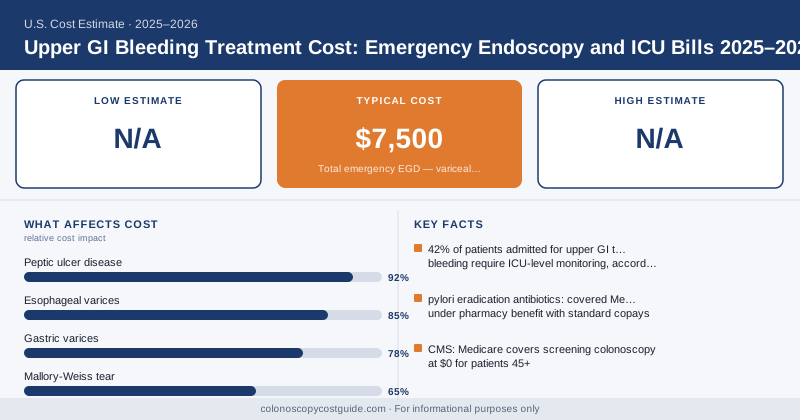
Upper GI Bleeding Treatment Cost: Emergency Endoscopy and ICU Bills 2025–2026
{ if eq .Lang "zh" }{ else }{ end }42% of patients admitted for upper GI bleeding require ICU-level monitoring, according to a landmark analysis in Clinical Gastroenterology and Hepatology. That statistic captures the stakes of this diagnosis — and explains why the bills are so large.
Upper GI bleeding isn’t a single disease. It’s a symptom caused by a spectrum of conditions ranging from a minor Mallory-Weiss tear (treatable with observation alone) to variceal hemorrhage from cirrhosis (potentially fatal even with optimal treatment). The cost reflects that spectrum: $8,000 for a mild ulcer bleed managed with endoscopy and a 2-night stay, to $80,000+ for esophageal variceal bleeding with ICU admission, multiple endoscopies, and blood product administration.
Causes of Upper GI Bleeding and Their Cost Implications
Peptic ulcer disease (35–50% of upper GI bleeds): Most are H. pylori-related or NSAID-related. Endoscopic hemostasis works well. Rebleeding rate is 10–20% after endoscopic treatment without H. pylori eradication.
Esophageal varices (10–20%): Dilated veins in the esophagus caused by portal hypertension in cirrhosis. When they rupture, bleeding is often massive. Requires specialized endoscopic banding, vasopressors, and possibly interventional radiology. Highest-acuity, highest-cost upper GI bleed.
Gastric varices: Similar to esophageal varices but harder to treat endoscopically. May require TIPS (transjugular intrahepatic portosystemic shunt) procedure — a $15,000–$40,000 intervention.
Mallory-Weiss tear (5–10%): Longitudinal tear at the gastroesophageal junction from forceful vomiting. Usually stops on its own. Lower cost profile.
Erosive gastritis/esophagitis (10–15%): Mucosal inflammation that bleeds slowly. Usually manageable with IV acid suppression (proton pump inhibitors).
Dieulafoy lesion (1–2%): An unusually large submucosal artery that erodes. Small but can bleed massively and is hard to find. High-cost due to repeat endoscopy and occasional IR intervention.
Emergency Endoscopy (EGD): The Core Procedure Cost
Upper GI bleeding is diagnosed and often treated via upper endoscopy (EGD — esophagogastroduodenoscopy). Endoscopic hemostasis techniques include injection therapy, thermal coagulation, hemostatic clips, and band ligation for varices.
| Emergency EGD Component | Typical Billed Cost |
|---|---|
| Hospital facility fee — diagnostic EGD | $2,500 – $6,000 |
| Hospital facility fee — therapeutic EGD (with hemostasis) | $4,000 – $10,000 |
| Gastroenterologist fee | $800 – $2,500 |
| Anesthesia/monitored sedation | $600 – $1,800 |
| Hemostatic clips (per clip, 1–4 used) | $300 – $800 each |
| Epinephrine injection + thermal coagulation (ulcer) | Included in therapeutic fee |
| Variceal band ligation (per session, 3–8 bands) | $1,500 – $4,000 additional |
| Total emergency EGD — ulcer with hemostasis | $5,300 – $15,100 |
| Total emergency EGD — variceal banding | $7,500 – $18,300 |
Emergency EGDs happen at hospitals, not ambulatory surgery centers. The facility fee is higher, the staffing costs are higher (24/7 teams), and the equipment is more sophisticated. This is unavoidable — it’s an emergency.
The ASGE recommends EGD within 24 hours of presentation for stable upper GI bleed patients. High-risk patients (active bleeding, hemodynamic instability) should go to endoscopy within 6–12 hours, as early endoscopy reduces hospital stays, blood transfusions, and costs.
ICU Admission: When Monitoring Is Critical
Not every upper GI bleed requires ICU care. But substantial bleeding — dropping hemoglobin, hemodynamic instability, active arterial bleeding on endoscopy — warrants ICU-level monitoring.
| ICU Component | Typical Billed Cost |
|---|---|
| ICU bed — daily facility charge | $2,500 – $6,000/day |
| ICU physician (intensivist) daily fee | $500 – $1,500/day |
| Vasopressors (for variceal bleed/hemodynamic shock) | $500 – $2,000/day |
| IV proton pump inhibitor (continuous infusion, 3 days) | $800 – $3,000 total |
| Somatostatin analog (octreotide, for variceal bleeds) | $500 – $2,500 total |
| Foley catheter, arterial line, central line placement | $1,500 – $4,000 total |
| 1-day ICU stay (moderate bleed monitoring) | $5,000 – $13,500 |
| 3-day ICU stay (severe bleed) | $12,000 – $33,000 |
| 7-day ICU stay (variceal hemorrhage with complications) | $28,000 – $77,000 |
Variceal hemorrhage from cirrhosis represents the worst-case upper GI bleed financially and medically. In-hospital mortality for acute variceal bleeding remains 10–20% even with modern treatment, per NEJM and AASLD guidelines. Survivors often need multiple endoscopies, TIPS, and liver transplant evaluation — costs that compound over months to years.
Blood Transfusions: A Significant Add-On Cost
Upper GI bleeds deplete blood volume rapidly. Transfusion is a routine part of resuscitation — and each unit costs more than most people expect.
- Single unit packed red blood cells (pRBC): $700 – $1,500 in hospital charges
- Moderate bleed (2–4 units): $1,400 – $6,000 for blood products alone
- Massive variceal hemorrhage (6–10+ units + plasma + platelets): $5,000 – $20,000
Current guidelines from ASGE and ACH recommend a restrictive transfusion strategy — transfuse to hemoglobin ≥7 g/dL, not ≥10. Studies show restrictive transfusion improves survival in variceal bleeds (lower portal pressure) and reduces total blood product costs. This is one area where the clinical guideline and cost containment point in the same direction.
H. Pylori Eradication: High-Value, Low-Cost Follow-Up
About 60–70% of duodenal ulcers and 30–40% of gastric ulcers are caused by H. pylori infection, according to NIH Helicobacter pylori data. After a bleeding ulcer is treated endoscopically, eradicating H. pylori reduces the 1-year rebleeding rate from ~20% to <5%.
H. pylori eradication therapy costs:
| H. Pylori Treatment Regimen | Cash Price (14 days) | With Insurance |
|---|---|---|
| Triple therapy (clarithromycin + amoxicillin + PPI) | $80 – $200 | $20 – $60 |
| Bismuth quadruple therapy (bismuth + metro + tetra + PPI) | $120 – $400 | $30 – $100 |
| Vonoprazan-based regimen (newer, higher eradication rate) | $400 – $900 | $50 – $200 |
| H. pylori breath test (confirms eradication, 4–6 weeks later) | $150 – $400 | $20 – $80 after deductible |
| Total eradication + confirmation | $230 – $1,300 | $50 – $280 |
Compare that to the cost of a rebleed — another emergency admission, another EGD, another hospitalization. H. pylori eradication is one of the best cost-effectiveness ratios in all of GI medicine. If you’re discharged after a bleeding ulcer, make sure H. pylori testing was done (urea breath test, stool antigen, or biopsy during EGD) and that you get the antibiotics.
Second-Look Endoscopy and Follow-Up Costs
High-risk ulcers (Forrest class Ia/Ib — active spurting or oozing arterial bleeding) have rebleeding rates of 15–30% after initial endoscopic treatment. A second-look EGD at 24–72 hours is sometimes recommended:
- Second EGD facility fee: $2,000–$6,000
- Gastroenterologist fee: $600–$2,000
- Often done while patient is still admitted; incremental cost is lower than a standalone procedure
Some high-risk patients also receive a PPI infusion for 72 hours post-endoscopy — an IV proton pump inhibitor drip that reduces rebleeding risk. IV pantoprazole or esomeprazole for 3 days adds $500–$2,000 in pharmacy charges.
Complete Cost Picture by Severity
| Severity Scenario | Estimated Total Hospital Charges |
|---|---|
| Mild bleed (Mallory-Weiss, low-risk ulcer), 1–2 night stay | $8,000 – $22,000 |
| Moderate bleed (high-risk ulcer), therapeutic EGD + 3-night stay | $20,000 – $45,000 |
| Severe bleed requiring ICU (3–5 days) + therapeutic EGD | $40,000 – $80,000 |
| Variceal hemorrhage — ICU, multiple EGDs, octreotide | $60,000 – $150,000+ |
| Variceal bleed requiring TIPS procedure | Add $15,000 – $40,000 |
What Insurance Covers
Commercial insurance:
- Inpatient admission: deductible ($1,000–$4,000) plus coinsurance to OOP max
- 2026 ACA individual OOP maximum: $9,200
- Moderate-to-severe upper GI bleeds almost always hit the OOP maximum
- H. pylori eradication antibiotics: covered under pharmacy benefit with standard copays
Medicare:
- Part A: inpatient deductible ($1,676 per benefit period) covers first 60 days
- Part B: EGD and physician fees at 80/20 after Part B deductible
- Extended ICU stays (>60 days) trigger daily coinsurance — Medigap eliminates this exposure
Medicaid:
- Full coverage; minimal cost-sharing for all emergency services
Upper GI bleeding is one of the most common GI emergencies in the US, with roughly 500,000 hospitalizations per year. Most are survivable. The costs are real but largely covered by insurance. The biggest financial risk is rebleeding — which is often preventable with H. pylori eradication, PPI therapy, or variceal prophylaxis after the first episode.
{ if eq .Lang "zh" }