Upper Endoscopy Cost With Medicare: Part B Coverage, CPT Codes, and What You'll Owe
42% of Medicare beneficiaries don’t know whether their endoscopy will trigger cost-sharing — and that confusion turns into billing surprises after the procedure. Here’s what Medicare actually covers for upper GI endoscopy and what you’ll realistically owe.
Medicare covers upper endoscopy (EGD — esophagogastroduodenoscopy) under Part B as a medically necessary diagnostic procedure. This is different from the way Medicare handles colonoscopy, which has a specific preventive screening benefit with $0 cost-sharing. Upper endoscopy doesn’t have a parallel preventive benefit for average-risk adults — so normal Part B cost-sharing almost always applies.
What Medicare Pays for Upper Endoscopy
Under standard Medicare Part B, the coverage structure for upper endoscopy works like this:
- Medicare sets an approved amount for each CPT code
- Medicare pays 80% of the approved amount after you’ve met your Part B deductible
- You’re responsible for the Part B deductible (currently $257 in 2025) if not already met
- You owe 20% coinsurance on the Medicare-approved amount
| CPT Code | Description | Medicare Approved Amount (Approx.) | Medicare Pays | You Owe (20% + deductible) |
|---|---|---|---|---|
| 43235 | EGD, diagnostic | $350 – $420 (physician) + facility | 80% | $70–$84 physician + facility share |
| 43239 | EGD with biopsy | $380 – $450 (physician) + facility | 80% | $76–$90 physician + facility share |
| 43255 | EGD with control of bleeding | $450 – $550 (physician) + facility | 80% | $90–$110 physician + facility share |
| ASC facility fee (EGD) | Facility charge | $350 – $550 | 80% | $70–$110 |
| Hospital outpatient facility | Facility charge | $600 – $1,100 | 80% | $120–$220 |
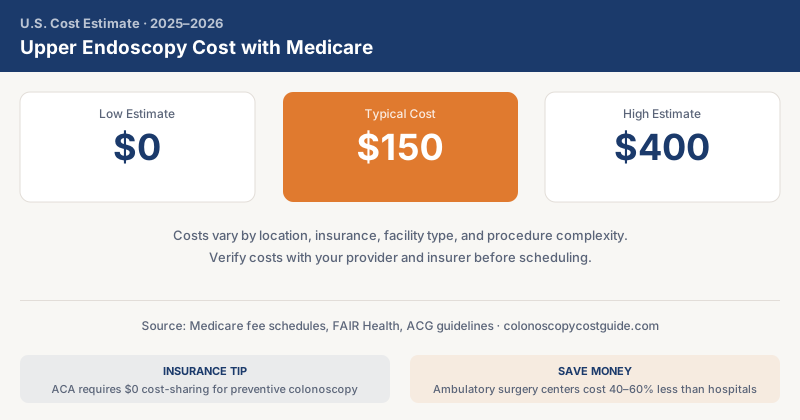
These are approximate physician fee schedule and Ambulatory Payment Classification amounts — actual figures vary slightly by geography and are updated annually in the Medicare Physician Fee Schedule. The total out-of-pocket for most Medicare beneficiaries for an uncomplicated EGD at an ASC runs $150 to $350 once the deductible is factored in.
Preventive vs. Diagnostic: Why the Billing Code Matters
This is the most important thing to understand about Medicare and upper endoscopy. Medicare does not have a $0-cost-share preventive benefit for upper endoscopy the way it does for colonoscopy.
Colonoscopy has a specific preventive benefit under the Social Security Act, Section 1861(pp). Upper endoscopy has no equivalent. So regardless of why your doctor orders an EGD, standard Part B cost-sharing applies.
The One Situation Where Upper Endoscopy May Be More Expensive
Common CPT Codes for EGD — What Each Means
Your Medicare Explanation of Benefits will reference a CPT code. Here are the ones most commonly used for upper endoscopy:
43235 — Diagnostic EGD, no intervention. Just looking. Used when your doctor needs to visualize the esophagus, stomach, and duodenum without performing any additional procedures.
43239 — EGD with biopsy. One or more tissue samples taken. This is probably the most common code — most EGDs result in at least one biopsy to test for H. pylori, Barrett’s esophagus, or other pathology.
43255 — EGD with control of bleeding. Therapeutic procedure for active upper GI bleeding.
43270 — EGD with dilation of esophageal stricture. Common for patients with swallowing difficulty.
43257 — EGD with delivery of thermal energy (Stretta procedure for GERD).
The code your GI physician uses determines both the Medicare-approved amount and your cost-sharing. If a biopsy is taken, your bill increases to include pathology charges — see endoscopy biopsy cost for that breakdown.
Medigap and Medicare Advantage Coverage
With a Medigap (Medicare Supplement) policy: Depending on your plan letter, Medigap covers some or all of the 20% Part B coinsurance and the Part B deductible. Medigap Plan G (the most popular new plan since Plan F was discontinued for new enrollees) covers the 20% coinsurance after you’ve paid the deductible. Medigap Plan N covers coinsurance with a small copay per office or outpatient visit. If you have a Medigap policy, your EGD out-of-pocket can drop to near zero.
With Medicare Advantage: Cost-sharing varies by plan. Some plans charge a flat specialist copay ($50 to $100 per visit), while others use coinsurance. Your out-of-pocket maximum provides a backstop, unlike Original Medicare, which has no annual out-of-pocket cap without a Medigap policy.
| Coverage Type | Typical EGD Out-of-Pocket |
|---|---|
| Original Medicare only (no supplement) | $150 – $350 (after deductible) |
| Original Medicare + Medigap Plan G | $0 – $257 (just the deductible) |
| Original Medicare + Medigap Plan N | $50 – $150 (deductible + small copay) |
| Medicare Advantage (varies by plan) | $0 – $300 depending on plan |
| Medicare + Medicaid dual eligible | Usually $0 |
When Medicare Denies an EGD
Medicare can deny an EGD claim if the documentation doesn’t support medical necessity. Common reasons for denial:
- No clear clinical indication documented in the physician’s notes
- Repeat EGD too soon after a prior procedure without documented reason
- Procedure performed outside of guideline parameters
If your claim is denied, your GI physician can appeal with additional clinical documentation. You should also receive an Advance Beneficiary Notice (ABN) before the procedure if your provider believes Medicare may not cover it — that notice gives you the option to proceed with or without Medicare submission.
According to CMS data, upper endoscopy is one of the 10 most commonly billed outpatient procedures among Medicare beneficiaries. The system is well-established for processing these claims — denials based on medical necessity are less common than for newer or more experimental procedures, as long as documentation is clear.