Ulcerative Colitis Medication Cost: Mesalamine, Biologics, and JAK Inhibitors
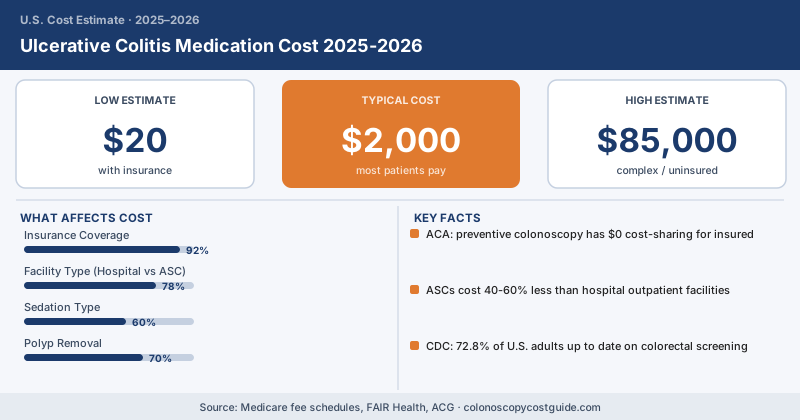
Most patients with mild ulcerative colitis pay $20 to $80 a month for mesalamine and live completely normally. Then there’s the 25% of UC patients whose disease is moderate-to-severe — they’re looking at biologic drugs with five- and six-figure annual price tags. Understanding where you fall on that spectrum, and what your actual out-of-pocket will be, is critical.
According to the Crohn’s & Colitis Foundation, approximately 907,000 Americans have ulcerative colitis as of 2024. Treatment costs vary enormously by disease severity. A 2023 analysis in Inflammatory Bowel Diseases found that mean annual direct medical costs for moderate-to-severe UC patients in the U.S. exceeded $35,000 — roughly 10 times higher than for mild UC patients on aminosalicylates alone.
The UC Drug Ladder: Cost by Treatment Class
UC treatment follows a step-up approach. You generally start with the least expensive drugs and escalate if they don’t work.
| Drug Class | Example Drugs | Monthly List Price | Typical Patient Cost (Insured) |
|---|---|---|---|
| Aminosalicylates (5-ASA) | Mesalamine (Lialda, Delzicol, Apriso), generic | $50–$400/month | $10–$80 with generic or GoodRx |
| Corticosteroids | Prednisone, budesonide (Uceris) | $20–$300/month | $5–$80 |
| Immunomodulators | Azathioprine, 6-MP, methotrexate | $30–$150/month | $10–$50 with generic |
| Anti-TNF biologics | Humira, Remicade + biosimilars | $5,000–$8,000/month | $0–$100 with co-pay card |
| Anti-integrin | Entyvio (vedolizumab) | $5,500–$7,000/month | $0–$100 with co-pay card |
| Anti-IL-12/23 | Stelara (ustekinumab) | $12,000–$18,000/month | $0–$100 with co-pay card |
| Anti-IL-23 | Skyrizi (risankizumab) | $12,000–$16,000/month | $0–$100 with co-pay card |
| JAK inhibitors (oral) | Xeljanz (tofacitinib), Rinvoq, Zeposia | $4,500–$6,000/month | $0–$150 with co-pay card |
The co-pay card column reflects commercial insurance patients using manufacturer assistance. Medicare patients cannot use co-pay cards, and their costs are different (see below).
Mesalamine: Generic vs. Brand Price Gap
Mesalamine is the first-line treatment for mild-to-moderate UC. It comes in multiple formulations (delayed-release capsules, extended-release, rectal suppositories, enemas) for different disease locations.
Generic mesalamine has been available since 2018. A 30-day supply of generic mesalamine 1.2g can cost as little as $25 to $60 through GoodRx at many pharmacies. Brand-name Lialda, Delzicol, or Apriso can run $400 to $600 per month without insurance.
If your doctor writes for brand-name mesalamine, ask specifically for generic — it’s therapeutically equivalent for most patients with mild-to-moderate UC and the savings are significant. Many specialty pharmacies will automatically switch to brand without telling you.
Biologics for UC: The Cost Structure
When mesalamine and immunomodulators aren’t enough, biologics are the next step. The same biologic drugs used for Crohn’s disease (Humira, Remicade, Entyvio, Stelara, Skyrizi) are also FDA-approved for UC, with similar pricing structures.
Entyvio (vedolizumab) is gut-selective — it acts specifically in the GI tract rather than systemically — which makes it popular for UC patients who want to minimize systemic immune suppression. Its list price is $65,000 to $85,000 per year, but Takeda’s co-pay program brings patient out-of-pocket to near $0 for most commercially insured patients.
The newer options — Skyrizi (risankizumab) and Rinvoq (upadacitinib) — were FDA-approved for UC in 2023. Both have shown strong efficacy data in clinical trials. Rinvoq (an oral pill) is particularly convenient compared to injectables or infusions, but it carries a black box warning for serious infections and other risks that require discussion with your GI doctor.
JAK Inhibitors: Lower List Price, Higher Safety Scrutiny
UC Medications on Medicare: The 2025 Part D Cap
Starting January 2025, the Inflation Reduction Act’s $2,000 annual out-of-pocket cap on Medicare Part D prescription drug costs took effect. This is a game-changer for UC patients on Medicare Part D-covered drugs (primarily the oral agents and self-injectable biologics).
Before 2025, a Medicare patient on Xeljanz could easily pay $3,000 to $7,000 per year in Part D out-of-pocket costs, even with Extra Help. The $2,000 cap means no Medicare Part D enrollee pays more than $2,000 in 2025 and beyond for covered drugs, regardless of list price.
Infused biologics like Remicade and Entyvio are covered under Medicare Part B (not Part D), where the 20% coinsurance still applies without an out-of-pocket cap unless you have Medigap coverage.
| Medicare Coverage | Drug Examples | 2025 Out-of-Pocket Cap |
|---|---|---|
| Part D (oral + home-inject) | Xeljanz, Rinvoq, Humira biosimilars | $2,000/year maximum |
| Part B (IV infusion) | Remicade, Entyvio | 20% coinsurance — no cap without Medigap |
| Part D Low-Income Subsidy (Extra Help) | All Part D drugs | $4–$12 copay per drug |
Steroids: Cheap but Not Long-Term
Prednisone costs almost nothing — $4 to $10 for a 30-day supply at most pharmacies. It’s highly effective for acute UC flares. The problem: it’s not appropriate for long-term use due to serious side effects (bone loss, diabetes, cataracts, adrenal suppression). Budesonide (Uceris), a more targeted oral steroid, costs $200 to $400 per month and is better tolerated for short courses, but still not a long-term solution.
If you’re repeatedly cycling on and off steroids rather than starting a maintenance medication, that pattern is medically risky and doesn’t save money in the long run — steroids suppress symptoms while disease activity continues.
UC Surveillance Colonoscopies: The Ongoing Cost
UC patients with extensive colitis have elevated colorectal cancer risk, requiring surveillance colonoscopies every 1 to 2 years after 8 years of disease. These procedures add another layer of annual cost on top of medication expenses. The colonoscopy cost with ulcerative colitis article has the full breakdown of what surveillance procedures cost and how insurance covers them.
For a broader picture of IBD-related GI procedure costs, the colonoscopy cost overview provides context on what surveillance and diagnostic workups typically add to your annual UC management expenses.