Trulance Cost: Monthly Price, Copay Savings, and Linzess Comparison
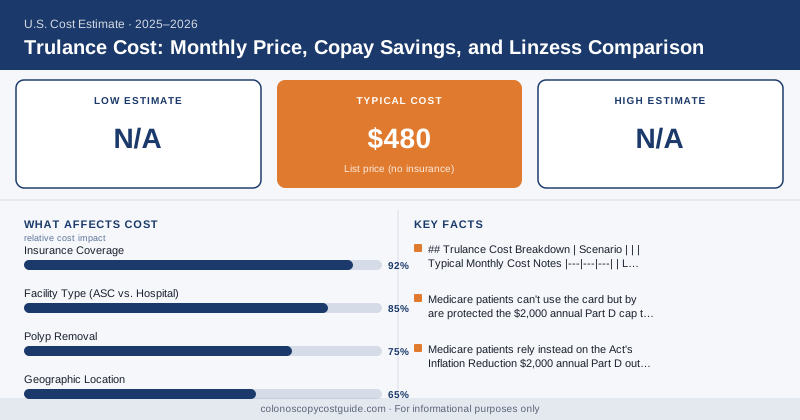
{ if eq .Lang "zh" }{ else }{ end }Two prescription pills for the same problem, similar list prices, and yet your copay for one could be triple the other. That’s the quiet reality of Trulance versus Linzess — and it’s exactly why you should price both before filling either. Trulance lists around $480 to $520 a month, but the right copay card can land you at $0 to $30.
Trulance is the brand name for plecanatide, an FDA-approved drug from 2017 for irritable bowel syndrome with constipation (IBS-C) and chronic idiopathic constipation. It works in the same broad family as Linzess but is a distinct molecule, which is why insurers sometimes prefer one over the other on formulary.
Trulance Cost Breakdown
| Scenario | Typical Monthly Cost | Notes |
|---|---|---|
| List price (no insurance) | $480-$520 | Brand-only, no generic |
| Commercial insurance + savings card | $0-$30 | Manufacturer copay program |
| Insurance copay (no card) | $50-$150 | Depends on formulary tier |
| Medicare Part D | Varies; subject to $2,000 cap | No savings card allowed |
| OTC alternatives first | $10-$25 | Fiber, PEG 3350, stool softeners |
The list price is the wholesale sticker before insurer negotiation. With no generic competition, that number stays high — which is why manufacturer assistance and formulary positioning matter so much for your real cost.
Trulance vs. Linzess: Why Your Copay Differs
Here’s the thing patients miss: your insurer’s formulary decides which drug is “preferred.” If Trulance is on a lower tier than Linzess on your plan, your copay could be far cheaper — or the reverse. The drugs are clinically comparable for many patients, so the cost difference often comes down to formulary politics, not medicine.
Key Takeaway
The Savings Card and Step Therapy
The Trulance copay program can bring commercially insured patients to $0-$30 per month. As with all manufacturer cards, Medicare and Medicaid patients are excluded by federal law. Medicare patients rely instead on the Inflation Reduction Act’s $2,000 annual Part D out-of-pocket cap, effective January 2025.
Expect step therapy. Most insurers require documentation that OTC options — fiber, polyethylene glycol, stool softeners — didn’t work before approving a brand-name prescription. Those cost $10 to $25 a month, and many patients get enough relief that they never need Trulance at all.
If you’re denied, don’t give up at the first “no.” Most prior authorization denials for IBS-C drugs get overturned on appeal once your doctor documents the cheaper therapies you’ve already tried and why they failed. Ask the office to submit your treatment history with the appeal — it’s usually a paperwork problem, not a medical one, and the manufacturer’s hub can help push it through.
Trulance in the IBS-C Treatment Picture
Trulance is one of several prescription IBS-C options. For the full lineup and how costs compare, see our IBS treatment cost guide. Its closest competitor is detailed in our Linzess cost breakdown — read both before deciding.
IBS-C symptoms sometimes overlap with reflux. If acid is also a factor, our GERD treatment cost guide and PPI medication cost breakdown cover the cheaper drug categories on that side.
When Diagnostics Come First
A change in bowel habits usually triggers a diagnostic workup before an IBS-C diagnosis is confirmed, sometimes including a colonoscopy to rule out other causes. That procedure can cost more than a year of Trulance — our colonoscopy cost guide explains why.
The Bottom Line
Trulance lists around $480 to $520 a month, but commercially insured patients with the copay card usually pay $0 to $30. The smartest move is comparing it head-to-head with Linzess under your plan, since formulary tier often decides which is cheaper for you. Clear step therapy by documenting the OTC options you’ve tried, and let your doctor’s office handle prior authorization. Medicare patients can’t use the card but benefit from the $2,000 annual cap.
{ if eq .Lang "zh" }