Small Intestine Biopsy Cost: What You'll Pay in 2025–2026
You just got a bill for $2,400 — and you’re not even sure what a small intestine biopsy actually involved. Welcome to American GI care. Let’s break down exactly what you’ll pay, why it varies so wildly, and what you can do about it.
What a Small Intestine Biopsy Actually Is
A small intestine biopsy is almost always performed during an upper endoscopy (EGD). Your gastroenterologist passes a thin scope down your throat, into the stomach, and then into the first part of the small bowel — the duodenum. Tiny forceps snip off tissue samples. The whole procedure takes 15–30 minutes.
The most common reason? Suspected celiac disease. The American College of Gastroenterology (ACG) recommends small bowel biopsy as the gold standard for confirming celiac disease — even when blood antibody tests are positive. Other reasons include evaluating chronic diarrhea, suspected Crohn’s disease affecting the small bowel, or unexplained nutrient malabsorption.
The 2025–2026 Cost Range
| Situation | Typical Cost Range |
|---|---|
| Insured (after deductible met) | $150–$600 |
| Insured (deductible not yet met) | $800–$3,500 |
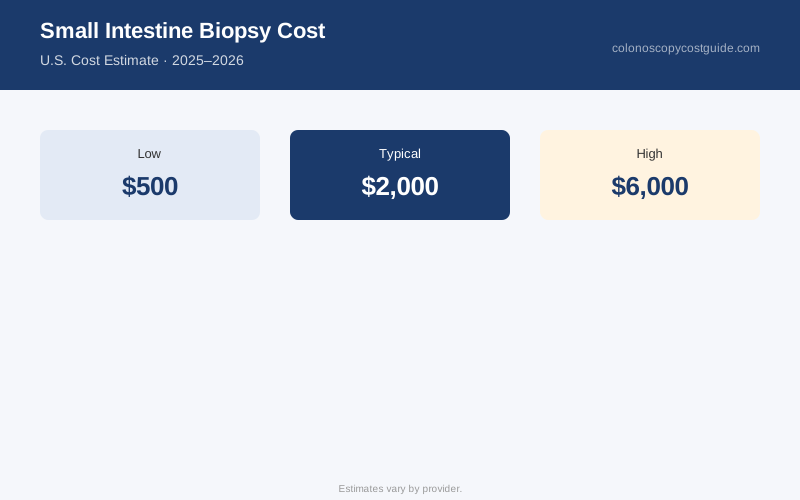
| Uninsured / self-pay | $500–$6,000 |
| Medicare (Part B, after 20% coinsurance) | $120–$450 |
| Ambulatory surgery center (self-pay) | $500–$2,000 |
| Hospital outpatient (self-pay) | $1,500–$6,000 |
The spread is enormous because the biopsy itself is just part of the bill. You’re paying for at least three things: the endoscopy procedure, the anesthesia or sedation, and the pathology lab that analyzes your tissue samples. Each arrives as a separate invoice.
Breaking Down the Charges
Procedure fee (the GI doctor): $300–$800 at a surgery center, $600–$1,500 at a hospital outpatient department. This covers the physician’s time and the scope work.
Facility fee: This is the big one. Hospitals charge $1,000–$3,500 more than ambulatory surgery centers for the same procedure. According to the American Society for Gastrointestinal Endoscopy (ASGE), facility setting is one of the largest single drivers of endoscopy cost variation in the U.S.
Anesthesia/sedation: Moderate sedation (a nurse-administered sedative) adds $150–$400. If a separate anesthesiologist pushes propofol, that’s another $400–$900 — and they’re frequently out of network.
Pathology fee: The lab that reads your biopsy samples charges $100–$500. This is billed separately and often at your deductible rate even when the procedure itself was fully covered as preventive care.
Is a Small Intestine Biopsy Covered by Insurance?
Usually yes — but the coverage type matters enormously.
If your doctor orders it as a diagnostic test (to evaluate symptoms), it’s treated as a diagnostic procedure. You’ll owe your deductible, coinsurance, and copays. That typically means $800–$3,500 out-of-pocket if you haven’t hit your deductible.
If your insurer considers part of the upper endoscopy preventive — for instance, for established celiac screening in a high-risk patient — some costs may be reduced. But biopsy pathology is almost always billed separately as diagnostic, regardless.
Pre-authorization tip: Always call your insurer before scheduling. Many plans require prior authorization for upper endoscopy with biopsy. Skipping this step is one of the most common reasons for claim denials.
Celiac Disease Biopsy: What the Research Shows
Why the Lab Bill Often Surprises People
Here’s a scenario that plays out thousands of times a week: a patient’s upper endoscopy is in-network. Their GI doctor is in-network. But the pathology lab the hospital automatically sends samples to? Out-of-network. Surprise bill incoming.
The No Surprises Act (effective 2022) is supposed to protect against this in many cases, but enforcement has been uneven. Before your procedure, ask your GI office: “Which pathology lab do you use, and is it in-network with my plan?” If it’s not, request that samples be sent to an in-network lab.
How to Pay Less
Choose an ambulatory surgery center. Self-pay patients at surgery centers typically pay 40–60% less than at hospital outpatient departments for the same GI scope. Even insured patients save on facility fees.
Ask about a bundled cash price. Some GI practices and surgery centers offer a flat-rate package — procedure, facility, and anesthesia — for uninsured or high-deductible patients. Prices of $800–$1,500 all-in are achievable.
Use your HSA or FSA. Small intestine biopsy is absolutely an eligible medical expense. If you have a health savings account, plan to use it.
Get the CPT codes in advance. The main code for upper endoscopy with biopsy is CPT 43239. Knowing this lets you call multiple facilities for price quotes before scheduling.
Medicare and Small Intestine Biopsy
Medicare Part B covers upper endoscopy with small intestine biopsy when medically necessary. After the Part B deductible ($257 in 2025), Medicare pays 80% of the approved amount. Your 20% coinsurance typically runs $120–$450 depending on the facility.
If you have a Medigap (supplemental) policy, that coinsurance may be fully covered. Medicare Advantage plans follow different cost-sharing rules — check your plan’s Summary of Benefits.
The Bottom Line
A small intestine biopsy costs $500–$6,000 out-of-pocket, with most insured patients paying $500–$1,500 once their deductible applies. The biggest levers are where you have the procedure done and whether your pathology lab is in-network. Ask both questions before your appointment date — not after.