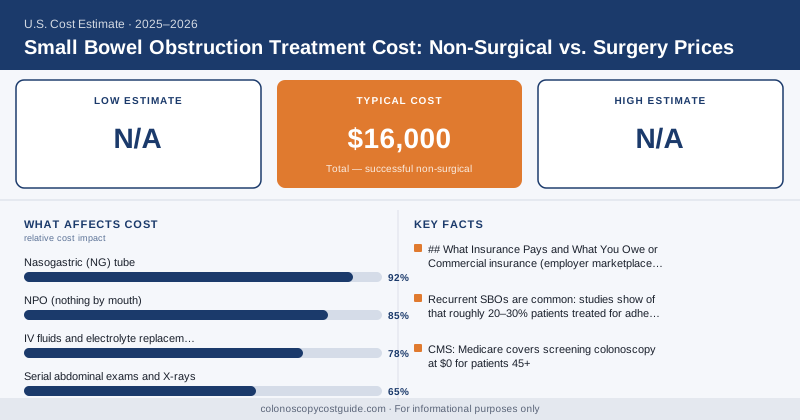
Small Bowel Obstruction Treatment Cost: Non-Surgical vs. Surgery Prices
{ if eq .Lang "zh" }{ else }{ end }The CT scan came back, and the radiologist’s three-word note changed everything: complete bowel obstruction.
If you or someone you love is facing that diagnosis, the medical questions are pressing — and the financial ones aren’t far behind. A small bowel obstruction (SBO) hospitalization is never cheap, and the range is wide: a successful non-surgical course might run $15,000–$30,000. A case that ends in surgery can reach $80,000 or more.
What drives you toward one end or the other? Mostly whether the obstruction resolves on its own — and whether your bowel stays healthy while you wait.
What Is a Small Bowel Obstruction?
The small intestine is roughly 20 feet long. When something blocks the passage of intestinal contents through it — gas, fluid, and digested food all back up — pressure builds, the bowel distends, and blood flow can be compromised. Left untreated, the bowel wall can die (necrosis), leading to perforation and life-threatening infection.
According to the American College of Surgeons, SBOs account for approximately 350,000 hospitalizations per year in the United States, making them one of the most common abdominal emergencies. About 60–70% are caused by adhesions — scar tissue from prior surgery — while hernias, Crohn’s disease strictures, and tumors make up most of the rest.
The fundamental treatment decision: wait and decompress (non-surgical), or go to the OR. That choice determines your bill more than any other factor.
Non-Surgical Management: Hospital Costs
A partial or early complete obstruction in a stable patient is almost always trialed with conservative management first. This means:
- Nasogastric (NG) tube inserted through the nose and into the stomach to continuously suction fluid and gas
- NPO (nothing by mouth) — no food or fluids by mouth while the bowel rests
- IV fluids and electrolyte replacement — dehydration and electrolyte imbalances are universal
- Serial abdominal exams and X-rays — monitoring for improvement or deterioration
- CT scan with contrast — to assess severity, identify the transition point, and rule out ischemia
| Non-Surgical SBO Component | Typical Billed Cost |
|---|---|
| Emergency department evaluation (level 4–5) | $1,500 – $4,000 |
| CT abdomen/pelvis with contrast | $1,800 – $4,500 |
| Nasogastric tube placement and suction | $500 – $1,500 |
| IV fluids and electrolyte replacement | $800 – $2,500 |
| Hospital room (3–5 days medical floor) | $8,000 – $18,000 |
| Daily physician and specialist fees | $2,000 – $5,000 |
| Lab work (daily metabolic panels, CBC) | $800 – $2,000 |
| Abdominal X-rays (daily monitoring) | $600 – $1,800 |
| Total — successful non-surgical | $16,000 – $39,300 |
If the obstruction resolves — bowel sounds return, gas passes, the NG tube output drops — you go home without surgery. About 65–75% of partial SBOs resolve with this approach, per ASGE and surgical literature. Complete obstructions have a lower spontaneous resolution rate, often 40–50%.
The 24–48 Hour Decision Window
Surgical Treatment: What the OR Costs
Roughly 25–30% of SBO hospitalizations end in surgery. The specific procedure depends on the cause:
- Lysis of adhesions: Cutting through scar tissue bands that are strangling the bowel. No bowel is removed.
- Small bowel resection: Removing a necrotic or irreversibly damaged segment of bowel, then reconnecting the two ends (anastomosis). More complex, higher risk.
- Hernia repair with bowel reduction: For hernia-related obstruction, the hernia is repaired and any incarcerated bowel is released.
| Surgical SBO Treatment | Typical Billed Cost |
|---|---|
| Operating room facility fee | $15,000 – $35,000 |
| Surgeon fee (lysis of adhesions) | $3,000 – $7,000 |
| Surgeon fee (bowel resection + anastomosis) | $5,000 – $12,000 |
| Anesthesiologist fee | $2,000 – $5,000 |
| Post-op ICU (if needed, 1–3 days) | $8,000 – $25,000 |
| Extended hospital stay (5–10 days total) | $15,000 – $35,000 |
| Pathology (resected bowel specimen) | $300 – $800 |
| Total — surgical SBO (lysis of adhesions) | $35,000 – $75,000 |
| Total — surgical SBO (bowel resection) | $45,000 – $100,000+ |
ICU admission after bowel resection is common, especially when there’s been ischemia, peritoneal contamination, or the patient arrived septic. Each ICU day adds $3,000–$8,000 in facility charges alone.
When Crohn’s Disease Is the Cause
Crohn’s disease strictures are responsible for a significant minority of SBOs, and they come with a different cost profile. Patients typically have a known Crohn’s diagnosis, and the management conversation includes not just the acute obstruction but long-term disease control.
A Crohn’s-related SBO may be managed with IV steroids and biologic therapy before committing to surgery. Strictureplasty (widening the narrowed segment without removing bowel) can be offered at surgery as an alternative to resection — important for Crohn’s patients who may face multiple future operations and can’t afford to lose too much small bowel length.
The cost of biologics like infliximab or adalimumab for underlying Crohn’s — $15,000–$40,000/year — is entirely separate from the acute SBO hospitalization but factors into total cost of care. See related guides on IBD treatment costs if this applies to your situation.
What Insurance Pays and What You Owe
Commercial insurance (employer or marketplace plan):
- Hospital admission triggers your inpatient deductible: typically $1,000–$4,000
- Coinsurance of 20–30% applies until you hit your annual out-of-pocket maximum
- OOP max for 2026: $9,200 individual, $18,400 family (ACA limits)
- A surgical SBO hospitalization will almost certainly push you to your OOP max
Medicare:
- Part A inpatient deductible: $1,676 per benefit period (2025 figure)
- Covers days 1–60 fully after the deductible; days 61–90 have coinsurance
- Part B covers surgeon and anesthesiologist fees at 80% after the Part B deductible
- Without Medigap supplemental coverage, Medicare beneficiaries face uncapped coinsurance beyond 60 days
Medicaid:
- Covers all emergency SBO treatment with minimal cost-sharing ($0–$8 typical)
Uninsured:
- Full chargemaster billing — $40,000–$80,000 for a surgical admission
- Hospital charity care programs (available at nonprofit hospitals) can dramatically reduce or eliminate the bill for eligible patients
- Apply before discharge or within 30 days after
Reducing Your Out-of-Pocket Costs
There’s limited room to shop when you’re admitted emergently, but a few strategies help:
- Request itemized billing after discharge — SBO hospitalizations involve dozens of line items, and billing errors are common
- Ask for charity care or financial assistance immediately if you’re uninsured or underinsured — most hospitals have programs, and you qualify based on income, not assets
- Confirm your surgeon is in-network before elective follow-up procedures — the No Surprises Act protects you for the emergency admission, but post-discharge follow-up care doesn’t carry the same automatic protection
- Use an in-network imaging center for any follow-up CT scans — hospital outpatient radiology charges 2–4x more than freestanding centers for the same image
An SBO hospitalization is always expensive. But understanding the cost structure helps you navigate what comes next — the bills, the appeals, and the decisions about long-term management.
{ if eq .Lang "zh" }