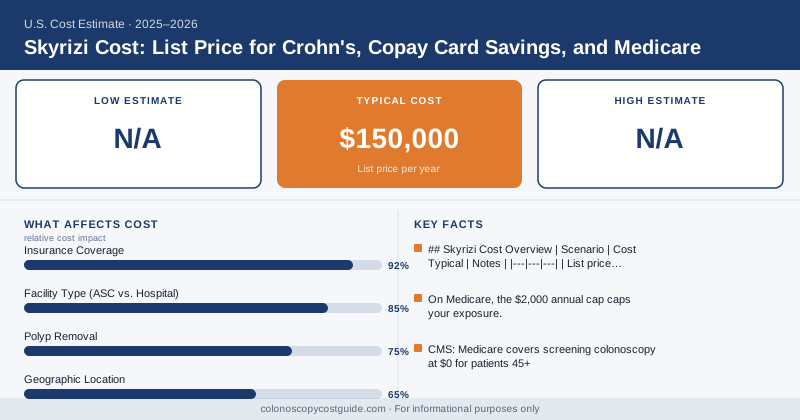
Skyrizi Cost: List Price for Crohn's, Copay Card Savings, and Medicare
{ if eq .Lang "zh" }{ else }{ end }42% of moderate-to-severe Crohn’s patients eventually cycle through more than one biologic, and for a growing share, Skyrizi is the answer. Then they see the price: roughly $150,000 to $190,000 a year at list. It’s one of the most expensive drugs in gastroenterology — and one where the gap between sticker and out-of-pocket is staggering.
Skyrizi is the brand name for risankizumab, an IL-23 inhibitor the FDA approved for Crohn’s disease in 2022 and ulcerative colitis in 2024. It’s newer than the anti-TNF agents, has no biosimilar competition, and that lack of competition keeps the list price stubbornly high.
Skyrizi Cost Overview
| Scenario | Typical Cost | Notes |
|---|---|---|
| List price per year | $150,000-$190,000 | IV loading + subcutaneous maintenance |
| Commercial insurance + copay card | $0-$5 | Skyrizi Complete program |
| High-deductible plan (early year) | Up to full deductible | Often thousands before coverage |
| Medicare Part D | Capped at $2,000/yr | No copay cards allowed |
| Biosimilar | None available | Still brand-only in 2025-2026 |
These are Wholesale Acquisition Cost figures — the manufacturer’s sticker before rebates and insurer negotiation. Treatment starts with IV loading doses, then transitions to a subcutaneous pen you inject at home every 8 weeks. The IV portion may be billed under your medical benefit while the pen runs through pharmacy.
No Biosimilar Means No Price Floor
Unlike Humira or Remicade, Skyrizi faces no biosimilar competition in 2025-2026. AbbVie holds patent protection, so there’s no cheaper clinically equivalent version to switch to. That matters most for the uninsured and for net costs your plan absorbs.
Key Takeaway
How Insured Patients Pay Almost Nothing
AbbVie’s Skyrizi Complete program is built to neutralize your copay if you have commercial insurance. You pay the specialty-tier copay and the card covers it, often landing you at $0 to $5 per dose. The program also helps coordinate the IV-to-pen transition and prior authorization paperwork.
Medicare is the exception. Federal law bars copay cards for Medicare beneficiaries, so without help you’d face coinsurance. The saving grace is the Inflation Reduction Act’s $2,000 annual Part D out-of-pocket cap, effective January 2025 — a major relief for a drug this expensive.
Skyrizi vs. the Other IL-23 and Anti-TNF Options
Skyrizi competes with Stelara and the anti-TNF biologics. Your GI doctor’s choice depends on your disease behavior and what you’ve already tried. For the full comparison, see our Crohn’s disease biologic medication cost guide. UC patients can find Skyrizi’s role in the ulcerative colitis medication cost breakdown.
Insurers almost never approve Skyrizi first. Expect step therapy starting with cheaper drugs — our mesalamine medication cost guide covers that entry-level requirement.
Prior Authorization and Step Therapy
Skyrizi needs prior authorization, and given the price, insurers scrutinize it hard. You’ll typically need a confirmed diagnosis with colonoscopy or biopsy documentation plus proof that a cheaper biologic, often an anti-TNF, failed or wasn’t tolerated. Build in one to three weeks for approval, and lean on your GI office’s specialty-pharmacy coordinator to manage the paperwork.
If the sticker shock here feels familiar, it’s the same opaque pricing logic that makes procedures cost what they do — explored in our colonoscopy cost without insurance guide.
Approval can also hinge on documentation you might not have on hand. Insurers frequently want recent labs, imaging, or endoscopy findings showing active disease, not just a past diagnosis. If your last colonoscopy was years ago, your GI office may need updated records before the prior authorization clears, so flag that early to avoid a delay in starting therapy.
The Bottom Line
Skyrizi’s $150,000-to-$190,000 annual list price is real, but with commercial insurance and the Skyrizi Complete card, most patients pay $0 to $5 per dose. On Medicare, the $2,000 annual cap caps your exposure. The wrinkle is the absence of any biosimilar, which keeps the list price high and makes manufacturer assistance essential. Before starting, get your specialty pharmacy to confirm your exact out-of-pocket and check whether a copay accumulator applies to your plan.
{ if eq .Lang "zh" }