Sitz Marker Colonic Transit Study Cost: Constipation Test Pricing in 2026
{ if eq .Lang "zh" }{ else }{ end }What if a constipation test cost less than a tank of gas and a half-day of your time? That’s basically the Sitz marker study — you swallow a single capsule of tiny markers, get an X-ray a few days later, and the radiologist counts how many are left. The whole thing runs $300 to $1,200 without insurance.
A Sitz marker colonic transit study measures how fast (or slow) stool moves through your large intestine. The capsule contains 24 small radiopaque rings that show up on X-ray. By counting how many remain at day five — and where they’ve clustered — your doctor can tell whether you have slow-transit constipation or an outlet problem. Here’s the cost breakdown.
What the Sitz Marker Study Costs
Most of the bill is just abdominal X-rays. The marker capsule is cheap; the imaging is the variable.
| Cost Component | Typical Range (Uninsured) |
|---|---|
| Sitz marker capsule | $30 – $120 |
| Abdominal X-ray (each) | $100 – $400 |
| Radiologist interpretation | $50 – $200 |
| Total (single X-ray protocol) | $300 – $700 |
| Total (multiple X-ray protocol) | $500 – $1,200 |
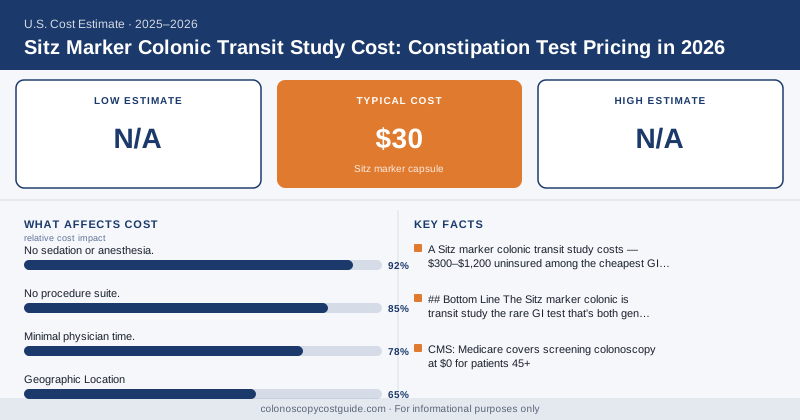
This is one of the most affordable GI diagnostics around — there’s no scope, no sedation, and no special facility. Compare that to a colonoscopy, which runs several times higher because of the procedure suite and anesthesia.
Why It’s So Cheap (Relatively)
The Sitz marker test sidesteps every expensive ingredient in GI care:
- No sedation or anesthesia. You stay awake; you just swallow a pill and walk in for X-rays.
- No procedure suite. A standard X-ray room handles it — far cheaper than an endoscopy facility.
- Minimal physician time. A radiologist spends a few minutes interpreting each film.
If you’ve wondered why other GI tests cost so much more, why is colonoscopy so expensive explains the facility and sedation overhead this test avoids.
What It Diagnoses
The Sitz marker study sorts chronic constipation into useful categories. The National Institute of Diabetes and Digestive and Kidney Diseases (NIDDK) estimates roughly 16% of U.S. adults live with chronic constipation, and figuring out the mechanism matters because treatment differs:
- Slow-transit constipation: markers spread evenly throughout the colon at day five — the whole colon is sluggish.
- Outlet dysfunction: markers pile up in the rectum/sigmoid — the problem is evacuation, not transit.
- Normal transit: most markers cleared — points toward a functional or dietary cause.
That distinction guides whether you need pelvic floor therapy, different medications, or further testing like defecography.
Key Takeaway
Insurance Coverage
Because it’s a low-cost diagnostic ordered for a real symptom, the Sitz marker study faces little resistance from insurers. It bills under your imaging benefit, so cost-sharing is typically light — your X-ray copay plus coinsurance once the deductible is met.
The American College of Gastroenterology recommends transit testing in patients with constipation that hasn’t responded to fiber, fluids, and laxatives, which gives clear documentation for medical necessity. Get that history in your chart and coverage is rarely an issue.
How It Fits Into the Constipation Workup
The Sitz marker study is usually an early, low-cost step once basic treatments fail and a colonoscopy has ruled out an obstruction or growth. If it points to an outlet problem, your doctor will likely follow with anorectal manometry or defecography to examine the pelvic floor mechanics. If broader abdominal pathology is suspected, an abdominal CT scan for GI issues explores different territory. The beauty of the Sitz test is that it’s cheap enough to do first.
Bottom Line
The Sitz marker colonic transit study is the rare GI test that’s both genuinely useful and genuinely affordable — $300 to $1,200 uninsured, and usually far less with insurance. It pinpoints whether your colon is slow or your evacuation is off, steering treatment in the right direction. Follow the laxative-hold instructions to keep the result valid, ask about a single-X-ray protocol, and you’ll get real answers without the price tag that comes with scopes and sedation.
{ if eq .Lang "zh" }