Sedation vs. No-Sedation Colonoscopy Cost: Can You Skip the Anesthesia Bill?
{ if eq .Lang "zh" }{ else }{ end }Most patients assume sedation is mandatory for a colonoscopy. It isn’t — and going without can wipe a four-figure anesthesia bill off your total. Whether that’s a smart trade is a different question.
Sedation is standard practice in the U.S., but it’s not medically required for everyone. A growing number of patients opt for an unsedated, or “no-sedation,” colonoscopy specifically to dodge the separate anesthesia charge. Here’s what you’d actually save and what you’d give up.
Where the Savings Come From
Your colonoscopy generates several separate bills. The anesthesia charge is one of the largest and most variable. When a colonoscopy uses propofol, an anesthesiologist or CRNA bills separately — typically $400 to $1,200. Skip sedation entirely, and that line item vanishes.
| Cost Component | With Sedation | No Sedation |
|---|---|---|
| Facility fee | $500 – $2,800 | $500 – $2,800 |
| Gastroenterologist fee | $250 – $600 | $250 – $600 |
| Anesthesia fee | $400 – $1,200 | $0 |
| Pathology (if biopsy) | $150 – $600 | $150 – $600 |
| Driver / lost workday | Required | Not required |
There’s a second, hidden savings: with no sedation, you don’t need a driver or a full day off. You can walk out and drive yourself home. For hourly workers, that recovered workday has real dollar value. Our colonoscopy sedation cost guide breaks down exactly how anesthesia gets billed.
Key Takeaway
The Insurance Catch
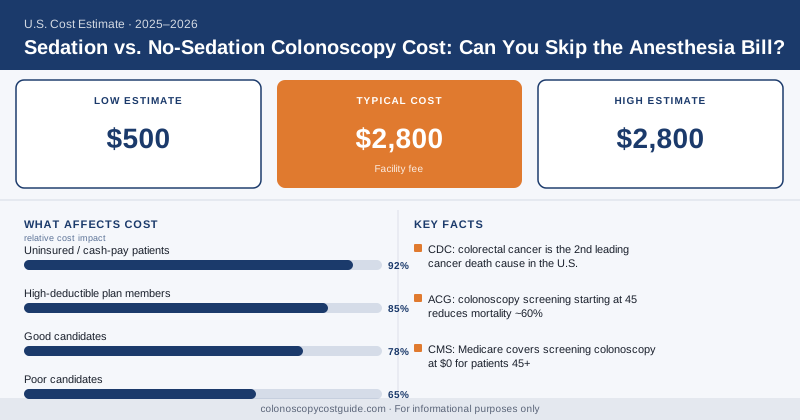
Here’s the twist for insured patients. If your screening colonoscopy is covered at $0 under ACA preventive rules, the anesthesia is often bundled into that $0 too. In that case, skipping sedation saves you nothing on the bill — you’d just be uncomfortable for free. The savings are real mainly for:
- Uninsured / cash-pay patients, where every line item is out of pocket
- High-deductible plan members who haven’t met their deductible
- Patients whose plan doesn’t fully cover anesthesia
So before you grit your teeth through an unsedated scope to save money, confirm what you’d actually owe with sedation. Our colonoscopy cost without insurance guide shows where cash payers benefit most.
Is It Tolerable?
Research on unsedated colonoscopy is reassuring. Studies, including data referenced by the ACS, show most no-sedation patients report only mild to moderate discomfort, and a majority say they’d do it again. Water-immersion technique — where the scope advances through infused water rather than air — has made unsedated exams notably more comfortable. Still, tolerance varies with anatomy, anxiety, and prior abdominal surgery.
Who Should Consider No Sedation
- Good candidates: Calm, motivated patients with no prior pelvic surgery, paying cash or facing a high deductible, who want to drive home and work the same day.
- Poor candidates: Anxious patients, those with complex anatomy or adhesions, or anyone insured at $0 who’d save nothing anyway.
The Bottom Line
No-sedation colonoscopy can shave $400 to $1,200 off a cash bill and save you a driver and a workday — but for insured screening patients covered at $0, it may save nothing while costing comfort. Run your specific numbers first. If you’re trying to trim the total, our guide on how to lower your colonoscopy bill covers strategies that work for everyone, sedated or not. And to understand the full price picture, start with our colonoscopy cost breakdown.
{ if eq .Lang "zh" }