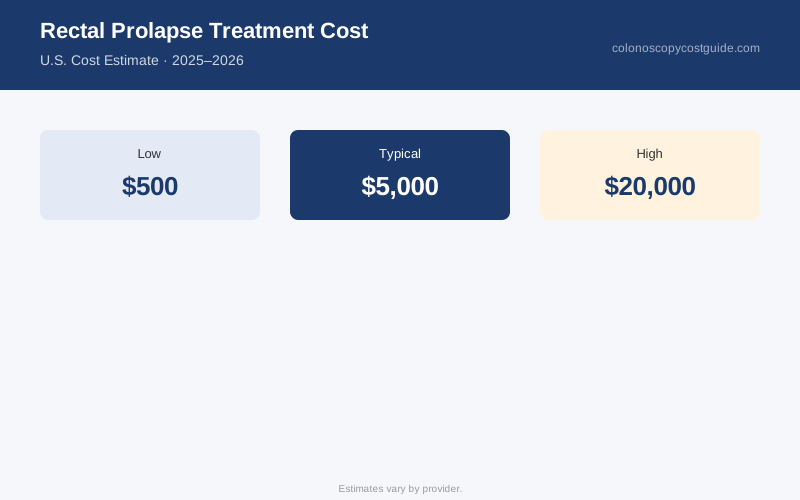
Rectal Prolapse Treatment Cost 2026: $8,000–$35,000 (Surgery Types Compared)
Sarah, 63, had been managing symptoms for two years before her colorectal surgeon told her the prolapse was complete and surgery was the only real fix. Her quote: $24,000 at the hospital where her surgeon had privileges. The same surgeon at an ambulatory surgery center: $11,500. Same procedure, different venue — $12,500 gap.
That price spread is real, and it’s one of the biggest levers you have when navigating rectal prolapse surgery costs.
Surgery Cost Overview
| Procedure | Self-Pay Total | Insured Out-of-Pocket |
|---|---|---|
| Perineal proctosigmoidectomy (Altemeier) — ASC | $8,000–$14,000 | $2,000–$5,000 |
| Perineal proctosigmoidectomy (Altemeier) — Hospital | $12,000–$22,000 | $3,000–$8,000 |
| Laparoscopic rectopexy | $12,000–$28,000 | $3,000–$9,000 |
| Open abdominal rectopexy | $10,000–$24,000 | $2,500–$8,000 |
| Robotic rectopexy | $18,000–$35,000 | $4,500–$12,000 |
| Delorme procedure (perineal mucosal resection) | $7,000–$16,000 | $2,000–$6,000 |
These totals include surgeon fee, anesthesia, facility, and a typical 1–3 night hospital stay where applicable. Non-surgical management (pelvic floor PT, stool softeners) costs $50–$300/month but doesn’t correct complete prolapse.
What Rectal Prolapse Is — and When Surgery Is Required
Rectal prolapse occurs when the rectum telescopes out through the anus. The American Society of Colon and Rectal Surgeons (ASCRS) estimates it affects approximately 2.5 per 100,000 people per year in the US, with women over 50 representing the majority of surgical cases. It’s not rare — it’s just rarely discussed.
Three grades exist:
- Mucosal prolapse: Only the mucosal lining protrudes, not the full rectal wall. Often managed non-surgically.
- Internal intussusception: The rectum telescopes internally but doesn’t prolapse externally. Symptoms include tenesmus and incomplete evacuation. Management varies.
- Complete (full-thickness) prolapse: The full rectal wall protrudes. This is the surgical indication.
Conservative management — dietary fiber, stool softeners to reduce straining, pelvic floor physical therapy — can help mucosal prolapse or serve as a bridge. But complete prolapse doesn’t resolve on its own. Surgery is the standard of care.
Perineal Approaches: Lower Risk, Shorter Stay
Perineal proctosigmoidectomy (Altemeier procedure) removes the prolapsed segment of rectum and sigmoid colon through the perineum — no abdominal incision. It’s done under spinal or general anesthesia, typically takes 1–2 hours, and involves a 1–2 day hospital stay. This is the preferred approach for older, frailer patients who are poor candidates for abdominal surgery.
Self-pay total at an ASC: $8,000–$14,000. At a hospital: $12,000–$22,000. The facility gap alone is $4,000–$8,000 for the same procedure. For patients who can safely receive perineal repair as an outpatient, an ASC is almost always the cost-effective choice.
Recurrence rates for Altemeier: 10–30% at 5 years — higher than abdominal approaches. For elderly patients with limited life expectancy or high surgical risk, this tradeoff is appropriate. For younger, healthier patients, abdominal rectopexy’s lower recurrence rate is usually worth the higher surgical complexity.
Delorme procedure (mucosal resection with plication of the rectal muscle) is a less extensive perineal option. It’s used for shorter segment prolapse. Costs run $7,000–$16,000 total; recurrence rates are similar to Altemeier.
Abdominal Approaches: Lower Recurrence, Higher Complexity
Laparoscopic rectopexy is the workhorse procedure for complete rectal prolapse in otherwise healthy patients. The surgeon secures the rectum to the sacrum (the pelvic bone at the bottom of the spine), correcting the descent. Done laparoscopically, it means 3–5 small incisions, 2–3 nights in the hospital, and a 2–3 week recovery.
Cost breakdown for laparoscopic rectopexy at a hospital:
- Surgeon fee: $2,500–$5,000
- Facility fee (hospital inpatient): $6,000–$18,000
- Anesthesia: $800–$1,500
- Pathology (if tissue sent): $200–$500
Mesh vs. Suture Rectopexy
Open abdominal rectopexy is less common today but still appropriate in complex cases — prior abdominal surgery with adhesions, combined procedures, or when laparoscopic equipment isn’t available. It costs $10,000–$24,000 total and involves a longer recovery (4–6 weeks) vs. laparoscopic (2–3 weeks).
Robotic rectopexy adds precision in the narrow pelvic space and may reduce conversion to open surgery. The $18,000–$35,000 price tag reflects the robot’s use costs and facility fees at tertiary centers. Evidence that robotic approaches improve outcomes over laparoscopic isn’t conclusive for most patients — it’s a preference and experience-driven choice.
Anesthesia and Hospital Stay: The Big Variables
Anesthesia adds $800–$1,500 for most perineal procedures; more for longer abdominal cases. If you’re a Medicare patient, make sure your anesthesiologist accepts Medicare assignment — otherwise you face balance billing.
Hospital inpatient stay is where cost variance is widest. A single night at a hospital can run $3,000–$8,000 in facility charges alone before surgeon and anesthesia fees. Rectopexy typically means 2–3 nights. A complex case with complications can extend to 5+ days, adding $10,000–$20,000 to the bill.
| Hospital Stay Length | Facility Charge Estimate |
|---|---|
| Same-day (outpatient ASC) | $3,000–$6,000 |
| 1-night inpatient | $4,000–$10,000 |
| 2–3 nights inpatient | $8,000–$22,000 |
| 4+ nights (complications) | $15,000–$40,000+ |
What Insurance Covers
Rectal prolapse surgery is medically necessary — coverage is standard across Medicare and commercial plans. Key items to confirm:
- Prior authorization: Required by almost every insurer. Your surgeon’s office handles this; verify it’s approved before your surgery date.
- In-network anesthesiologist: This is the most common surprise billing trap. Your surgeon may be in-network but their anesthesiologist group may not be. Under the No Surprises Act, you’re protected from balance billing for emergency situations — but elective surgery anesthesia isn’t always covered by the same protection. Confirm in advance.
- Surgeon’s hospital privileges: If your colorectal surgeon has privileges at multiple hospitals, ask which facility is most cost-effective for your insurance.
Medicare covers rectal prolapse surgery under Part A (inpatient) and Part B (surgeon, anesthesiologist). After the Part A deductible ($1,676 in 2026) and Part B coinsurance, most patients on Original Medicare owe $2,000–$5,000 out-of-pocket. Medicare Advantage plans vary — some have $0 surgical copays after prior auth.
Hidden Costs to Budget For
Beyond the surgery itself:
- Pre-op colonoscopy: $800–$2,500 if you haven’t had one recently — most colorectal surgeons require it to rule out other pathology before operating.
- Post-op office visits: 2–4 visits at $150–$300 each.
- Pelvic floor physical therapy: Strong evidence supports post-surgical PT for improving fecal continence outcomes. 6–12 sessions at $100–$300 each — often covered with a physician referral.
- Recovery time: Perineal repair means 1–2 weeks off work; laparoscopic rectopexy 2–4 weeks. Factor income loss into your financial planning, especially if you’re self-employed.
How to Reduce Your Out-of-Pocket Cost
Get at least two surgical opinions — ideally from different hospital systems. The same surgeon’s fee at different facilities can vary by $3,000–$8,000 depending on facility contracts and whether a more cost-effective ASC is an option. One phone call asking your colorectal surgeon “can this be done at an ASC?” could save thousands.
If you’ve had significant medical expenses this year and are approaching your annual out-of-pocket maximum, scheduling surgery before December 31 could mean the facility costs are covered at 100%. The opposite is also true: don’t schedule in January if you haven’t met your deductible yet.