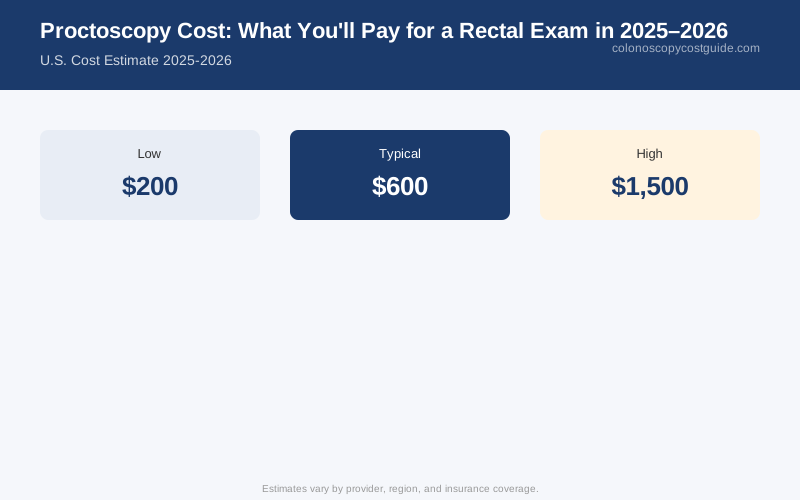
Proctoscopy Cost: What You'll Pay for a Rectal Exam in 2025–2026
What does a flexible sigmoidoscopy cost compared to a proctoscopy? More than you’d expect — because proctoscopy is a much shorter, simpler exam that gets underused and underbilled compared to its cousins.
A proctoscopy (also called rigid proctoscopy or proctoscopic examination) examines only the rectum — the last 6 to 8 inches of the colon. It uses a short, rigid or semi-rigid scope, usually takes 5 to 10 minutes, requires no sedation, and rarely requires the full preparation that a colonoscopy demands. It’s one of the most underappreciated tools in GI medicine for evaluating rectal symptoms quickly and inexpensively.
Proctoscopy Cost Overview
| Setting | Procedure Fee | With Biopsy (Add-On) | Total (Uninsured) |
|---|---|---|---|
| Primary care office | $150 – $350 | +$100 – $250 | $150 – $600 |
| GI specialist office | $200 – $500 | +$150 – $350 | $200 – $850 |
| Hospital outpatient | $400 – $900 | +$200 – $450 | $400 – $1,350 |
| Urgent care / colorectal clinic | $175 – $400 | +$100 – $300 | $175 – $700 |
The CPT code for proctoscopy is 46600 (anoscopy) or 46604 (anoscopy with dilation) for the rigid short-scope exam, and 45300 (flexible proctosigmoidoscopy, diagnostic) for the flexible version. The choice of CPT code determines what your insurer reimburses and what you owe.
What Proctoscopy Is Used For
Your doctor might recommend a proctoscopy — rather than a full colonoscopy — when the clinical question involves the rectum specifically:
- Rectal bleeding in a younger patient with low risk of proximal disease
- Hemorrhoid evaluation and treatment (rubber band ligation can be performed at the same time)
- Rectal prolapse assessment
- Anal fissure or fistula evaluation
- Surveillance of rectal cancer margins after prior resection
- Biopsy of visible rectal lesion before planning more extensive workup
- Rectal foreign body evaluation
For bleeding in patients over 45 or with a family history of colorectal cancer, your GI doctor will typically recommend a full colonoscopy rather than proctoscopy — because the clinical question shifts to ruling out proximal lesions that proctoscopy can’t reach.
Proctoscopy vs. Anoscopy vs. Sigmoidoscopy
These three procedures cover different depths of examination:
- Anoscopy: 3 to 4 cm, examines the anal canal only — typically $100 to $250
- Rigid proctoscopy: 6 to 8 cm, examines the rectum — typically $150 to $500
- Flexible sigmoidoscopy: 40 to 60 cm, examines the rectum and sigmoid colon — typically $400 to $1,200
- Colonoscopy: full colon examination — typically $800 to $3,000+
For hemorrhoid evaluation and treatment, anoscopy is often sufficient. For rectal lesion evaluation or bleeding workup, proctoscopy or sigmoidoscopy provides more reliable visualization.
Insurance Coverage for Proctoscopy
Commercial insurance covers proctoscopy as a medically necessary diagnostic procedure when there’s a documented clinical indication (rectal bleeding, rectal pain, evaluation of known hemorrhoids, follow-up of prior rectal surgery). You’ll owe your standard cost-sharing:
- Copay if billed as office visit: $30 to $80 specialist copay
- Coinsurance if billed as outpatient procedure: 10–20% after deductible
- Pre-deductible: Full allowed amount (typically $200 to $450 for the procedure component alone)
The billing distinction matters: if your GI doctor performs proctoscopy in the office and bills it as a procedure during an office visit, you may owe the office visit copay plus a procedure copay. Some practices bundle it into the visit E&M code; others bill separately. Ask before you arrive.
Preparation and What to Expect
Proctoscopy preparation is minimal compared to colonoscopy:
- Enema: One or two over-the-counter saline or Fleet enemas taken 1 to 2 hours before the procedure — typically no dietary restriction required
- No sedation: The exam is brief and while uncomfortable for some patients, doesn’t require IV medication
- Drive yourself home: No recovery period required
- No day-off work typically needed: Most patients return to normal activity immediately
The enemas themselves cost $5 to $15 at any pharmacy and are not typically billed through insurance.
When Biopsy Is Performed
If your doctor sees an abnormality and takes a tissue sample during proctoscopy, pathology charges are added:
| Pathology Scenario | Added Cost (Uninsured) |
|---|---|
| Single biopsy specimen | $100 – $300 |
| Multiple specimens (2–3) | $200 – $600 |
| Immunohistochemistry stains | Additional $150 – $400 |
The pathology lab is billed separately from the procedure, often by a separate pathology group. Confirm that the pathology lab is in-network if you have insurance — this is a common source of surprise bills.
Cash-Pay and Self-Pay Options
For patients without insurance or with high deductibles:
- Primary care or colorectal surgery office: Often the most affordable setting — ask explicitly for “self-pay pricing for a proctoscopy or anoscopy.” Many offices offer $150 to $250 all-in for a straightforward exam.
- FQHC (Federally Qualified Health Centers): Sliding-scale fee based on income — often $20 to $75 for the entire visit including the procedure.
- GoodRx Care and telehealth referrals: Some platforms facilitate cash-pay specialist visits with transparent pricing.
Proctoscopy is one of the few GI procedures where the out-of-pocket cost for an uninsured patient can genuinely be modest — under $300 in many settings — if you seek the right facility and ask about self-pay rates upfront. For more on the broader rectal evaluation workup, see rectal bleeding evaluation cost and anoscopy cost.