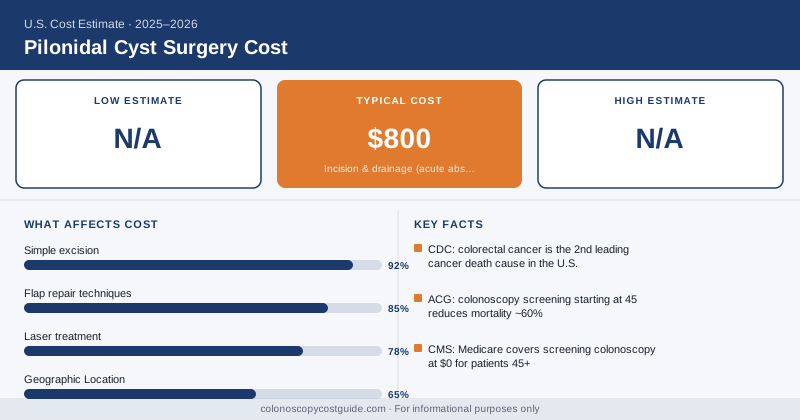
Pilonidal Cyst Surgery Cost
Most patients assume a pilonidal cyst is a minor procedure — a quick fix and they’re out the door. Wrong. Surgeons perform roughly 70,000 pilonidal surgeries every year in the United States, and recurrence rates for the simplest technique run as high as 15%. Pick the wrong procedure to save money upfront, and you could be back in the OR within two years.
Here’s a realistic look at what pilonidal cyst surgery costs, what drives the price, and how to choose the right approach the first time.
What Is a Pilonidal Cyst?
A pilonidal cyst is an abnormal pocket of skin and hair debris that forms at the top of the buttocks crease (the sacrococcygeal area). It’s not a GI condition in the digestive sense, but it’s commonly managed by colorectal surgeons. Males are 3–4 times more likely to develop one than females, and the condition peaks in adults in their 20s.
When infected, a pilonidal cyst becomes an abscess — painful, red, and swollen — and requires drainage or surgery to resolve. Simple incision and drainage provides temporary relief but doesn’t cure the underlying problem; the cyst nearly always returns without definitive excision.
Surgery Options and Their Costs
| Procedure | Typical Cash Cost | Recurrence Rate |
|---|---|---|
| Incision & drainage (acute abscess, not curative) | $800 – $2,000 | Very high without follow-up excision |
| Simple excision with primary closure | $2,500 – $6,000 | 5–15% |
| Excision left open to heal (secondary intention) | $2,500 – $5,500 | 5–10%; longer recovery |
| Complex excision with flap repair (Karydakis, Limberg) | $4,000 – $10,000 | 1–3% |
| Laser treatment (minimally invasive) | $1,500 – $3,500 | Limited long-term data |
Breaking Down the Costs
Simple excision is the most commonly performed procedure for a first-time, uncomplicated pilonidal cyst. The surgeon removes the cyst and either closes the wound primarily or leaves it open to heal from the inside out. Open healing takes 4–8 weeks of wound care but may reduce recurrence slightly. Cash price at an ambulatory surgery center (ASC) typically runs $2,500–$4,500 — lower than a hospital outpatient setting by 30–50%.
Flap repair techniques — most commonly the Karydakis flap or Limberg rhomboid flap — involve reconstructing the skin over the excision site to eliminate the natal cleft where hair becomes trapped. Colorectal surgery literature consistently shows recurrence rates of just 1–3% with flap repair, versus 5–15% for primary closure. The higher upfront cost ($4,000–$10,000) often saves money long-term by avoiding a second surgery.
Laser treatment uses a small laser probe to destroy the cyst cavity without large incisions. It’s minimally invasive and has faster recovery, but long-term data is limited and not all surgeons offer it. Cash pricing is often $1,500–$3,500, but availability varies by region.
What Insurance Typically Covers
Pilonidal cyst surgery is covered by commercial insurance, Medicare, and Medicaid when the cyst is infected, symptomatic, or has been previously drained. Purely asymptomatic cysts found incidentally may face coverage hurdles — document your symptoms clearly.
With insurance, your out-of-pocket costs generally include:
- Surgeon’s fee coinsurance: $300–$800 after deductible
- ASC or hospital facility fee: $500–$2,500 depending on your plan
- Anesthesia: $200–$600
- Post-op wound care supplies: $30–$100/month if healing open
Most insured patients with a standard commercial plan pay $500–$2,000 total for a straightforward excision.
Choosing the Right Surgeon Matters More Than Usual Here
Pilonidal disease has unusually high variation in surgical outcomes depending on technique. A general surgeon doing two or three pilonidal cases per year will likely offer simple excision with primary closure — perfectly adequate for many patients, but higher recurrence risk. A colorectal surgeon who specializes in pilonidal disease may default to flap techniques with demonstrably lower recurrence rates.
Ask any surgeon you consult: “How many pilonidal surgeries do you perform per year, and what is your recurrence rate?” That question tells you more than any price comparison.
Additional Costs to Budget For
| Expense | Estimated Cost |
|---|---|
| Pre-op consultation | $200 – $500 |
| Anesthesia (general or spinal) | $500 – $1,500 cash |
| Post-op office visits (2–4) | $150 – $400 each |
| Wound care supplies (if open healing) | $30 – $100/month |
| Missed work / recovery time | 2–6 weeks depending on job type |
| Repeat surgery if recurrence | Full procedure cost again |
Ways to Reduce Your Total Cost
- Choose an ASC over a hospital outpatient department. For a straightforward pilonidal excision, an ambulatory surgery center is almost always cheaper — often by $1,500–$3,000 in facility fees alone.
- Ask about flap repair. The higher upfront cost frequently beats paying for a second surgery. If your surgeon recommends simple excision, ask why flap repair isn’t appropriate for your case.
- Get the laser option evaluated if you’re a good candidate. Faster recovery means less lost income — factor that into the true cost.
- Verify anesthesia is in-network. Anesthesiologists at in-network facilities are sometimes out-of-network themselves. Confirm before your surgery date.
- Use your HSA or FSA. All surgical costs, wound care supplies, and post-op visits are eligible expenses.
Pilonidal cysts are manageable — but they reward patients who push for definitive treatment over the cheapest quick fix. Do the math before defaulting to the lowest-cost option.