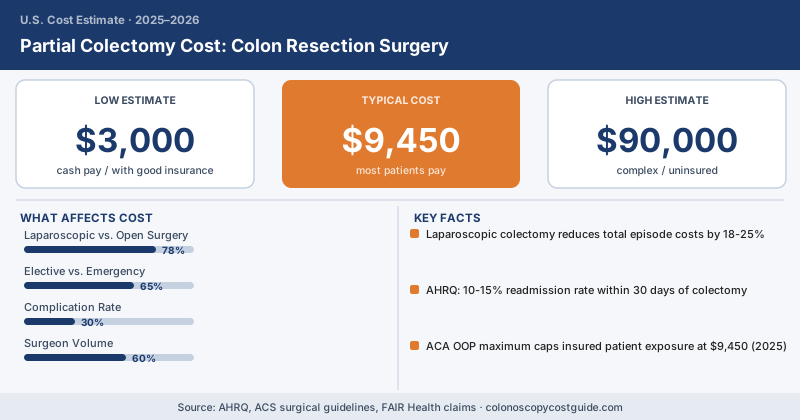
Partial Colectomy Cost: Colon Resection Surgery Prices in 2025–2026
Your surgeon just told you that you need part of your colon removed. Before the fear hits too hard, here’s the number you need to know: for insured patients, your actual out-of-pocket exposure is almost always capped at your annual out-of-pocket maximum — not the $50,000 or $80,000 hospital bill that’s about to arrive.
Partial colectomy (also called segmental resection or hemicolectomy) is major surgery, but it’s one of the most commonly performed abdominal operations in the US. Surgical technique has advanced dramatically — most are now done laparoscopically — and the cost differences between approaches and facilities are substantial.
What Partial Colectomy Actually Includes
“Colon resection” isn’t a single item on a bill. You’ll receive separate charges from:
- The hospital/facility — operating room time, recovery room, hospital room and board
- The colorectal surgeon or general surgeon — professional fee
- The anesthesiologist — separate professional fee
- The assistant surgeon (if used) — 20–30% of surgeon’s fee
- Pathology — the resected tissue is analyzed
- Pre-op labs and imaging — CT scan, bloodwork, colonoscopy (may have been done before surgery)
| Surgery Type | Total Hospital Billed Charges |
|---|---|
| Laparoscopic partial colectomy (elective) | $25,000 – $65,000 |
| Open partial colectomy (elective) | $35,000 – $90,000 |
| Emergency colon resection (perforation/obstruction) | $50,000 – $150,000 |
| Robotic-assisted colectomy | $30,000 – $80,000 |
| Colectomy with colostomy creation | $45,000 – $100,000 |
| Colostomy reversal (separate procedure) | $15,000 – $40,000 |
The range within each category is wide because hospital charge-masters vary dramatically by institution. A community hospital in the South might bill $30,000 for a laparoscopic hemicolectomy; an academic medical center in California might bill $90,000 for the same procedure. The actual payment (after insurer discounts and negotiations) is far lower.
Laparoscopic vs. Open: The Cost-Quality Comparison
Laparoscopic colectomy costs roughly the same to perform — similar OR time and similar supplies — but generates lower total episode costs because:
- Hospital stay: 3–4 days vs. 5–7 days (saves $6,000–$15,000 in room and board)
- Complication rates: Lower wound infection rates, lower ileus rates
- ICU admission rates: Lower for uncomplicated laparoscopic cases
- Return to normal activity: 3–6 weeks vs. 6–12 weeks
A 2021 analysis in the Journal of the American College of Surgeons confirmed that laparoscopic colectomy reduces total 30-day episode costs by approximately 18–25% compared to open surgery, primarily through shorter hospitalizations and lower readmission rates.
Robotic-assisted colectomy adds $2,000–$8,000 in OR equipment costs but offers similar recovery profiles to standard laparoscopy. The cost premium rarely translates to better outcomes for standard colectomy cases.
Surgeon Volume and Hospital Volume Matter
What Drives the Cost Higher: Complications
The baseline colectomy cost assumes an uneventful surgery and recovery. Complications can multiply costs dramatically:
| Complication | Additional Cost |
|---|---|
| Anastomotic leak (reoperation needed) | $40,000 – $100,000 |
| Surgical site infection (wound care, antibiotics) | $5,000 – $20,000 |
| Prolonged ileus (hospital day extension) | $3,000 – $8,000/day |
| Deep vein thrombosis / pulmonary embolism | $10,000 – $40,000 |
| Urinary retention requiring catheterization | $500 – $2,000 |
| Readmission within 30 days (any cause) | $10,000 – $40,000 |
National readmission rates for colectomy run 10–15% within 30 days, according to AHRQ data. Each readmission resets your cost exposure — though your annual out-of-pocket maximum provides protection for insured patients within the same plan year.
Surgery for Specific Conditions: How Indication Affects Cost
Colon Cancer Resection
For colorectal cancer, the colectomy is the beginning — not the end — of treatment costs. Surgery alone runs $30,000–$80,000. Add adjuvant chemotherapy for stage III or IV cancer:
- Adjuvant FOLFOX chemotherapy (6-month course): $30,000–$80,000
- Targeted biologics (bevacizumab, cetuximab) for metastatic disease: $50,000–$150,000/year
Diverticular Disease (Elective)
Elective sigmoid colectomy for recurrent diverticulitis typically costs $25,000–$50,000 total including pre-op workup and hospitalization. Emergency surgery for perforated diverticulitis is considerably more: $40,000–$100,000.
Inflammatory Bowel Disease (Ulcerative Colitis)
When UC doesn’t respond to medication and total colectomy is needed, the procedure may be done in 2–3 stages. Each stage is a separate surgery and hospitalization, meaning total costs can exceed $100,000–$200,000 including all stages.
What You Actually Pay With Insurance
For elective colon surgery, the insurance math is predictable:
- Annual deductible: $1,000–$5,000 (you pay this first)
- Coinsurance: 20–30% of allowed charges until OOP max
- Annual out-of-pocket maximum: $9,450 for individuals in 2025 (ACA cap)
Most insured patients hit their annual OOP maximum with colon surgery. That’s your ceiling in most cases.
Watch for: Out-of-network anesthesiologists or assistant surgeons, which can generate balance bills outside the OOP maximum (though the No Surprises Act limits this at in-network facilities).
For Uninsured Patients
Uninsured patients are billed at full chargemaster rates but almost always qualify for significant discounts:
- Hospital financial assistance (charity care): 40–100% discount based on income
- Prompt-pay discounts: 10–30% reduction for immediate payment
- Payment plan negotiations: most hospitals will not pursue collection on active payment plans
The effective out-of-pocket for a low-income uninsured patient at a large nonprofit hospital may ultimately be $0–$5,000 through charity care programs, even for a $60,000 procedure.