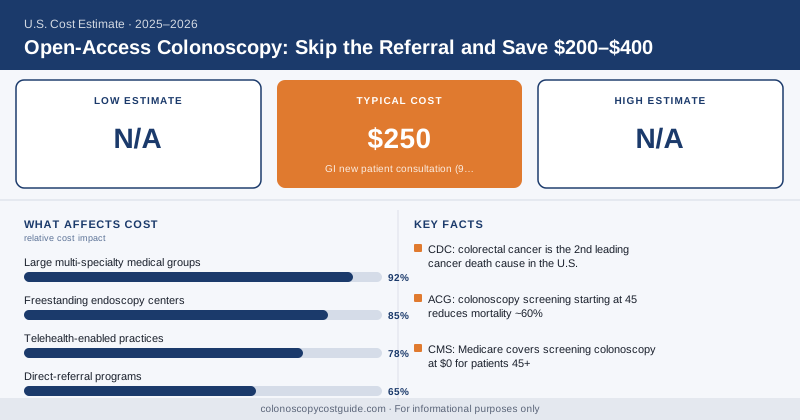
Open-Access Colonoscopy: Skip the Referral and Save $200–$400
{ if eq .Lang "zh" }{ else }{ end }The average American pays for two visits before a colonoscopy even starts. First, a primary care visit to get the referral. Then, a GI consultation visit to meet the specialist, review the patient’s history, and schedule the actual procedure. Only after those two appointments — often separated by weeks — does the patient finally get the colonoscopy.
That’s the traditional pathway. It exists for good reasons. But for millions of average-risk adults who simply need a routine screening colonoscopy, it’s a detour that adds $200–$400 in consultation costs and 3–8 weeks of wait time.
Open-access colonoscopy eliminates the consultation step. You get the procedure directly. And the data supporting it is strong.
What Is Open-Access Colonoscopy?
Open-access (also called direct-access) colonoscopy is a scheduling pathway where average-risk patients can book their colonoscopy directly with a gastroenterologist or endoscopy center — without first completing a separate in-person GI consultation visit.
The GI physician still reviews your medical history before the procedure. That review typically happens via a questionnaire, a phone or telehealth screening call, or a patient portal intake form — not a separate billed office visit. By the time you arrive for the colonoscopy, the physician has confirmed you’re an appropriate candidate.
The Cost Savings: What You Actually Skip
A GI consultation visit is typically billed as a new patient office visit — CPT 99203 or 99204 depending on complexity. Those visits run:
| Visit Type | Typical Billed Rate | Insured Out-of-Pocket (20% coinsurance) | Self-Pay Cash Rate |
|---|---|---|---|
| GI new patient consultation (99203) | $250–$400 | $50–$80 | $120–$200 |
| GI new patient consultation (99204) | $350–$600 | $70–$120 | $175–$300 |
| PCP referral visit (if needed) | $200–$400 | $20–$80 copay | $100–$180 |
| Savings with open-access (typical) | — | $150–$300 | $200–$400 |
For patients on high-deductible health plans with unmet deductibles, every dollar of that consultation is paid out of pocket. For patients close to their deductible, the consultation may partially apply — but even then, skipping unnecessary visits is financially smart.
Who Qualifies for Open-Access Colonoscopy?
Open-access pathways are appropriate for average-risk screening patients who meet all of the following criteria:
- Age 45–75 (the USPSTF’s 2021 updated screening recommendation expanded the start age from 50 to 45, adding approximately 19 million newly eligible Americans)
- No current GI symptoms (rectal bleeding, change in bowel habits, persistent abdominal pain, unexplained weight loss)
- No personal history of colorectal cancer or colorectal polyps
- No family history of colorectal cancer in a first-degree relative before age 60
- No personal history of inflammatory bowel disease (Crohn’s or ulcerative colitis)
- No prior incomplete colonoscopy or significantly abnormal colon anatomy
If any of those flags apply to you, you need a consultation — and that visit earns its cost by ensuring the right preparation and monitoring plan for a higher-complexity case.
Which Systems and States Offer Open-Access
Open-access colonoscopy is not universally available — it depends on the GI practice, the endoscopy center’s protocols, and sometimes state regulations around prescribing without an in-person visit.
That said, it’s increasingly common in:
- Large multi-specialty medical groups (Kaiser Permanente has offered it for years; many regional health systems have adopted it)
- Freestanding endoscopy centers that see high volumes of screening patients
- Telehealth-enabled practices, where a pre-procedure video or phone visit satisfies the consultation requirement at lower cost
- Direct-referral programs in which primary care physicians send patients directly to scheduling without requiring a separate GI appointment
To find out if open access is available in your area: call GI practices directly and ask, “Do you offer direct-scheduling for average-risk screening colonoscopy without a prior in-person consultation?”
How the Process Works
- Call the GI practice or endoscopy center and state you’re an average-risk patient who would like to schedule a screening colonoscopy directly
- They’ll ask a series of screening questions to confirm your risk level
- You’ll complete a health intake form (often online via patient portal)
- A physician or advanced practice provider reviews your intake before confirming scheduling
- You receive a prep kit and instructions by mail or portal
- You show up for your procedure — the physician reviews your history at arrival and proceeds
In many open-access programs, the pre-procedure review is brief (5–10 minutes at the facility) and doesn’t generate a separate consultation bill.
Ask About Telehealth Consultation
Open Access Doesn’t Mean Lower Quality
The clinical evidence on open-access colonoscopy is reassuring. Multiple studies published in Gastrointestinal Endoscopy have found that adenoma detection rates (the key quality metric for colonoscopy) are equivalent or even slightly better in open-access programs, likely because the patient population is properly selected for average-risk screening.
The consultation visit, for average-risk patients, adds administrative overhead without adding clinical value. That’s the core argument for open access — it removes a step that wasn’t improving outcomes.
One Caveat: Don’t Skip It If You Have Symptoms
Open access is only appropriate if you’re truly asymptomatic and average-risk. If you have rectal bleeding, persistent change in bowel habits, anemia, or unexplained weight loss — you need a diagnostic colonoscopy with a proper pre-procedure workup. The consultation visit exists specifically to catch the patients who need more careful preparation or a higher-acuity setting.
Skipping a consultation when you actually have symptoms could mean getting a screening scope when you need a therapeutic one — a clinical mismatch that’s both a safety issue and a billing problem (since diagnostic colonoscopies have different coverage rules).
If you’re not sure whether your symptoms are significant enough to require a consultation, err on the side of scheduling one. The $200–$300 it costs is cheap compared to a mismanaged procedure.
{ if eq .Lang "zh" }