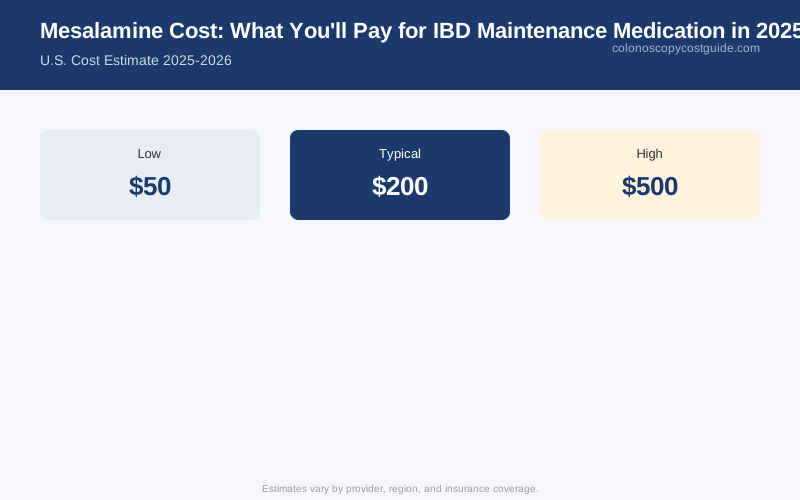
Mesalamine Cost: What You'll Pay for IBD Maintenance Medication in 2025–2026
Most patients assume all mesalamine is the same. It’s not — and the price differences between formulations can run hundreds of dollars a month, even with good insurance.
Mesalamine (5-aminosalicylic acid, or 5-ASA) is the cornerstone maintenance medication for mild to moderate ulcerative colitis and, in some cases, Crohn’s disease limited to the colon. The Crohn’s and Colitis Foundation estimates that more than 900,000 Americans are living with ulcerative colitis, the majority of whom are on some form of 5-ASA therapy long-term.
The drug itself has been around for decades. But the delivery systems — enteric coatings, delayed-release mechanisms, rectal formulations — remain branded and expensive in many cases. Here’s what you’ll actually pay.
Mesalamine Formulations and List Prices
| Formulation | Brand Name | Generic Available | Monthly List Price | Monthly With Good Insurance |
|---|---|---|---|---|
| Delayed-release capsules 0.375g | Apriso | No | $450 – $650 | $30 – $100 |
| Delayed-release tablets 1.2g | Lialda | Yes | $500 – $750 | $25 – $80 |
| Delayed-release capsules 250/500mg | Pentasa | Yes | $400 – $600 | $20 – $75 |
| Multi-matrix system tablets | Asacol HD | Yes | $450 – $700 | $30 – $90 |
| Rectal enema 4g/60mL | Rowasa | Yes | $200 – $400 (box) | $10 – $50 |
| Rectal suppository 1g | Canasa | Yes | $300 – $500 (box) | $15 – $60 |
Generic Lialda (mesalamine delayed-release 1.2g) is the most widely available and typically the most affordable generic option. If your GI doctor writes a prescription for a brand-name version, ask whether the generic is appropriate for your disease location and severity — in most cases it is.
What Insurance Actually Pays For
Commercial plans vary in how they tier mesalamine:
- Tier 1 (generic): $10 to $30 copay — available for generic Lialda, Pentasa generics, and generic enemas/suppositories
- Tier 2 (preferred brand): $50 to $120 copay — some brand-name formulations
- Tier 3 (non-preferred brand): $100 to $250+ copay — brands without strong generic competition like Apriso
Step Therapy: A Common Insurance Hurdle
Medicare Part D Coverage
Medicare Part D covers mesalamine generics at relatively low cost-sharing for most plans. Brand-name versions can be more expensive, depending on which formulary tier they occupy:
| Drug Type | Typical Part D Tier | Monthly Cost-Sharing (2025) |
|---|---|---|
| Generic mesalamine tablets/capsules | Tier 1–2 | $5 – $45 |
| Brand-name formulation | Tier 3–4 | $45 – $150 |
| Brand with no generic | Tier 4–5 | $100 – $300+ |
The $2,000 annual Part D out-of-pocket cap that took effect in January 2025 under the Inflation Reduction Act provides important protection for patients on long-term mesalamine who reach higher tiers. For those on brand-name versions without generic alternatives, this cap prevents the extreme costs that previously accumulated in the catastrophic coverage phase.
Patient Assistance Programs
Both brand-name and generic manufacturers offer assistance:
Allergan/AbbVie Savings Card (Lialda brand): Reduces copay to $25 or less for commercially insured patients.
Pfizer Patient Assistance: Covers Apriso for qualifying uninsured patients.
NeedyMeds database: Lists generic manufacturer assistance programs — less common, but worth checking.
State pharmaceutical assistance programs: Several states (Connecticut, New Jersey, Pennsylvania, others) offer supplemental coverage for low-income residents on medications like mesalamine. Check with your state’s SHIP (State Health Insurance Assistance Program) coordinator.
Rectal Formulations: When Topical Therapy Makes Sense
For left-sided colitis or proctitis, rectal delivery of mesalamine can be more effective than oral dosing — and often cheaper:
| Formulation | Indication | Monthly Out-of-Pocket (Est.) |
|---|---|---|
| Enema 4g (generic) | Left-sided colitis, to splenic flexure | $30 – $80 |
| Suppository 1g (generic) | Proctitis (last 6–8 inches) | $40 – $90 |
| Combination (oral + rectal) | Extensive or refractory colitis | $50 – $150 total |
The ACG (American College of Gastroenterology) guidelines for ulcerative colitis, updated in 2023, recommend combination oral and rectal 5-ASA as the preferred induction and maintenance approach for left-sided colitis — citing superior mucosal healing rates compared to either route alone. Combination therapy doesn’t necessarily cost twice as much if the rectal component is generic.
Long-Term Cost Planning
Ulcerative colitis is a lifelong condition. Mesalamine maintenance therapy typically continues indefinitely, meaning you’ll likely be paying this monthly cost for years. Here’s how to reduce the burden:
90-day supply: Many mail-order pharmacies offer 90-day supplies at 2× the 30-day price, effectively giving one month free. For long-term maintenance, this is worth setting up.
GoodRx for generics: Generic mesalamine (Lialda generic, 1.2g) is often available at major pharmacies for $60 to $100 with GoodRx or similar discount cards — sometimes less than your insurance copay.
Regular insurance plan reviews: During open enrollment, compare which plans tier your specific mesalamine formulation favorably. This decision can save $50 to $200 per month.
Stay in remission: The most expensive mesalamine scenario is failing maintenance and escalating to biologics — which cost $15,000 to $60,000 annually. Consistent mesalamine adherence is the most cost-effective strategy for mild to moderate ulcerative colitis.
For patients who escalate beyond 5-ASA therapy, see ulcerative colitis medication cost for biologic pricing and Crohn’s biologic medication cost for Crohn’s-specific options.