MDsave & ColonoscopyAssist: Do Colonoscopy Vouchers Actually Save You Money?
{ if eq .Lang "zh" }{ else }{ end }Maria, 52, was overdue for her first colonoscopy. Her doctor gave her a referral, she called the local hospital outpatient center, and the billing rep quoted $3,800 for the full procedure — facility, gastroenterologist, and anesthesia. She had a high-deductible plan. Every dollar of that $3,800 would come out of her own pocket before insurance touched a cent.
A friend suggested she check MDsave. Twenty minutes later she’d found a pre-negotiated bundle at a nearby accredited surgery center: $1,180 all-in. Same procedure. Same CPT code. About $2,600 less.
Colonoscopy voucher platforms like MDsave and ColonoscopyAssist are one of the most underused cost-savings tools for uninsured patients and people on high-deductible health plans. Here’s an honest breakdown of how they work, what they actually cost, and when they make sense.
What Are Colonoscopy Voucher Platforms?
MDsave and ColonoscopyAssist are online healthcare bundled-pricing marketplaces. The idea is simple: they pre-negotiate a flat, all-in price with a network of providers — typically ambulatory surgery centers — and sell that package directly to consumers. You pay upfront, receive a voucher, and the provider is reimbursed by the platform.
The bundled price typically includes:
- Facility fee (the ASC or endoscopy center)
- Gastroenterologist/physician fee
- Anesthesia fee
That last one matters a lot. Out-of-network anesthesia is one of the most common sources of surprise colonoscopy bills. When you buy a bundle, anesthesia is included upfront — no separate bill later.
MDsave vs. ColonoscopyAssist: What Each Platform Offers
| Feature | MDsave | ColonoscopyAssist |
|---|---|---|
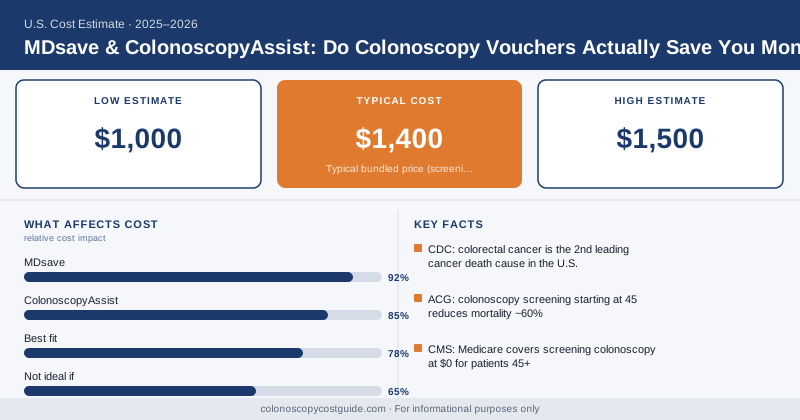
| Typical bundled price (screening) | $1,000–$1,400 | $1,050–$1,500 |
| Typical bundled price (with biopsy) | $1,200–$1,800 | $1,200–$1,900 |
| What’s included | Facility + GI + anesthesia | Facility + GI + anesthesia |
| Geographic coverage | Nationwide, 40+ states | Mostly Southeast, expanding |
| Pathology fees included? | No (usually separate) | No (usually separate) |
| How to pay | Credit card, HSA, FSA | Credit card, HSA, FSA |
| Insurance accepted | Optional — applies as savings | Optional |
MDsave has broader national coverage and a larger provider network. You search by procedure and zip code, select a provider, purchase the bundle, and receive a voucher to schedule. The platform has been operating since 2011 and lists prices for hundreds of procedures beyond colonoscopy.
ColonoscopyAssist is colonoscopy-specific, which means it’s more focused but more limited geographically. It was purpose-built to address one of the most-deferred preventive procedures in the US. Some patients find the narrower focus helpful — you’re not navigating a marketplace of 500 procedures.
How the Voucher System Works — Step by Step
- Go to MDsave.com (or colonoscopyassist.com) and enter your zip code
- Search for “colonoscopy” — prices at nearby facilities appear
- Select your preferred facility and review what’s included
- Purchase the bundle with a credit card, HSA, or FSA card
- Receive a confirmation/voucher by email
- Call the facility directly to schedule — tell them you purchased through MDsave
- Show up for your procedure
- Receive an itemized receipt you can submit to insurance if desired
The provider accepts the bundled rate as payment in full. You won’t get a separate bill afterward — except for pathology if polyps are found (more on that below).
Compared to What? The Real Baseline Price
According to CMS data and FAIR Health consumer cost benchmarks, uninsured patients are typically quoted “chargemaster” (list price) rates at hospital outpatient facilities. Those rates run:
- Hospital outpatient, no polyp: $3,000–$5,500 nationwide
- ASC, no polyp, self-pay rate: $1,200–$2,800 (negotiated rate, varies by market)
- MDsave/ColonoscopyAssist bundle: $1,000–$1,400 typical
Even compared to negotiating a cash/self-pay rate directly with an ASC (which can yield 30–40% off chargemaster), the voucher platforms often come in lower because they’ve done bulk-volume negotiating on your behalf.
The USPSTF updated its colorectal cancer screening recommendation in 2021 to include adults starting at age 45 — expanding the eligible population by roughly 19 million Americans, many of whom are in lower-income, higher-deductible coverage situations where these platforms are most valuable.
The One Big Caveat: Pathology Is Separate
This is the part that catches people off guard. If your gastroenterologist finds and removes a polyp during the procedure, those tissue samples go to a pathology lab for analysis. That lab fee is almost never included in the bundle price.
Pathology bills typically run $200–$600, depending on the number of polyps and what the lab charges. The pathology lab may or may not be in-network with your insurance. If you’re using a voucher platform precisely because you’re uninsured, you’ll get a separate pathology bill.
Ask Before You Book
Who Benefits Most From Voucher Platforms
Best fit:
- Uninsured patients — the platform pricing beats chargemaster rates by 60–70%
- HDHP patients who haven’t met their deductible — the bundle price may be lower than your deductible rate
- Patients whose in-network ASC options are limited
- HSA/FSA holders who want a clean single payment
Not ideal if:
- You have insurance with a low deductible already met — your insurer’s negotiated rate plus your plan’s coverage will likely be cheaper overall
- You need a diagnostic colonoscopy (due to symptoms, positive stool test, or prior polyps) — some platforms price differently for diagnostic vs. screening; confirm before purchasing
- You’re in a rural area with no MDsave-contracted facilities nearby
Does Using a Voucher Affect Your Insurance?
No — purchasing a colonoscopy through a voucher platform doesn’t affect your insurance policy, your deductible tracking, or your coverage. You can submit the itemized receipt to your insurance for out-of-network reimbursement if your plan has any out-of-network benefits. Some patients in PPO plans with out-of-network coverage do exactly this, effectively getting reimbursed a portion of the voucher cost.
The platform price does not “count” toward your in-network deductible accumulation in most cases. If deductible credit matters to you, verify with your insurer before going the voucher route.
Bottom Line
For uninsured patients or those facing a full deductible, MDsave and ColonoscopyAssist offer real, verifiable savings over hospital list pricing. The $1,000–$1,400 all-in bundle versus a $3,800 hospital quote isn’t a gimmick — it’s the difference between getting screened on schedule and deferring a preventive procedure that can catch colon cancer at a curable stage. Just factor in the separate pathology cost, and you’ll have the full picture.
{ if eq .Lang "zh" }