Lower GI Bleeding Treatment Cost: Diagnosis and Procedures 2025–2026
{ if eq .Lang "zh" }{ else }{ end }What does a lower GI bleed actually cost to diagnose and treat? The answer depends on what’s causing the bleeding, how much blood you lose, and whether colonoscopy gets it under control or your team needs to escalate to angiography or surgery.
The range is wide. A colonoscopy to identify and clip a diverticular bleeder — the most common cause — runs $5,000–$15,000 in total facility charges. Angiography with embolization adds another $10,000–$30,000 on top. Emergency surgery for an uncontrolled bleeder starts at $35,000. Here’s how to understand each scenario.
What Is Lower GI Bleeding?
Lower GI bleeding means blood from anywhere between the ligament of Treitz (just below the stomach) and the anus. In practice, “lower GI bleed” almost always means colonic bleeding — blood that comes out looking maroon or bright red, sometimes with clots.
The most common causes by frequency:
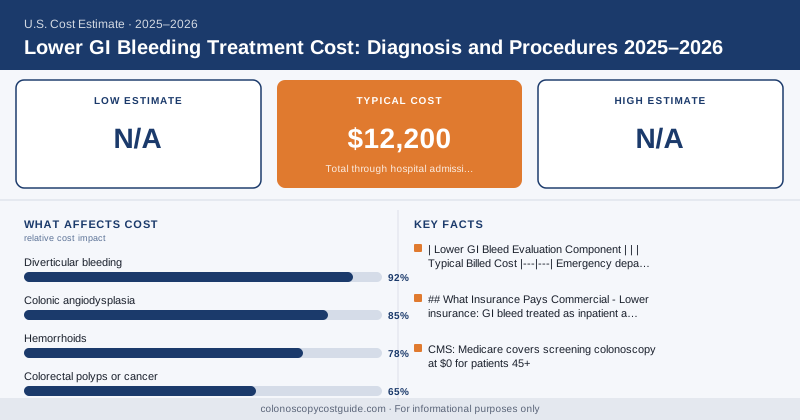
- Diverticular bleeding (30–40% of lower GI bleeds): Arteries within diverticula erode. Usually painless, often brisk.
- Colonic angiodysplasia (15–20%): Abnormal, fragile blood vessel tangles in the colon wall, common in older adults. ACG data shows angiodysplasia is the dominant vascular cause in patients over 65.
- Hemorrhoids (common cause of low-volume rectal bleeding, less often of significant blood loss)
- Colorectal polyps or cancer (usually slow/occult bleeding, occasionally acute)
- IBD flare (Crohn’s or ulcerative colitis)
- Ischemic colitis (reduced blood flow to colon, often in older adults with atherosclerosis)
Evaluation: ER, Hospitalization, and First-Line Costs
Most significant lower GI bleeds land patients in the ER, where the initial cost clock starts.
| Lower GI Bleed Evaluation Component | Typical Billed Cost |
|---|---|
| Emergency department evaluation (level 4–5) | $1,500 – $4,000 |
| ER physician fee | $400 – $900 |
| IV access, fluids, blood draw | $400 – $1,000 |
| Complete blood count, coagulation studies, type and screen | $400 – $900 |
| CT angiography of abdomen/pelvis (active bleeding evaluation) | $2,000 – $5,000 |
| Hospital admission (2–4 days observation/treatment) | $6,000 – $18,000 |
| Hospitalist/GI specialist daily fees | $1,500 – $4,500 |
| Total through hospital admission (no procedure yet) | $12,200 – $34,300 |
CT angiography (CTA) is increasingly used as a rapid first step in active lower GI bleeding — it identifies the bleeding source faster than bowel prep and colonoscopy, and guides intervention. If the CTA shows active bleeding, the patient often goes directly to angiography rather than colonoscopy.
Colonoscopy for Diagnosis and Treatment
Colonoscopy is the primary diagnostic and therapeutic tool for lower GI bleeding. When the source is found, the endoscopist can treat it directly during the same procedure.
| Colonoscopy Component (Hospital-Based) | Typical Billed Cost |
|---|---|
| Hospital facility fee — diagnostic colonoscopy | $3,000 – $8,000 |
| Hospital facility fee — therapeutic colonoscopy (with treatment) | $5,000 – $15,000 |
| Gastroenterologist fee | $800 – $2,500 |
| Anesthesia/sedation | $600 – $1,800 |
| Hemostasis clips (diverticular bleeding) | $500 – $2,000 additional |
| Thermal coagulation (for angiodysplasia) | Included in therapeutic fee |
| Band ligation (for hemorrhoids) | Included in therapeutic fee |
| Total colonoscopy — therapeutic, hospital-based | $6,900 – $21,300 |
Note: a colonoscopy for active bleeding is performed at a hospital, not an ambulatory surgery center. The patient is admitted and monitored. This is the same procedure as a routine screening colonoscopy but the cost is significantly higher because it’s done urgently, in an inpatient setting, and often with therapeutic equipment.
Argon Plasma Coagulation for Angiodysplasia
Angiodysplasia — abnormal blood vessel tangles in the colon — doesn’t respond well to clips. The preferred treatment is argon plasma coagulation (APC), a non-contact thermal ablation technique that cauterizes the lesion.
APC is performed during colonoscopy. The add-on cost for APC equipment and use runs $500–$2,500 in facility charges, added to the base colonoscopy bill. Multiple lesions may require multiple sessions. For patients with recurrent bleeding from angiodysplasia — particularly those with hereditary hemorrhagic telangiectasia (HHT) — serial APC sessions can cost $5,000–$15,000 over a year. See the argon plasma coagulation cost guide for a full breakdown.
Angiography and Embolization: When Colonoscopy Isn’t Enough
If colonoscopy can’t stop the bleeding — or if the patient is too unstable to prep for colonoscopy — interventional radiology (IR) performs mesenteric angiography.
The IR team threads a catheter through the femoral artery, navigates to the colonic blood supply, and identifies the bleeding vessel on fluoroscopy. If active bleeding is visualized, they embolize (block) the feeding artery with coils, foam, or microspheres.
| Angiography/Embolization Component | Typical Billed Cost |
|---|---|
| Interventional radiology facility fee | $8,000 – $20,000 |
| Radiologist/IR physician fee | $3,000 – $8,000 |
| Embolic materials (coils, microspheres) | $1,500 – $5,000 |
| ICU admission post-procedure (common 1–2 days) | $7,000 – $16,000 |
| Total angiography + embolization | $19,500 – $49,000 |
Embolization is effective in stopping acute bleeding in 70–90% of cases, per Society of Interventional Radiology data. The main risk: ischemic colitis from cutting off blood flow to colonic tissue. About 5–10% of patients develop colonic ischemia after embolization — which may require additional surgery.
Surgery: When Embolization and Colonoscopy Both Fail
Surgical intervention for lower GI bleeding is reserved for patients who can’t be controlled endoscopically or via IR. The procedure is segmental colectomy — removing the bleeding portion of colon.
| Surgical Treatment for GI Bleed | Typical Total Hospital Charges |
|---|---|
| Laparoscopic segmental colectomy | $30,000 – $60,000 |
| Open segmental colectomy (emergent) | $45,000 – $90,000 |
| Subtotal colectomy (source unknown, life-threatening bleed) | $55,000 – $120,000 |
| ICU admission post-op (common, 2–5 days) | $14,000 – $40,000 |
The worst surgical scenario is a blind subtotal colectomy — removing most of the colon when the bleeding source can’t be identified pre-operatively. This is rare but carries higher mortality, higher complication rates, and permanently alters bowel function.
Blood Transfusions: An Easily Overlooked Cost
Significant lower GI bleeds require blood transfusions. This cost doesn’t appear in procedure fees — it’s an add-on.
- Single unit of packed red blood cells: $700–$1,500 in hospital charges (includes cross-matching, nursing time, storage)
- Patients requiring 2–4 units (moderate bleed): $1,400–$6,000 in transfusion costs alone
- Patients requiring 6+ units (massive transfusion protocol): $4,200–$9,000+ for blood products alone
This is separate from the ICU and procedure costs above.
What Insurance Pays
Commercial insurance:
- Lower GI bleed treated as inpatient admission: full inpatient cost-sharing applies
- Deductible ($1,000–$4,000) plus coinsurance until OOP max
- Complex bleeds requiring IR or surgery will hit the annual OOP maximum ($9,200 individual for 2026)
- The colonoscopy is NOT a free preventive service when done for active bleeding — it’s diagnostic/therapeutic, with normal cost-sharing
Medicare:
- Part A covers inpatient admission after Part A deductible ($1,676 per benefit period)
- Colonoscopy for diagnosis/treatment: covered under Part B at 80/20 after Part B deductible
- Note: If a screening colonoscopy converts to a therapeutic one when a bleeding polyp is found, the procedure reverts to diagnostic cost-sharing — patients often receive unexpected bills in this scenario
Medicaid:
- Covers all emergency treatment with minimal copays
Lower GI bleeding can range from a frightening but minor hemorrhoid bleed to a life-threatening diverticular eruption. The cost scales accordingly — but knowing the range helps you understand the bills when they arrive.
{ if eq .Lang "zh" }