Liver Function Tests Cost: What You'll Pay With and Without Insurance
The CDC estimates that roughly 4.5 million American adults — about 1.8% of the population — have been diagnosed with liver disease, and tens of millions more get liver function panels ordered every year as routine screening. Yet most patients have no idea what those tubes of blood will cost until the bill arrives.
Here’s a straightforward breakdown of liver function test (LFT) costs so you can plan ahead.
What Are Liver Function Tests?
A liver function panel — sometimes called a hepatic function panel or liver panel — is a group of blood tests that measure enzymes and proteins your liver produces. Your doctor uses these numbers to spot inflammation, damage, or poor liver function before symptoms show up.
A standard liver panel typically includes:
- ALT (alanine aminotransferase) — elevated when liver cells are inflamed
- AST (aspartate aminotransferase) — rises with liver and muscle damage
- ALP (alkaline phosphatase) — signals bile duct problems
- Total bilirubin — measures bile pigment; high levels cause jaundice
- Albumin — tracks how well your liver makes protein
- Total protein — overall protein level in blood
Some panels also include GGT, LDH, and PT/INR. Your doctor’s order determines exactly which tests run.
How Much Do Liver Function Tests Cost?
Costs vary based on where the blood draw happens, whether you’re insured, and how labs bill the tests — individually or as a bundled panel.
| Service | Uninsured / Cash Pay | With Insurance (Copay/Coinsurance) |
|---|---|---|
| Basic liver panel (bundled CPT 80076) | $30 – $120 | $0 – $40 |
| Individual enzyme tests (ALT, AST each) | $10 – $50 per test | $0 – $20 per test |
| Comprehensive metabolic panel (includes LFTs) | $45 – $150 | $0 – $50 |
| Hospital lab vs. independent lab | $80 – $400 | $20 – $100 |
| Doctor’s office lab fee (if in-house) | $40 – $130 | $10 – $40 |
The biggest driver of cost is where the sample gets processed. Hospital-based labs typically bill at 3–5× the rate of independent labs like Quest Diagnostics or LabCorp. If your doctor orders the test and sends it to a hospital lab, you’ll pay considerably more than if you went directly to an independent lab.
Insurance Coverage for Liver Function Tests
Most commercial insurance plans cover liver panels when medically necessary — meaning your doctor ordered them to diagnose or monitor a condition. Coverage gets murkier in a few situations:
Preventive vs. diagnostic billing. If your doctor orders a liver panel as part of a routine physical checkup, some insurers classify it as “preventive” and cover it at 100% under ACA rules. If it’s billed as “diagnostic,” your deductible and coinsurance apply.
High-deductible plans. If you haven’t met your deductible yet, you’ll likely pay the full contracted rate — typically $30 to $120 at an in-network independent lab, or $80 to $300+ at a hospital lab.
Medicare. Medicare Part B covers liver function tests when medically necessary at 80% after the Part B deductible. Medicare Advantage plans may cover them differently.
Key Insurance Terms to Know
- Contracted rate: The discounted price your insurer has negotiated with the lab — much lower than the “list price”
- In-network lab: A lab with a contract with your insurer — always use in-network labs to avoid surprise bills
- ABN (Advance Beneficiary Notice): If a Medicare patient may be billed, the lab should give you this notice before drawing blood
When Are Liver Function Tests Ordered?
Your GI doctor or primary care physician might order a liver panel for many reasons:
- Routine monitoring if you take statins, methotrexate, or other medications that stress the liver
- Suspected hepatitis B or C — the American Gastroenterological Association (AGA) recommends at least one hepatitis C screening for adults born between 1945 and 1965
- Alcohol use evaluation — elevated GGT and AST:ALT ratio can signal heavy drinking patterns
- Follow-up after abnormal results — if a previous panel was off, your doctor may reorder in 4–12 weeks
- Workup for GI symptoms — unexplained fatigue, right-side abdominal pain, or jaundice all prompt a liver panel
- Pre-procedure lab work — colonoscopy or other GI procedures sometimes include liver labs in the workup
The National Institutes of Health (NIH) notes that nonalcoholic fatty liver disease (NAFLD) now affects an estimated 80–100 million Americans, making routine LFT screening increasingly common during annual physicals.
How to Lower Your Liver Panel Cost
Use an independent reference lab. Quest Diagnostics and LabCorp both offer direct-to-patient pricing. A basic liver panel through Quest’s self-pay program runs $30–$50 in most markets. You can order it yourself (in most states) without a doctor’s order at sites like GetLabTests.com or HealthLabs.com.
Ask your doctor to specify bundled billing. CPT code 80076 (hepatic function panel) bundles seven tests into one charge. If your doctor orders each test individually, you’ll get five to seven separate line items on your bill — each with its own fee. One bundled order is almost always cheaper.
Check your FSA or HSA. Liver function tests ordered by a physician are eligible medical expenses. You can pay from a tax-advantaged account, effectively reducing the cost by your marginal tax rate.
Compare prices through your insurer’s portal. Most major insurers — UnitedHealthcare, Aetna, Blue Cross — have online cost estimators. Plug in CPT code 80076 and your zip code to see what different in-network labs charge.
What Happens After an Abnormal Liver Panel?
If your results come back abnormal, don’t panic — a single elevated value rarely means liver disease. Many things spike liver enzymes temporarily: strenuous exercise, certain supplements (including high-dose vitamin A and some herbal products), and common over-the-counter medications like acetaminophen.
Your doctor will likely:
- Repeat the panel in 4–8 weeks to see if values normalize
- Order additional tests if values stay elevated — including hepatitis B surface antigen, hepatitis C antibody, ANA, and possibly a liver ultrasound
- Refer to a hepatologist or GI specialist if results suggest structural damage
Each of those additional tests and visits adds to your total cost. A liver ultrasound, for example, typically runs $200–$500 without insurance. A hepatologist consultation adds another $150–$400. Budget for the follow-up, not just the initial panel.
Bottom Line
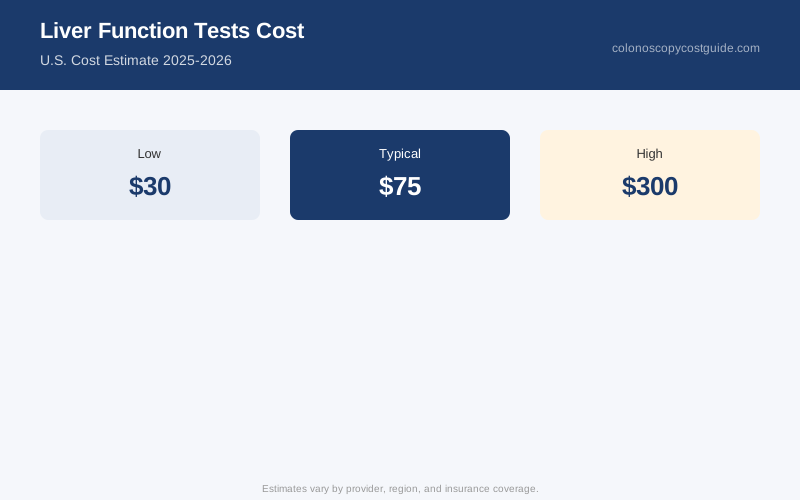
A liver function panel costs $30–$120 at an independent cash-pay lab, rising to $300–$400 at a hospital facility without insurance. With insurance, most patients pay little or nothing when the test is ordered medically. The biggest money-saver is choosing an in-network independent lab over a hospital lab — that single decision can cut your bill by 60–75%.
If cost is a barrier, direct-to-consumer lab services let you order your own liver panel for under $50 in most states. Your doctor still needs to interpret the results, but you control where the blood goes and what it costs.