Liver Biopsy Cost: What You'll Pay at a Hospital, Outpatient Center, or Radiology Suite
Most patients assume a liver biopsy is a major surgical event. It’s not. It’s typically a 15–30 minute image-guided procedure done with a needle, often in a radiology suite, with a few hours of observation afterward. But the bill? That can surprise you.
Liver biopsy remains the definitive tool for evaluating liver fibrosis, unexplained elevated enzymes, fatty liver disease severity, and suspected autoimmune hepatitis. The American Association for the Study of Liver Diseases (AASLD) estimates that over 300,000 liver biopsies are performed annually in the US — the majority for staging chronic hepatitis B, hepatitis C, and nonalcoholic steatohepatitis (NASH).
How Much Does a Liver Biopsy Cost?
The total cost depends on the technique used and where it’s performed. There are three main approaches:
| Technique | Setting | Typical Total Cost (Uninsured) |
|---|---|---|
| Percutaneous (ultrasound-guided) | Radiology suite or hospital | $1,500 – $4,500 |
| Percutaneous (CT-guided) | Hospital radiology | $2,500 – $6,000 |
| Transjugular (via neck vein) | Hospital interventional radiology | $4,000 – $10,000 |
| Surgical (laparoscopic) | Hospital OR | $6,000 – $15,000+ |
| FibroScan (non-invasive alternative) | GI office or imaging center | $400 – $1,000 |
Percutaneous ultrasound-guided biopsy is the most common method — a radiologist or hepatologist inserts a needle through your skin into the liver under ultrasound guidance. It’s done in an outpatient or hospital radiology setting, usually under local anesthesia with optional light sedation.
Transjugular biopsy is used when you have clotting problems or fluid in the abdomen (ascites) that makes the percutaneous approach risky. It’s more complex, requires interventional radiology, and costs significantly more.
What’s Included in the Bill?
A liver biopsy generates multiple charges. Don’t assume one number covers everything:
| Charge Component | Typical Range |
|---|---|
| Facility fee (hospital or ASC) | $800 – $4,000 |
| Radiologist / physician fee | $400 – $1,200 |
| Pathology (tissue analysis) | $300 – $800 |
| Anesthesia or sedation (if used) | $300 – $800 |
| Observation room (2–4 hrs post-procedure) | $200 – $600 |
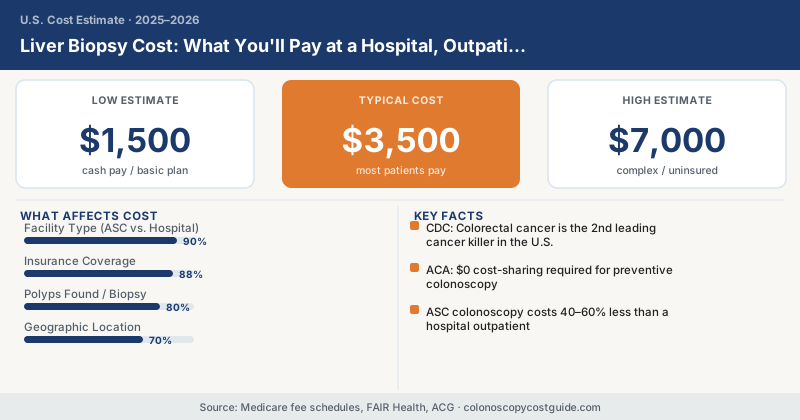
| Total estimate | $1,500 – $7,000 |
The pathology component is non-negotiable — the biopsy has no diagnostic value without a pathologist reading it. That’s a separate bill, often from a group you don’t choose.
Does Insurance Cover Liver Biopsy?
Yes, when it’s medically necessary. Insurance carriers and Medicare cover liver biopsy when ordered with an appropriate diagnosis code — elevated liver enzymes (R74.8), chronic hepatitis (B18.x), suspected NASH or cirrhosis (K76.x), or autoimmune hepatitis (K75.4). You’ll pay your deductible plus coinsurance.
Medicare Part B covers liver biopsy as an outpatient procedure. The Medicare-approved rate for percutaneous liver biopsy (CPT 47000) in hospital outpatient settings is roughly $1,200–$1,800 total; you owe 20% after the Part B deductible — typically $240–$360 in coinsurance once the deductible is satisfied.
What Insurance Reviewers Look For When Approving Liver Biopsy
Prior authorization is commonly required. Your insurer will want to see:
- Persistently abnormal liver enzymes or imaging findings over 3–6 months
- Documentation that non-invasive tests (FibroScan, FIB-4 index, APRI score) were considered
- Treating physician’s clinical rationale explaining why biopsy is needed
- For NASH: BMI, metabolic syndrome markers, duration of disease
If non-invasive staging (FibroScan) is available and appropriate for your condition, insurers may require it before approving biopsy. It’s much cheaper.
Liver Biopsy Costs With and Without Insurance
With insurance (deductible met): Most patients pay $300–$1,500 in coinsurance depending on plan type. An in-network hospital outpatient procedure with a 20% coinsurance rate on a $3,000 allowed amount = $600 out of pocket.
Without insurance: Cash-pay options exist at freestanding radiology groups and academic medical center financial assistance programs. A percutaneous ultrasound-guided biopsy at a radiology-only outpatient center may be negotiated to $1,200–$2,500 for uninsured patients. Hospital systems are harder to negotiate down.
If you’re uninsured and need this test: Ask the hospital’s financial assistance office about income-based charity care. Many large hospital systems write off or deeply discount procedures for patients under 200–300% of the federal poverty level.
FibroScan as an Alternative: Lower Cost, No Needle
FibroScan (transient elastography, CPT 91200) measures liver stiffness non-invasively using sound waves. It costs $400–$1,000 without insurance — a fraction of a biopsy — and is widely used to stage fibrosis in hepatitis C, hepatitis B, and NASH.
It’s not a perfect substitute: FibroScan can’t diagnose all liver conditions or determine cause. But for staging known chronic liver disease in a straightforward clinical picture, most current AASLD guidelines favor non-invasive testing first.
Tips for Managing Liver Biopsy Costs
- Ask your hepatologist or GI doctor whether FibroScan is appropriate first — it may satisfy the clinical question at a fraction of the cost.
- Get the exact CPT codes your facility plans to use (likely 47000 or 47001) and call your insurer for a cost estimate.
- Confirm all providers are in-network: the interventional radiologist, the pathologist, and the facility can each be different billing entities.
- Schedule at an outpatient radiology center rather than a hospital inpatient admission when your condition allows — facility fees are significantly lower.
- Check for hospital financial assistance before assuming you’ll be billed full price.
A liver biopsy is often medically unavoidable. But knowing the cost components ahead of time — facility, physician, pathology, and observation — means you won’t be blindsided when the EOBs start arriving.