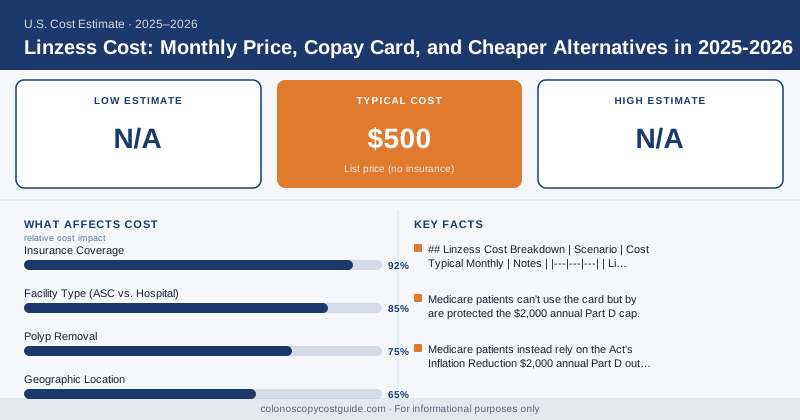
Linzess Cost: Monthly Price, Copay Card, and Cheaper Alternatives in 2026-2026
{ if eq .Lang "zh" }{ else }{ end }Your insurance just denied Linzess and suggested you try fiber and a stool softener first. Frustrating, but it tells you something: at a list price around $500 to $550 a month with no generic, insurers fight hard before they’ll pay for it. The good news is there are real ways to bring that number down to $30 or less.
Linzess is the brand name for linaclotide, approved by the FDA in 2012 for irritable bowel syndrome with constipation (IBS-C) and chronic idiopathic constipation. IBS affects an estimated 10-15% of U.S. adults according to the American College of Gastroenterology, and Linzess is one of the prescription options when over-the-counter measures fall short.
Linzess Cost Breakdown
| Scenario | Typical Monthly Cost | Notes |
|---|---|---|
| List price (no insurance) | $500-$550 | Brand-only, no generic |
| Commercial insurance + savings card | $30 or less | AbbVie/Ironwood savings program |
| Insurance copay (no card) | $50-$150 | Varies by formulary tier |
| Medicare Part D | Varies; subject to $2,000 cap | No savings card allowed |
| OTC alternatives first | $10-$25 | Fiber, PEG 3350, stool softeners |
The list price is the manufacturer’s sticker before insurer negotiation. Because there’s no generic yet, that sticker has no direct competition, which is why insurers lean so hard on step therapy.
Why Insurers Make You Try Other Things First
Step therapy is the central cost story for Linzess. Most plans require you to document that cheaper options — fiber supplements, polyethylene glycol (Miralax), stool softeners — didn’t control your symptoms before they’ll approve Linzess. Those OTC products cost $10 to $25 a month, a fraction of Linzess.
Key Takeaway
The Savings Card and Its Limits
The Linzess savings program can bring commercially insured patients to $30 or less per month. Like all manufacturer cards, it’s off-limits to Medicare and Medicaid patients under federal law. Medicare patients instead rely on the Inflation Reduction Act’s $2,000 annual Part D out-of-pocket cap, effective January 2025.
If you’re uninsured, the full list price is steep. Compare it against the OTC regimens your doctor would have you try anyway — many patients get adequate relief from a $15 combination before ever needing a prescription drug.
Generic relief may also be coming. Patent settlements mean generic linaclotide is expected later this decade, and once it arrives the price math changes completely — much like it did for the PPIs years ago. Until then, the savings card is the main tool for insured patients, and the manufacturer’s patient assistance program is the backstop for those who qualify on income.
Linzess vs. Other IBS-C Options
Linzess competes with other prescription IBS-C drugs and with cheaper OTC laxatives. For the full comparison, see our IBS treatment cost guide. One direct competitor, plecanatide, is covered in our Trulance cost breakdown — the two work similarly, and your copay may differ between them.
IBS-C symptoms can overlap with reflux and other GI issues. If acid is also in the mix, our GERD treatment cost guide covers that side.
When a Colonoscopy Enters the Picture
Persistent constipation or a change in bowel habits often prompts a diagnostic colonoscopy to rule out other causes before settling on an IBS-C diagnosis. That procedure can cost far more than a year of Linzess — see our colonoscopy cost guide for what to expect. If you’re uninsured and facing both, our colonoscopy cost without insurance guide covers strategies that apply to drugs too.
The Bottom Line
Linzess lists around $500 to $550 a month, but commercially insured patients with the savings card usually pay $30 or less. The main barrier is step therapy — insurers want proof that cheaper OTC options failed first, so document everything you’ve tried. Medicare patients can’t use the card but are protected by the $2,000 annual cap. Before assuming you can’t afford it, ask your doctor’s office to handle the prior authorization and apply the manufacturer card.
{ if eq .Lang "zh" }