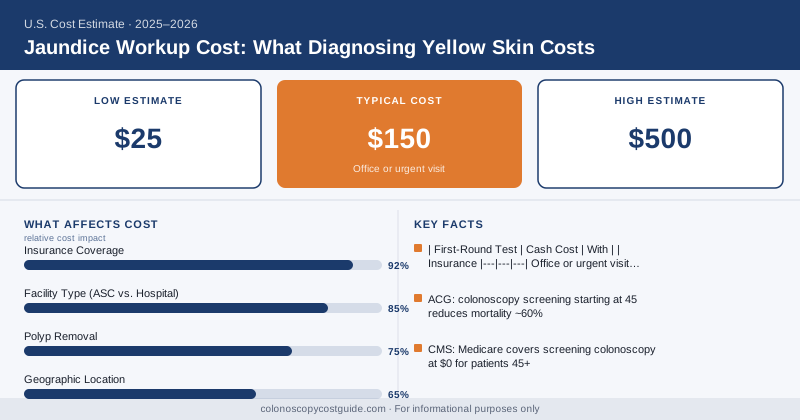
Jaundice Workup Cost: What Diagnosing Yellow Skin Costs
{ if eq .Lang "zh" }{ else }{ end }When the whites of your eyes and your skin turn yellow, your body is flagging a bilirubin problem — and bilirubin backs up for reasons that range from a benign genetic quirk to a blocked bile duct or liver disease. Sorting out which one you’ve got costs anywhere from about $400 to $8,000, depending on how deep the search has to go.
Here’s how the workup unfolds and what each layer costs.
The Branch Point: Liver or Blockage
Jaundice splits into two big categories, and the first round of testing exists to figure out which side you’re on. Is the problem inside the liver (hepatitis, cirrhosis, medication injury), or is it an obstruction blocking bile from draining (a gallstone, a stricture, a tumor)? The answer steers every test that follows.
| First-Round Test | Cash Cost | With Insurance |
|---|---|---|
| Office or urgent visit | $150 – $500 | $25 – $100 copay |
| Liver function panel + bilirubin | $80 – $300 | $10 – $60 |
| CBC + coagulation labs | $80 – $250 | $5 – $50 |
| Viral hepatitis panel | $100 – $400 | $10 – $80 |
| Abdominal ultrasound | $200 – $1,000 | $50 – $300 |
The CDC reports that millions of Americans live with chronic viral hepatitis, much of it undiagnosed, which is why the hepatitis panel is a routine early test. The ultrasound, meanwhile, is the cheap workhorse for spotting a dilated bile duct that signals a blockage.
When Advanced Imaging Is Needed
If the ultrasound suggests a blockage, or the picture stays murky, the workup escalates to cross-sectional imaging and specialized bile-duct studies. This is the expensive tier.
| Advanced Test | Total Billed Cost |
|---|---|
| Abdominal/pelvic CT scan | $300 – $3,000 |
| MRCP (MRI of bile ducts) | $1,000 – $5,000 |
| ERCP (scope of bile ducts) | $2,500 – $8,000 |
| Endoscopic ultrasound (EUS) | $1,500 – $5,000 |
A CT scan surveys the liver, pancreas, and ducts. MRCP is a non-invasive MRI that maps the bile ducts in detail. When a blockage needs to be both confirmed and relieved, ERCP — a specialized scope passed down into the bile duct — can remove a stone or place a stent in the same procedure, which is why it’s often the most expensive single step.
Key Takeaway
How This Connects to the GI Scope Family
ERCP and endoscopic ultrasound are cousins of the standard upper endoscopy — same general approach of passing a scope through the mouth, but aimed at the bile and pancreatic ducts. If tissue is sampled during EUS or ERCP, expect biopsy and pathology fees of $200–$800 on top.
What It Costs Overall
A jaundice traced to a benign or viral cause through labs and ultrasound runs $400–$1,500. A case needing CT or MRCP climbs to $2,000–$5,000. And one requiring ERCP to clear a blocked duct can reach $8,000, especially if it happens during a hospital admission.
The biggest cost driver, as with most GI workups, is the setting — why these scopes get so expensive comes down to facility fees, sedation, and the specialized equipment involved. For non-emergency jaundice, ask whether the imaging can be done outpatient before you’re admitted, since that single choice can shift thousands of dollars.
{ if eq .Lang "zh" }