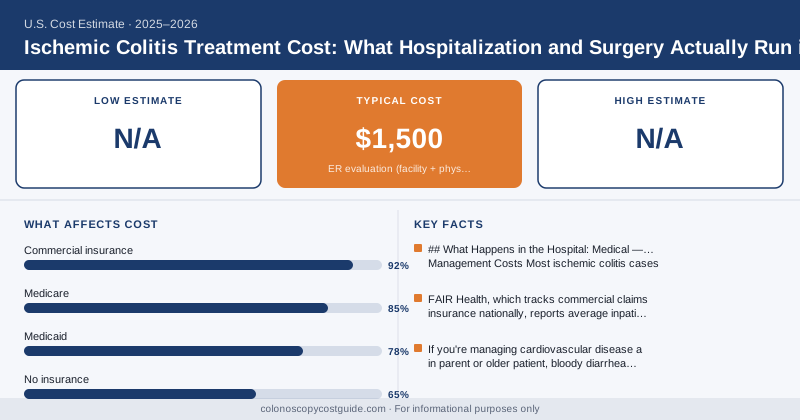
Ischemic Colitis Treatment Cost: What Hospitalization and Surgery Actually Run in 2025–2026
42% of ischemic colitis patients are admitted through the emergency department without any prior GI history. One day you’re managing blood pressure or recovering from a cardiac event; the next you have bloody diarrhea and left-sided cramping that sends you to the ER. The diagnosis often surprises both the patient and their primary care doctor.
The cost range is equally wide. Mild cases that respond to fluids and bowel rest might run $2,000–$6,000 total. If the colon has lost blood supply long enough to develop necrosis, you’re looking at emergency surgery and a bill that can top $60,000. Knowing where you fall in that spectrum — and what drives costs — matters a lot when you’re reviewing an EOB.
What Happens in the Hospital: Medical Management Costs
Most ischemic colitis cases — roughly 80–85%, according to the American College of Gastroenterology — resolve with non-surgical medical management. That means IV fluids to restore perfusion, bowel rest (nothing by mouth), IV antibiotics to prevent bacterial translocation, and close monitoring.
| Medical Management (Non-Surgical) | Typical Billed Cost |
|---|---|
| ER evaluation (facility + physician fees) | $1,500 – $4,000 |
| CT scan of abdomen/pelvis with contrast | $1,500 – $4,000 |
| Hospital admission and daily facility fee (2–5 days) | $6,000 – $30,000 |
| IV fluids and electrolyte replacement | $300 – $900 |
| IV antibiotics (3–5 day course) | $400 – $1,500 |
| Colonoscopy or flexible sigmoidoscopy (diagnostic) | $800 – $2,500 |
| Pathology (biopsy specimens) | $200 – $600 |
| Hospitalist/internist physician fees | $800 – $2,000 |
| Total: mild to moderate, medical management | $11,500 – $45,500 |
The colonoscopy or flexible sigmoidoscopy is usually performed within 48 hours of admission to assess the extent and severity of mucosal injury. Mild ischemia looks like pale, patchy mucosa; severe cases show ulceration, necrosis, or gangrene. That endoscopic finding is what drives the decision about surgery.
FAIR Health, which tracks commercial insurance claims nationally, reports average inpatient claims of $8,000–$15,000 for ischemic colitis hospitalizations where surgery isn’t required. The actual insurer payment is typically 30–50% lower than billed charges.
Surgical Cases: When the Colon Requires Resection
When ischemia progresses to bowel necrosis — or when perforation occurs — surgery is unavoidable. This typically means a segmental colectomy (removing the damaged section of colon), which may be performed open or laparoscopically depending on the patient’s condition and the surgeon’s assessment.
| Surgical Treatment (Colectomy) | Typical Billed Cost |
|---|---|
| Operating room facility fee | $12,000 – $28,000 |
| Colorectal surgeon fee | $3,500 – $8,000 |
| Anesthesiologist fee | $2,000 – $5,000 |
| Post-surgical ICU (1–3 days, if required) | $8,000 – $24,000 |
| Extended hospital stay (7–14 days) | $21,000 – $70,000 |
| Temporary ostomy creation (if needed) | $1,500 – $4,000 |
| Pathology (resected specimen) | $400 – $1,200 |
| Total: severe ischemic colitis requiring surgery | $48,400 – $140,200 |
Not every surgical case involves an ostomy, but if the remaining bowel ends can’t be safely reconnected — because of contamination, inflammation, or the patient’s overall condition — a temporary colostomy or ileostomy is created. That adds both immediate surgical cost and the downstream expense of ostomy supplies ($150–$400/month) until reversal surgery can be performed.
Why Ischemic Colitis Disproportionately Affects Older Adults
What You’ll Pay With Insurance
Commercial insurance:
- Deductible first: typically $1,500–$5,000
- Coinsurance (20–30%) until OOP max is reached
- 2025 ACA OOP max: $9,450 individual / $18,900 family
- Most surgical cases will hit the OOP max; insured patients typically pay $3,000–$9,450 total
Medicare:
- Part A hospital deductible: $1,676 per benefit period (2025)
- Days 1–60: no coinsurance
- Days 61–90: $419/day coinsurance
- Part B covers physician fees at 80% after the $257 annual deductible
- Medigap plans (supplemental) cover most or all of the Part A and B cost-sharing
Medicaid:
- Hospitalization and surgery covered with minimal or no cost-sharing
- Eligibility for Medicaid expansion states starts at 138% of the federal poverty level
No insurance:
- Full chargemaster billing, but hospitals are required to screen for charity care and offer financial assistance
- Uninsured patients with low income often qualify for charity care programs that substantially reduce or eliminate the balance