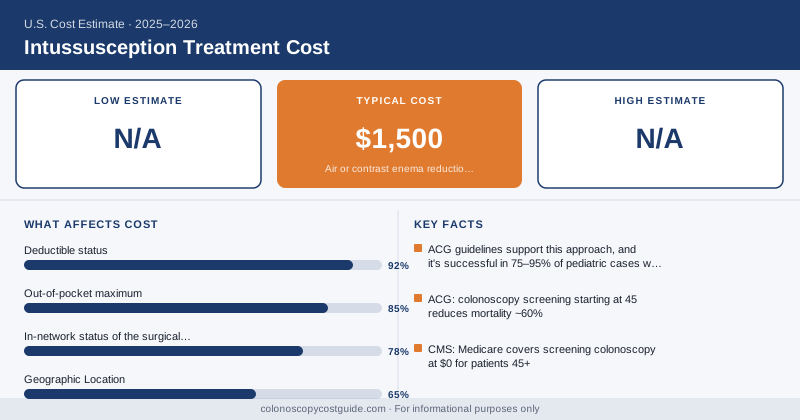
Intussusception Treatment Cost
In 2010, treating a pediatric intussusception with an air enema cost roughly $3,000–$5,000 total if it worked on the first try. Today, that same successful enema reduction at a children’s hospital runs $4,500–$8,000 — and if surgery is needed, you’re looking at $15,000–$30,000 before insurance applies. Hospital costs have outpaced inflation in this space significantly, and intussusception is a time-sensitive emergency where cost comparisons aren’t really an option.
Here’s what families and adult patients should expect to pay, and why the stakes are high.
What Is Intussusception?
Intussusception occurs when one segment of the intestine telescopes into an adjacent segment, creating a blockage. It’s the most common cause of bowel obstruction in children under 2 years old, according to the American College of Gastroenterology — occurring in roughly 1–4 per 1,000 infants in the United States. Symptoms include sudden severe abdominal pain, vomiting, and blood in stool (the classic “currant jelly” stool).
In adults, intussusception is rare — it accounts for only 1–5% of bowel obstruction cases — and almost always has an underlying cause such as a polyp, tumor, or Meckel’s diverticulum. Adult intussusception typically requires surgery to address both the obstruction and its root cause.
Treatment Options and Their Costs
| Treatment | Typical Cash Cost | Notes |
|---|---|---|
| Air or contrast enema reduction (children) | $1,500 – $4,500 | Non-surgical; successful in 75–95% of pediatric cases |
| ER evaluation + imaging (CT or ultrasound) | $800 – $2,500 | Required before treatment; separate from procedure cost |
| Hospital admission (1–2 nights, post-reduction) | $3,000 – $8,000 per day | Standard observation after enema reduction |
| Surgery (failed enema or adult presentation) | $8,000 – $25,000 | Laparoscopic or open; includes bowel resection if needed |
| ICU stay (complications) | $10,000 – $30,000+ per day | Rare; sepsis, perforation, or necrotic bowel |
Pediatric Intussusception: The Enema-First Approach
For children, the standard first-line treatment is a pneumatic (air) or hydrostatic (contrast fluid) enema performed under fluoroscopic or ultrasound guidance. The radiologist uses the pressure of air or fluid to push the telescoped segment back into position — no incision required. ACG guidelines support this approach, and it’s successful in 75–95% of pediatric cases when the child is diagnosed quickly and shows no signs of bowel perforation.
The enema procedure itself bills as a radiologic procedure — typically $800–$2,000 for the radiologist’s professional fee and imaging center. The real cost driver is the emergency setting: ER fees, IV placement, monitoring, and mandatory observation admission afterward add $3,000–$8,000 per day.
If the enema fails (roughly 5–25% of cases), or if the child shows signs of perforation or bowel death (necrosis), emergency surgery is required immediately. That’s where costs escalate sharply.
Adult Intussusception: Surgery Is Usually Unavoidable
Adults don’t get the same conservative option. Because adult intussusception almost always has an underlying structural cause — a polyp, lipoma, or (in some cases) colorectal cancer — enema reduction alone isn’t appropriate. Surgery is needed both to relieve the obstruction and to diagnose and treat the underlying lesion.
Laparoscopic resection for a straightforward adult intussusception runs $8,000–$15,000 at an academic medical center, cash price. Open surgery, or cases where a bowel segment is necrotic and requires resection, pushes costs to $15,000–$25,000 or more. A malignant cause (tumor) means additional oncologic workup and possible staged surgeries, adding significantly to the total.
Time Is the Most Critical Variable
Intussusception is a true GI emergency. Every hour of delay increases the risk that the trapped bowel segment will lose its blood supply and become gangrenous — requiring resection rather than simple reduction. A gangrenous bowel segment means bowel resection surgery, longer hospitalization, and potentially a temporary colostomy.
For parents: if your infant is inconsolably crying in episodes, vomiting bile, or has blood in the stool, go to the ER immediately. Do not wait for a pediatrician appointment. Speed of diagnosis directly determines whether the cheaper, non-surgical treatment is still an option.
Insurance Coverage
Intussusception treatment — whether enema reduction or surgery — is always covered as a medical emergency by commercial insurance, Medicare, and Medicaid. There’s no insurer who classifies this as elective.
Your out-of-pocket exposure depends almost entirely on:
- Deductible status: This is an emergency, so you’ll typically hit your deductible with a single hospitalization
- Out-of-pocket maximum: Most families will hit their annual OOP max with an intussusception surgery admission
- In-network status of the surgical team: In a pediatric emergency, you may not have time to verify in-network status — federal surprise billing rules (No Surprises Act) provide some protection for emergency care
For insured patients, the realistic out-of-pocket for a successful enema reduction with 1-night observation is $1,000–$3,500. Surgery admissions typically run $2,500–$8,000 out-of-pocket depending on plan design and deductible status.
The Full Cost Picture
| Scenario | Estimated Total (Cash) | Estimated OOP (Insured) |
|---|---|---|
| Pediatric: enema success, 1-night stay | $5,000 – $12,000 | $1,000 – $3,500 |
| Pediatric: enema fails, laparoscopic surgery | $15,000 – $30,000 | $2,500 – $7,000 |
| Adult: laparoscopic resection, benign cause | $10,000 – $20,000 | $2,000 – $6,000 |
| Adult: open resection, malignant cause | $20,000 – $50,000+ | $3,000 – $8,000+ (to OOP max) |
What You Can Do
You can’t price-shop an intussusception — it’s an emergency. What you can do is:
- Know your deductible and out-of-pocket maximum before a crisis hits. If you have a family, know exactly what your plan covers for pediatric emergencies.
- Request itemized bills. Hospital bills for emergency care routinely include errors. An itemized review often finds $200–$1,000 in duplicate or incorrect charges.
- Ask about financial assistance programs. Children’s hospitals and academic medical centers routinely offer income-based financial assistance — and these programs aren’t just for uninsured patients. Even insured families with high out-of-pocket costs may qualify.
- Document everything for FSA/HSA reimbursement. All surgical costs, ER fees, imaging, and follow-up care are HSA/FSA eligible.
Intussusception is frightening and expensive — but it’s also highly survivable when treated promptly. The cost gap between early treatment and delayed presentation is enormous, both financially and clinically.