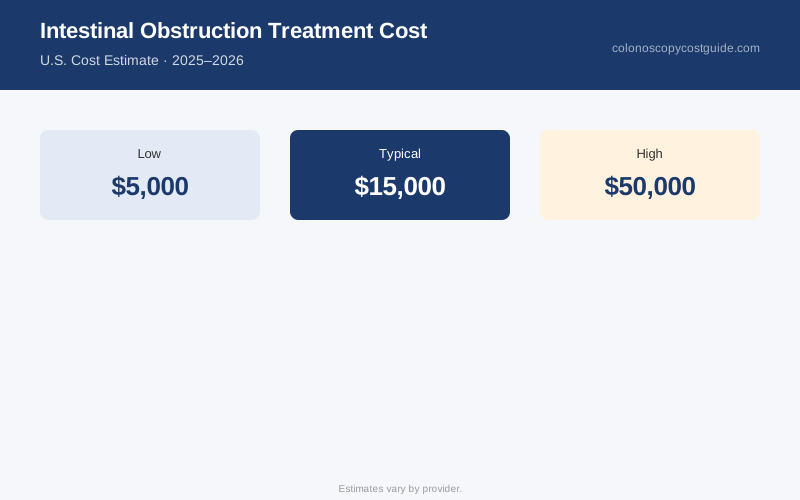
Intestinal Obstruction Treatment Cost: What You'll Pay in 2025–2026
Here’s the honest answer before anything else: intestinal obstructions are medical emergencies. You don’t price-shop for an ER visit when you’re vomiting bile and your abdomen is distended. But once you’re out of the hospital staring at a $28,000 bill, you need to understand what happened and what your options are. This guide covers both.
What Is a Bowel Obstruction?
A bowel obstruction occurs when something — adhesions from prior surgery, a tumor, a hernia, or impacted stool — physically blocks the passage of intestinal contents. The blockage can be in the small intestine (small bowel obstruction, SBO) or the large intestine (large bowel obstruction, LBO).
- Small bowel obstruction is more common, accounting for about 80% of mechanical obstructions. Post-surgical adhesions cause roughly 65–75% of SBOs, according to the American College of Surgeons.
- Large bowel obstruction is less common and more often caused by colorectal cancer, diverticular disease, or sigmoid volvulus.
Some obstructions are partial (contents can still pass slowly) and can be managed without surgery. Complete obstructions are surgical emergencies.
The Cost Ranges for 2025–2026
| Treatment Path | Self-Pay Range | Insured Out-of-Pocket |
|---|---|---|
| ER evaluation only (resolved, discharged) | $1,500–$5,000 | $300–$1,500 |
| Hospital admission, non-surgical management | $5,000–$20,000 | $1,500–$6,000 |
| Surgical intervention (laparoscopic) | $15,000–$35,000 | $3,000–$10,000 |
| Surgical intervention (open) | $20,000–$50,000+ | $4,000–$15,000 |
| Colon stent placement (for LBO) | $8,000–$18,000 | $2,000–$7,000 |
| ICU stay (if complications) | $3,000–$10,000/day | Varies widely |
These numbers assume a single uncomplicated event. Bowel resection with complications — infection, anastomotic leak, reoperation — can push total hospital bills to $100,000+.
What Non-Surgical Management Involves (and Costs)
Not every bowel obstruction requires the operating room. Partial small bowel obstructions from adhesions are often managed conservatively: NPO (nothing by mouth), IV fluids, nasogastric tube decompression, and watchful waiting.
A typical non-surgical hospital stay for SBO runs 3–7 days. What you’re paying for:
- ER evaluation: $1,500–$4,000 (physician fee + facility fee for ER visit, plus CT scan $600–$2,000)
- Hospital room: $2,000–$5,000 per day (medical/surgical floor) or $3,000–$8,000/day (ICU if needed)
- IV fluids, NG tube, nursing care: Bundled into the daily room rate at most hospitals
- GI or surgical consultation: $300–$600 per visit
At self-pay rates, a 4-day non-surgical admission easily runs $15,000–$25,000. With insurance and a typical deductible + out-of-pocket maximum structure, most patients owe $3,000–$8,000.
Surgical Treatment Costs
Surgery is required when an obstruction is complete, when the bowel is at risk of strangulation (cut off blood supply), or when conservative management fails. The two main approaches:
Laparoscopic Lysis of Adhesions
Cutting the adhesive bands causing an SBO via small abdominal incisions. This is the standard first approach when the patient is stable and anatomy allows it.
Surgeon fee: $2,500–$6,000. Anesthesia: $1,500–$3,500. Facility (hospital): $8,000–$20,000. Total: $12,000–$29,000 self-pay. With insurance: $3,000–$9,000 out-of-pocket after deductibles.
Open Surgery / Bowel Resection
If laparoscopy isn’t feasible, or if the bowel is damaged and a section must be removed, open surgery is performed. A bowel resection (removing the obstructed segment) adds significant complexity.
Surgeon fees: $4,000–$9,000. Anesthesia: $2,500–$5,000. Facility: $12,000–$30,000. Hospital stay post-op: 5–10 days. Total self-pay: $25,000–$55,000. With insurance at out-of-pocket maximum: $5,000–$15,000.
Colon Stenting: An Alternative to Emergency Surgery for LBO
Insurance Coverage
Because bowel obstruction is an acute, medically necessary condition, it’s covered by all major insurance plans. Coverage is not the issue — cost-sharing is.
Deductible and out-of-pocket maximum: Most insured patients hit their annual out-of-pocket maximum during a surgical hospitalization. In 2025, the ACA out-of-pocket maximum is $9,450 for individual coverage. If your surgery and hospitalization exceed your OOP max, you pay nothing additional for the rest of the year.
In-network emergency exception: The No Surprises Act requires that emergency care be treated as in-network for cost-sharing purposes, even if the ER or its physicians aren’t in your network. This protection applies to the ER evaluation and any services delivered during the emergency.
Post-emergency care: Once you’re stabilized and transferred to an in-hospital floor, the No Surprises Act protections have more nuance. Specialist consultants (GI, surgery) may be out-of-network. Get the billing team to confirm network status before non-emergency portions of your stay.
Medicare Coverage
Medicare Part A covers hospital stays for bowel obstruction treatment. In 2025:
- Days 1–60: $0 after the Part A deductible ($1,676)
- Days 61–90: $419/day coinsurance
- Beyond day 90: lifetime reserve days at $838/day
Medicare Part B covers the surgeon, anesthesiologist, and any post-discharge follow-up. Most patients with a standard hospitalization owe $1,676 (deductible) + 20% of Part B-covered professional fees — roughly $2,500–$5,000 total unless they have Medigap.
Managing the Bill After the Fact
Hospital billing departments expect negotiation, especially for large uninsured bills.
Request an itemized bill. Hospital bills routinely contain duplicate charges, billing errors, and unbundled line items. Studies from the Medical Billing Advocates of America suggest 80% of hospital bills contain at least one error.
Apply for financial assistance. All nonprofit hospitals receiving federal funding are required to have charity care programs. Even for patients above federal poverty guidelines, many hospitals offer sliding-scale discounts of 20–60%.
Negotiate a payment plan or lump-sum settlement. Hospitals frequently accept 40–60 cents on the dollar for self-pay patients paying a lump sum. Get any settlement in writing before paying.
The Bottom Line
Intestinal obstruction treatment costs $5,000–$50,000+ depending on whether surgery is required and how long hospitalization lasts. Insured patients typically reach their out-of-pocket maximum of $5,000–$9,450. The financial pain is real, but it’s manageable with itemized billing review and proactive engagement with hospital financial counselors.