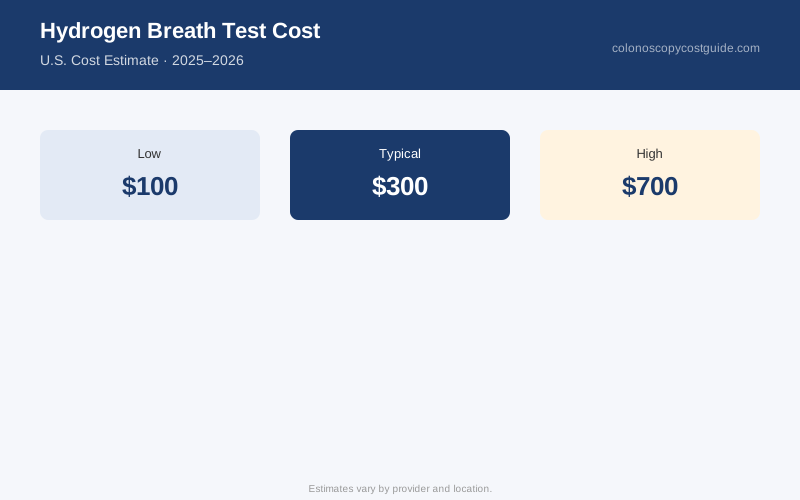
Hydrogen Breath Test Cost: SIBO, Lactose, and Fructose Testing Prices
42% of Americans with chronic bloating, gas, or diarrhea never get a definitive diagnosis — they just keep eliminating foods and hoping. A hydrogen breath test can actually give you an answer, and it costs a fraction of what an endoscopy or colonoscopy runs.
Here’s the full breakdown of what breath testing costs, what each test covers, and how insurance handles it.
What Is a Hydrogen Breath Test?
When bacteria ferment undigested carbohydrates in your gut, they produce hydrogen (and sometimes methane) gas that gets absorbed into your bloodstream and exhaled. A breath test measures these gases before and after you drink a sugar solution, helping diagnose:
- SIBO (Small Intestinal Bacterial Overgrowth): bacteria colonizing the small intestine where they shouldn’t be concentrated
- Lactose intolerance: inability to digest lactose (milk sugar)
- Fructose malabsorption: difficulty absorbing fructose (fruit sugar, HFCS)
- Sucrose malabsorption: rare but increasingly tested
The North American Consensus on SIBO (published in American Journal of Gastroenterology, 2017) established standardized protocols for lactulose and glucose breath testing that most GI labs now follow.
Hydrogen Breath Test Cost by Type
Costs vary by the substrate used (lactulose, glucose, lactose, fructose), test duration, and whether it’s done in a GI office vs. mailed to a home testing lab.
| Test Type | In-Office Cost (Uninsured) | At-Home Kit Cost |
|---|---|---|
| SIBO — Lactulose breath test (3-hour) | $200 – $450 | $90 – $180 |
| SIBO — Glucose breath test (2-hour) | $175 – $400 | $90 – $160 |
| Lactose intolerance breath test | $150 – $350 | $70 – $140 |
| Fructose malabsorption breath test | $150 – $350 | $70 – $140 |
| Sucrose malabsorption test | $150 – $350 | $80 – $150 |
| Combined SIBO + carbohydrate panel | $350 – $650 | $150 – $300 |
At-home breath test kits — from companies like QuinTron, Aerodiagnostics, and Commonwealth Diagnostics International — mail you a collection kit. You follow the prep protocol, breathe into the tubes at timed intervals, and mail them back for analysis. They’re cheaper but require discipline with the protocol, since deviations affect accuracy.
What Affects the Price?
Setting: GI office-based testing is more expensive than at-home kits, but in-office tests are interpreted by a GI physician in real time and are billable to insurance. Home kits are often self-pay only.
Test duration: SIBO lactulose tests run 3 hours (with samples every 20 minutes), while lactose and fructose tests are typically 2 hours. Longer tests mean more clinical staff time — and higher fees.
Geographic variation: A 2-hour lactose breath test runs $150 in rural Midwest practices and $350+ in major metropolitan GI groups. Location matters.
Add-on services: Some practices charge a separate physician interpretation fee ($75–$150) beyond the technical test fee.
Insurance Coverage for Breath Testing
Coverage is inconsistent — this is one area where calling your insurer before scheduling genuinely matters.
Generally covered:
- Lactose intolerance breath testing: most major plans cover this under the same benefit as diagnostic GI labs when ordered by a physician for GI symptoms
- Fructose malabsorption testing: covered by many plans when clinically indicated
Often requires prior auth or denied:
- SIBO breath testing: still considered investigational by some payers, though coverage is expanding as SIBO gains clinical recognition
- United Healthcare and Cigna have issued positive coverage determinations for lactulose breath testing in recent years; Aetna’s policy remains restrictive
CPT codes to know:
- Hydrogen breath test: CPT 91065
- Lactose intolerance test: CPT 82951 (sometimes used)
Before You Book: Insurance Steps
- Ask your GI office for the CPT code(s) they’ll bill.
- Call your insurer’s member services and ask specifically whether CPT 91065 is covered for your diagnosis code.
- If SIBO is suspected, ask the GI office to document ICD-10 K63.4 (Other specified diseases of intestine) or K58 (IBS) on the order — specific diagnosis coding improves coverage odds.
- Get authorization in writing before the test date.
With Insurance: What You’ll Actually Pay
If your plan covers breath testing, you’ll typically pay your specialist copay ($30–$80) plus any applicable lab coinsurance. With a met deductible, total out-of-pocket is usually $30–$100 for an in-office test.
If you haven’t met your deductible, you may pay the full contracted rate ($150–$300) — but that still applies toward your deductible, which matters if you have further GI workup ahead.
The At-Home vs. In-Office Decision
At-home kits make sense if:
- Your insurance won’t cover in-office testing
- You want to test for multiple carbohydrate intolerances affordably
- A telehealth GI provider (like Oshi Health or GI Alliance) has ordered the kit and will interpret results remotely
In-office testing makes sense if:
- Your insurer will cover it (making it far cheaper than self-pay)
- You want your GI doctor to monitor your real-time symptoms during the test
- Prior at-home testing was inconclusive
What Happens After a Positive Test?
A positive SIBO breath test typically leads to antibiotic treatment — most commonly rifaximin (Xifaxan). That’s a separate cost: brand-name Xifaxan runs $1,200–$1,800 for a 14-day course without insurance. Generic rifaximin (available since 2023) drops that to $200–$600 depending on pharmacy. GoodRx coupons vary significantly by location.
Positive lactose or fructose tests don’t require medication — they guide dietary changes and may involve referral to a GI dietitian ($100–$250/session, sometimes covered by insurance).
Bottom Line
Hydrogen breath testing is one of the more affordable GI diagnostic tools — especially compared to colonoscopy or endoscopy. If you’re dealing with unexplained bloating, gas, or diarrhea, it’s worth asking your GI doctor or even a telehealth provider about breath testing before going straight to more invasive procedures.
Out-of-pocket cost with insurance: $30–$100 if covered. Without insurance or with a self-pay kit: $70–$300. That’s a reasonable price for a definitive answer.