Humira for Crohn's Cost: List Price, Biosimilars, and What You'll Actually Pay
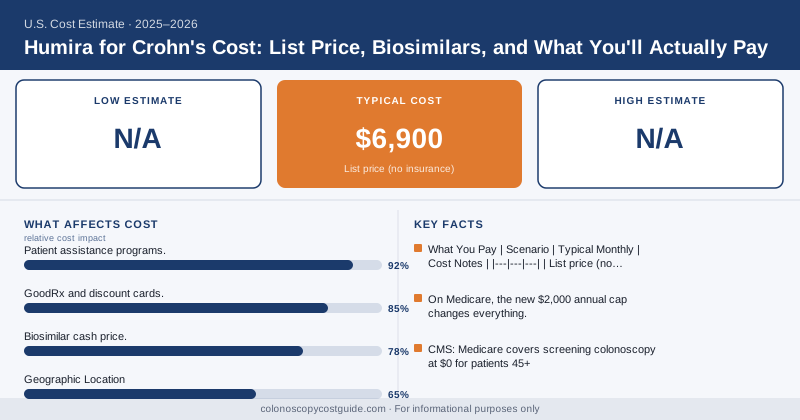
{ if eq .Lang "zh" }{ else }{ end }A single Humira pen carries a list price north of $3,400 — and you inject two of them a month. That’s about $6,900 monthly, or roughly $83,000 a year at sticker price. Terrifying number. Here’s the part nobody tells you up front: hardly anyone with insurance actually pays that.
Crohn’s disease affects around 780,000 Americans, according to the Crohn’s & Colitis Foundation’s 2024 figures, and adalimumab — sold as Humira — has been a workhorse anti-TNF biologic since the FDA cleared it for Crohn’s back in 2007. Understanding what it really costs you in 2025-2026 means separating the scary list price from the number that hits your bank account.
Humira List Price vs. What You Pay
| Scenario | Typical Monthly Cost | Notes |
|---|---|---|
| List price (no insurance) | ~$6,900 | Wholesale Acquisition Cost, two pens |
| Commercial insurance + copay card | $0-$100 | myAbbVie Assist covers most copays |
| High-deductible plan (early year) | Up to full deductible | Often $2,000-$5,000 before coverage |
| Medicare Part D | Capped at $2,000/yr | No copay cards allowed |
| Adalimumab biosimilar | ~30-50% less | Hadlima, Cyltezo, Hyrimoz, others |
The list price is the Wholesale Acquisition Cost — the manufacturer’s sticker before any rebate, negotiation, or discount. Your insurer pays a negotiated net price that’s usually far lower. What matters to you is your cost-sharing after the plan does its part.
The Biosimilar Shake-Up
For years Humira had no competition. That ended in 2023, when nearly a dozen adalimumab biosimilars hit the U.S. market. Names like Hadlima, Cyltezo, Hyrimoz, and Amjevita are clinically equivalent by FDA standard — not generics, but interchangeable for treatment purposes when your doctor agrees.
Key Takeaway
Copay Cards: How Insured Patients Pay So Little
If you have commercial (employer or marketplace) insurance, AbbVie’s myAbbVie Assist program is built to drive your out-of-pocket to near zero. You pay your plan’s specialty-tier copay — often $100 to $500 — and the card absorbs most or all of it.
The catch is something called a copay accumulator. Some plans no longer count copay-card dollars toward your deductible, which can leave you with a surprise bill mid-year once the card maxes out. Read your plan’s fine print, or call the number on your insurance card and ask directly whether accumulator adjustment applies.
When You Don’t Have Insurance
Paying cash for Humira is brutal. A 30-day supply at full list runs thousands. If you’re uninsured, your realistic options are:
- Patient assistance programs. AbbVie offers free Humira to qualifying low-income uninsured patients through its foundation.
- GoodRx and discount cards. These barely dent a specialty biologic — expect modest savings at best.
- Biosimilar cash price. Some biosimilars are meaningfully cheaper out of pocket than brand Humira.
This is the same affordability gap people hit with procedures, which is why so many search for colonoscopy cost without insurance before a diagnosis even lands. The medication side is just as steep.
Humira in the Bigger Crohn’s Treatment Picture
Humira is one of several biologics your GI doctor may consider. If it stops working or you can’t tolerate it, the next step might be an IL-23 or anti-integrin agent. For a full comparison of the class, see our guide on Crohn’s disease biologic medication cost. And if medication can’t control your disease, the conversation may turn to Crohn’s disease surgery cost — a very different financial picture.
Many Crohn’s patients also juggle overlapping conditions. If reflux is part of your daily reality, our GERD treatment cost breakdown covers the cheaper end of the GI drug spectrum.
Prior Authorization Will Slow You Down
Every Crohn’s biologic, Humira included, needs prior authorization. Insurers usually want a confirmed diagnosis — often with colonoscopy documentation — plus evidence that cheaper conventional therapies failed first. Build in one to three weeks for approval, and ask your GI office whether they have a dedicated specialty-pharmacy coordinator. They usually do, and they handle most of the paperwork battle for you.
The Bottom Line
Humira’s $6,900-a-month headline is real, but it’s rarely your number. With commercial insurance and a copay card, you’re likely looking at $0 to $100 a month. On Medicare, the new $2,000 annual cap changes everything. And biosimilars now give nearly everyone a cheaper path. Before your first injection, get your specialty pharmacy to quote your exact out-of-pocket — both brand and biosimilar — so there are no January surprises.
{ if eq .Lang "zh" }