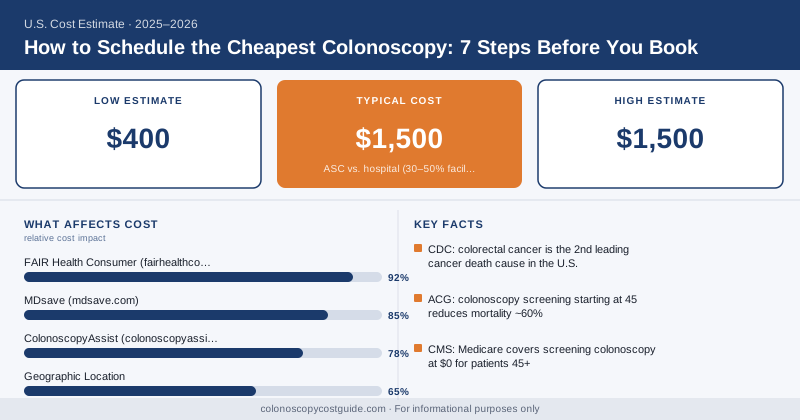
How to Schedule the Cheapest Colonoscopy: 7 Steps Before You Book
{ if eq .Lang "zh" }{ else }{ end }You’ve been putting off your colonoscopy partly because you’re not sure what it’ll cost — here’s how to know before you book, and how to make sure you’re getting the lowest price available to you.
Most patients schedule a colonoscopy the same way they schedule any appointment: their doctor refers them, a scheduler calls, they pick a date. That’s it. No price comparison, no facility check, no insurance verification. And then the bill arrives.
The patients who pay the least for their colonoscopy are the ones who spend 30–45 minutes doing homework before they ever commit to a date. These seven steps can realistically save you $500–$2,500 depending on your situation.
Step 1: Choose an ASC Over a Hospital
The single biggest controllable variable in colonoscopy cost is where you have it done. Ambulatory surgery centers (ASCs) charge 30–60% less in facility fees than hospital outpatient departments for the same procedure with the same physician.
A 2022 Health Affairs study found Medicare pays 2.3 times more for colonoscopies at hospital outpatient departments than at ASCs. That differential flows directly to insured patients paying coinsurance, and to self-pay patients who bear the full cost.
Ask your GI doctor: “Do you also perform colonoscopies at an ASC?” Many gastroenterologists work at both settings. If yours doesn’t, ask for a referral to a colleague who does. It’s worth the extra step.
Step 2: Confirm ALL Providers Are In-Network
This step is underestimated and trips up a surprising number of patients. A colonoscopy involves at least three separate billed entities: the facility, the GI physician, and the anesthesiologist (or CRNA). All three bill separately. All three need to be in-network with your insurance.
The anesthesia provider is the most common surprise. Hospitals and some ASCs contract with third-party anesthesia groups — and those groups often have different network status than the facility. Call your insurance company before booking and ask specifically: “If I have my colonoscopy at [facility name], will the anesthesia provider also be in-network?”
If the answer is unclear, ask the facility directly which anesthesia group they use, then call your insurer to verify that group’s network status. The No Surprises Act provides some protection here, but verifying in advance is easier than disputing a bill later.
Step 3: Ask About Direct-Access Scheduling
Many gastroenterologists offer “open-access” or “direct-access” colonoscopy scheduling — meaning you can book the procedure directly without a prior consultation visit. That skips a $150–$300 specialist office visit charge.
This approach is appropriate for average-risk patients without complex histories. You typically complete a health history questionnaire and bowel prep instructions are sent in advance. Not every practice offers this, and it’s not right for everyone — patients with complicated cardiac histories, prior difficult scopes, or active GI symptoms may genuinely need a pre-procedure consultation.
Ask when you call to schedule: “Do you offer direct-access colonoscopy scheduling for average-risk patients?” If yes, you’ve just saved a visit copay.
Step 4: Benchmark the Price Before You Commit
You don’t have to accept the first number you’re quoted. Check these resources first:
FAIR Health Consumer (fairhealthconsumer.org): Enter your zip code and CPT code 45378 (diagnostic colonoscopy) or 45380 (with biopsy) to see the range of fair and typical costs in your area for both insured and uninsured patients.
MDsave (mdsave.com): Lists colonoscopy packages at ASCs in your area with upfront bundled pricing. Often $900–$1,400 for a diagnostic scope at participating facilities.
ColonoscopyAssist (colonoscopyassist.com): A colonoscopy-specific platform connecting self-pay and high-deductible patients with ASCs offering direct-pay packages.
Having a benchmark number before you call a facility’s billing department gives you a genuine negotiating position.
Step 5: Ask for the Cash/Self-Pay Rate
If you’re uninsured or your deductible is so high that you’ll likely pay the full negotiated rate anyway, ask the billing department directly for the self-pay or cash rate. This is standard practice and there’s nothing awkward about requesting it.
Most hospitals and many ASCs have a published cash-pay discount — often 20–50% off billed charges. Some facilities will match competitor prices if you tell them what a nearby ASC quoted you.
For uninsured patients specifically, you’re also entitled to a Good Faith Estimate under the No Surprises Act before any scheduled service. Request one in writing before you confirm your appointment.
Script for Calling the Billing Department
Step 6: Use Your HSA or FSA
If you have a Health Savings Account (HSA) or Flexible Spending Account (FSA), colonoscopy costs are fully eligible expenses — facility fee, physician fee, anesthesia, pathology, and even the bowel prep prescription. You pay with pre-tax dollars, which reduces your effective cost by your marginal tax rate.
For someone in the 22% federal bracket, a $1,200 colonoscopy paid via HSA actually costs you about $936 in after-tax dollars. Not a massive difference, but free money is free money.
FSA users: watch the use-it-or-lose-it deadline. If your FSA year ends December 31 and you have an unmet balance, scheduling your colonoscopy before year-end uses that money before it evaporates.
Step 7: Schedule Before Year-End If Your Deductible Is Already Met
If you’ve already hit your annual deductible — because of other medical expenses earlier in the year — a colonoscopy scheduled before December 31 costs you only the coinsurance percentage (typically 10–20% of the negotiated rate). The same colonoscopy in January starts fresh against your full deductible.
For someone with a $2,000 deductible and 20% coinsurance who’s already met their deductible: a colonoscopy in November costs roughly $280–$400 (20% of a $1,400–$2,000 negotiated rate). The same procedure in January could cost $1,400–$2,000 (full deductible reset, plus coinsurance on any amount above it).
That’s a $1,000–$1,600 swing for doing nothing other than checking a calendar.
What You Can Realistically Save
| Optimization Applied | Estimated Savings |
|---|---|
| ASC vs. hospital (30–50% facility fee reduction) | $400–$1,500 |
| Skip pre-procedure consultation (direct access) | $150–$300 |
| Cash/self-pay discount if uninsured | $300–$800 |
| Timing procedure after deductible is met | $500–$2,000 |
| HSA/FSA pre-tax payment (22% bracket) | $200–$400 |
| All strategies combined (insured, high deductible) | $800–$2,500 |
The combination effect is real. Patients who choose an ASC, verify all providers are in-network, use direct-access scheduling, and time their procedure to post-deductible can reduce a $3,000 colonoscopy bill to under $500. That’s not a hypothetical — it’s a realistic outcome for a patient who does the work upfront.
For more on specific facility pricing, see ambulatory surgery center vs. hospital colonoscopy cost and colonoscopy all-inclusive package pricing.
{ if eq .Lang "zh" }