How to Reduce Colonoscopy Cost: 7 Strategies That Actually Work
{ if eq .Lang "zh" }{ else }{ end }A colonoscopy billed at $3,800 doesn’t mean you’ll pay $3,800. The gap between what the system charges and what you actually owe is one of the widest in all of healthcare — if you know where to look.
These seven strategies are concrete, actionable, and grounded in how healthcare billing actually works. They apply whether you have insurance or not.
Strategy 1: Choose a Freestanding Ambulatory Surgery Center
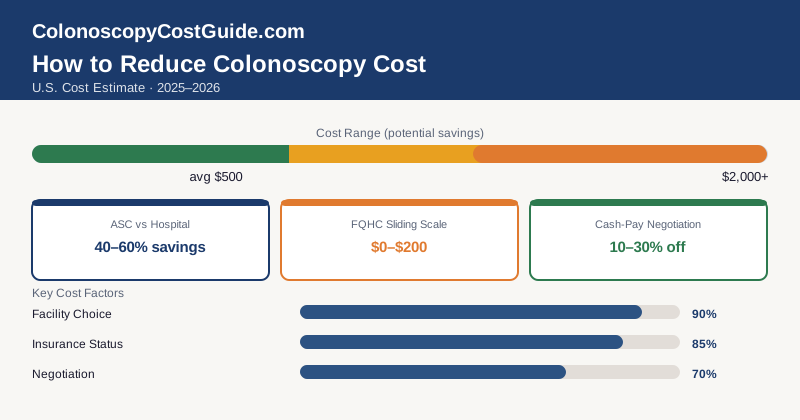
This is the single highest-impact cost decision for most patients. For the exact same procedure, freestanding ASCs charge 40–55% less than hospital outpatient departments. FAIR Health data shows the difference routinely exceeds $1,000 in allowed amounts for CPT 45378.
What to do:
- Ask your GI physician if they have privileges at a freestanding ASC
- Verify the ASC bills as an ASC, not as a hospital outpatient department
- Confirm both the facility and your GI physician are in-network at the ASC
See colonoscopy cost: hospital vs. surgery center for the full breakdown on why this gap exists.
Strategy 2: Use GoodRx for Your Prep Prescription
Colonoscopy prep prescriptions run $40 to $300+ at retail. GoodRx brings generic options down to $18–$35 in most markets. That’s a simple $20–$200 savings for 5 minutes on an app or website.
What to do:
- Search your specific prep medication at goodrx.com before going to the pharmacy
- Compare prices at multiple pharmacies — variance is significant
- Don’t use insurance if GoodRx is cheaper (you can’t combine them)
- Ask your GI physician if the Miralax + Gatorade split-dose OTC prep ($22–$28 total) is appropriate for you
For the full breakdown of every prep option and price, see colonoscopy prep cost.
Strategy 3: Ask for the Self-Pay Discount (Even If You Have Insurance)
This surprises people: if your insurance’s cost-sharing would be higher than a facility’s cash-pay rate, you can sometimes pay cash instead. This is most relevant when:
- Your deductible hasn’t been met and the colonoscopy will be coded as diagnostic
- Your plan’s allowed amount at a hospital is higher than what an ASC charges cash-pay
Call the ASC billing department and say: “I’m considering paying self-pay. What is your cash rate for CPT 45378?” Get the number, compare it to your insurance out-of-pocket estimate, and choose the lower one.
Note: If you use your insurance, that spending counts toward your deductible. If you pay cash, it doesn’t. Factor that in for the rest of the year.
The Self-Pay Request Script
“I’m a patient scheduled for a colonoscopy. I want to compare your self-pay rate against my insurance cost-sharing. What is your complete self-pay package for CPT 45378, including facility, physician, and anesthesia if applicable?”
Most facilities have a bundled cash rate that includes all these components. Get it in writing before your procedure. If they quote you the chargemaster price, push back: “I’d like your prompt-pay or self-pay discounted rate, please.”
Strategy 4: Verify Every Provider’s Network Status — Before Scheduling
Out-of-network billing is the fastest way to turn a managed cost into a surprise. Verify individually:
- The facility (ASC or hospital)
- Your gastroenterologist
- The anesthesiology group that covers that facility
- The pathology lab that processes specimens from that facility
Call your insurer with each provider’s NPI number — not their name — to confirm network status. Names can be ambiguous; NPIs are unique identifiers.
Strategy 5: Time Your Procedure After Your Deductible Is Met
If your deductible is $1,500 and you’ve already paid $1,400 this year from other medical expenses, a colonoscopy in October or November means you owe only the remaining $100 before hitting your deductible, then just your coinsurance. The same procedure in January means you might owe the full $1,500+ before insurance kicks in.
This applies only to diagnostic colonoscopies or screening colonoscopies that get reclassified. For a clean preventive screening, there’s no deductible — timing doesn’t matter.
The math only works if you genuinely have other medical spending that’s already drawing down your deductible. Don’t delay a medically necessary colonoscopy just to hit a calendar timing goal.
Strategy 6: Use Your HSA or FSA
If you have a Health Savings Account (HSA) or Flexible Spending Account (FSA), every colonoscopy-related expense is eligible: facility fees, physician fees, anesthesia, pathology, and prep medications. Using pre-tax dollars to pay these costs reduces the real cost by your marginal tax rate.
For someone in the 22% federal tax bracket, $500 in colonoscopy expenses costs $390 in real dollars when paid from an HSA. That’s a 22% discount with no negotiation required.
See colonoscopy HSA and FSA coverage for how to document expenses correctly and use your accounts most effectively.
Strategy 7: Check Federally Qualified Health Centers and Free Programs
FQHCs offer colonoscopy on a sliding fee scale based on income. The lowest fee tier — typically for patients under 100–200% of the federal poverty level — can bring your cost to $0 to $50.
The CDC’s Colorectal Cancer Control Program (CRCCP) funds colonoscopy and stool screening for low-income, uninsured and underinsured adults through community health centers in participating states. If you qualify, you may be eligible for a fully covered colonoscopy with no out-of-pocket cost.
To check availability:
- Search for an FQHC near you at findahealthcenter.hrsa.gov
- Ask the FQHC whether they perform colonoscopy on-site or refer to a partner facility
- Ask specifically about the CRCCP program if you’re low-income or uninsured
See free and low-cost colonoscopy for the full list of programs.
| Strategy | Potential Savings |
|---|---|
| Choose freestanding ASC vs. hospital | $500 – $1,500 |
| GoodRx on prep medication | $20 – $250 |
| Self-pay discount (if applicable) | $200 – $800 |
| Verify all providers are in-network | $0 – $1,200 (avoids surprise bills) |
| Time procedure after deductible met | $0 – $1,500 |
| Use HSA/FSA | 22–37% effective discount |
| FQHC / free programs | Up to 100% covered |
None of these strategies are complicated. Most take one phone call or one app search. Used together, they can drop a $2,500 expected bill to $400 — or to $0 if you qualify for FQHC or CRCCP coverage.
{ if eq .Lang "zh" }