How Often Do You Need a Colonoscopy? Guidelines by Age and Risk
Most people at average risk need a colonoscopy every 10 years, starting at age 45. That’s the guidance from both the American College of Gastroenterology (ACG) and the US Multi-Society Task Force on Colorectal Cancer (USMSTF) — and it’s the baseline everything else is measured against.
But your interval can shorten dramatically if your first colonoscopy finds anything unusual. Here’s what the guidelines actually say, and what that means for your lifetime cost.
The Standard 10-Year Interval (Average Risk)
You’re average risk if all of these apply:
- No personal history of colorectal cancer or polyps
- No family history of colorectal cancer in a first-degree relative before age 60
- No personal history of inflammatory bowel disease (Crohn’s or ulcerative colitis)
- No known hereditary colorectal cancer syndrome (Lynch syndrome, FAP)
For average-risk adults, the ACG recommends beginning screening at age 45 — lowered from 50 in 2021 to reflect CDC surveillance data showing rising rates of colorectal cancer in adults under 50. If your colonoscopy is normal, the next one isn’t needed for 10 years.
The USPSTF (US Preventive Services Task Force) aligned with this in 2021, issuing a Grade B recommendation for colorectal cancer screening starting at age 45.
| Risk Level | Recommended Interval | Starting Age |
|---|---|---|
| Average risk, normal colonoscopy | Every 10 years | 45 |
| Hyperplastic polyps only (small, distal) | Every 10 years | 45 |
| 1–2 small tubular adenomas (< 10mm) | Every 3–5 years | After finding |
| 3–4 small tubular adenomas | Every 3 years | After finding |
| 5+ adenomas, or any adenoma ≥ 10mm | Every 1–3 years | After finding |
| High-grade dysplasia or villous features | 1 year | After removal |
| Personal history of colorectal cancer | 1 year post-surgery | After treatment |
After Polyps: The 3–5 Year Window
If your colonoscopy finds one or two small tubular adenomas under 10mm and removes them, your GI physician will typically schedule your next colonoscopy in 3 years — though recent 2022 USMSTF guidance relaxed this to 3–5 years for low-risk findings (1–2 small tubular adenomas with no high-grade features).
This is where colonoscopy costs compound. A 3-year surveillance schedule instead of a 10-year screening schedule means roughly 3x the procedures over a lifetime. For a patient who pays $400 out of pocket per colonoscopy:
- 10-year schedule from age 45–75: ~3 colonoscopies = ~$1,200 lifetime
- 3-year schedule from age 45–75: ~10 colonoscopies = ~$4,000 lifetime
That’s not a reason to avoid colonoscopy — early detection is far cheaper than colorectal cancer treatment. But it’s useful context for lifetime healthcare planning.
What 'Surveillance' vs. 'Screening' Means for Your Insurance
A first colonoscopy for average-risk screening is covered 100% by most ACA-compliant plans. A surveillance colonoscopy — your follow-up after polyps — is not automatically preventive under all plans. Some insurers classify it as diagnostic, which means your deductible and copay apply.
Before your surveillance colonoscopy, call your insurer and ask: “Is a post-polypectomy surveillance colonoscopy covered as preventive or diagnostic under my plan?” The answer can mean the difference between $0 and $600+ out of pocket.
High-Risk Schedules
Several conditions push your colonoscopy interval well below 10 years:
Family history of colorectal cancer: If a first-degree relative (parent, sibling, child) was diagnosed under age 60, the ACG recommends starting screening at age 40 or 10 years before the relative’s diagnosis age — whichever is earlier. Interval: every 5 years.
Inflammatory bowel disease (IBD): Patients with long-standing ulcerative colitis or Crohn’s disease involving the colon need surveillance colonoscopies every 1–3 years starting 8 years after disease onset, according to ACG guidelines. UC and Crohn’s both increase colorectal cancer risk significantly.
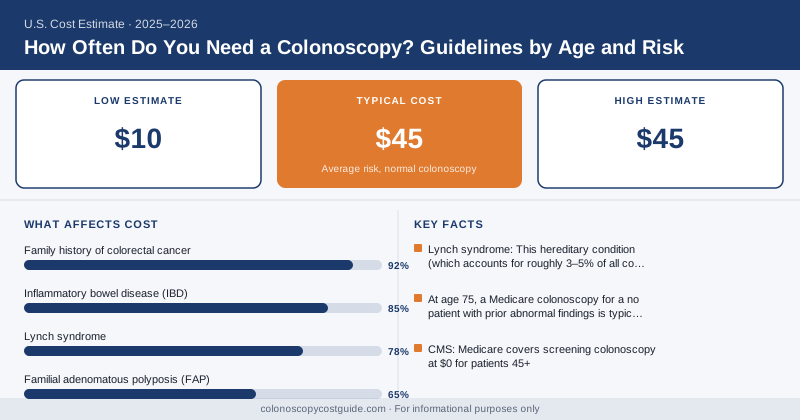
Lynch syndrome: This hereditary condition (which accounts for roughly 3–5% of all colorectal cancers, per CDC data) requires colonoscopy every 1–2 years starting at age 20–25.
Familial adenomatous polyposis (FAP): Annual sigmoidoscopy or colonoscopy beginning in the teenage years.
| Condition | Interval | Notes |
|---|---|---|
| Family history (1st-degree, dx < 60) | Every 5 years | Start at 40 or 10 yrs before relative’s dx |
| IBD (UC or Crohn’s, colon involved) | Every 1–3 years | After 8 years of disease |
| Lynch syndrome | Every 1–2 years | Start age 20–25 |
| FAP | Annually | Start in teens |
| Previous colorectal cancer | 1 year post-surgery, then per findings | — |
When Can You Stop?
The ACG and USMSTF generally recommend stopping routine colonoscopy screening at age 75 if the patient has had consistently normal results and average life expectancy. For patients 76–85, screening is an individual decision based on health status and prior findings. Above 85, routine screening is not recommended.
At age 75, a Medicare colonoscopy for a patient with no prior abnormal findings is typically covered at 100% under Medicare Part B for the screening indication.
The Cost Implications of Your Schedule
How often you need a colonoscopy matters a lot for planning. A normal screening colonoscopy every 10 years is relatively affordable over a lifetime. An annual surveillance schedule — which some high-risk patients need — can cost $400–$1,500 out of pocket per procedure depending on your plan.
If you’re on a surveillance schedule, ask your GI physician:
- What specific findings put me on this timeline?
- Could anything from a surveillance colonoscopy move me back to a longer interval?
- Would a Cologuard test between colonoscopies be appropriate for my risk profile?
For details on what colonoscopy cost by insurance type, see colonoscopy cost with insurance. For post-polyp cost planning, see colon polyp surveillance cost.