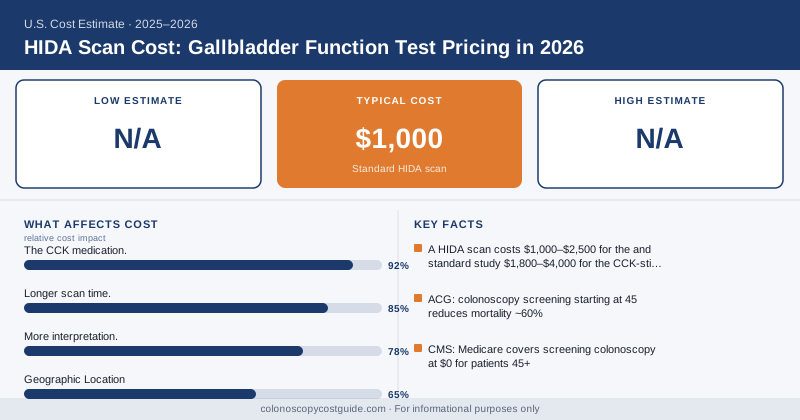
HIDA Scan Cost: Gallbladder Function Test Pricing in 2026
{ if eq .Lang "zh" }{ else }{ end }You’ve had right-sided belly pain after fatty meals, your ultrasound looked normal, and your doctor says you need a HIDA scan. The first question most people ask: what’s this going to cost? The answer is $1,000 to $4,000 without insurance — and the version you get matters.
A HIDA scan (hepatobiliary iminodiacetic acid scan) is a nuclear medicine study that watches bile flow from your liver through the gallbladder and into the small intestine. A small dose of radioactive tracer is injected, and a gamma camera tracks where it goes. It diagnoses gallbladder and bile-duct problems an ultrasound or scope can miss. Here’s the cost picture.
What a HIDA Scan Costs
The plain HIDA scan is cheaper; adding CCK (a hormone that makes the gallbladder contract so its ejection fraction can be measured) pushes the price up.
| Type | What It Adds | Typical Range (Uninsured) |
|---|---|---|
| Standard HIDA scan | Tracer + gamma camera imaging | $1,000 – $2,500 |
| HIDA with CCK stimulation | CCK drug + extended imaging | $1,800 – $4,000 |
| Radiologist / nuclear med interpretation | included or $150 – $400 | varies |
There’s no scope and no sedation here, which keeps it below a colonoscopy — but the radioactive tracer and gamma camera make it pricier than a plain X-ray-based test.
Why the CCK Version Costs More
- The CCK medication. This is the hormone analog (often sincalide) that triggers gallbladder contraction, and it’s an added drug charge.
- Longer scan time. Measuring the gallbladder ejection fraction means imaging before and after CCK, extending the study and the camera time.
- More interpretation. Calculating the ejection fraction percentage adds analysis the standard scan doesn’t require.
The CCK-stimulated study is what diagnoses biliary dyskinesia — a poorly functioning gallbladder that looks normal on ultrasound — so the extra cost often buys the actual answer.
What a HIDA Scan Diagnoses
HIDA scans answer biliary questions other tests can’t. Gallbladder disease is extraordinarily common — the National Institute of Diabetes and Digestive and Kidney Diseases (NIDDK) estimates that gallstones affect roughly 10–15% of U.S. adults. HIDA is used to:
- Confirm acute cholecystitis when the gallbladder won’t fill with tracer
- Measure gallbladder ejection fraction (the CCK version) for biliary dyskinesia
- Detect bile leaks after gallbladder surgery
- Assess bile-duct obstruction when other imaging is inconclusive
It’s frequently ordered after a normal ultrasound when symptoms strongly suggest a gallbladder problem.
Key Takeaway
Insurance Coverage
HIDA scans are covered when there’s a clear biliary indication — gallbladder pain, suspected cholecystitis, post-surgical leak, or inconclusive ultrasound. As a nuclear medicine imaging study, it bills under your imaging benefit, so cost-sharing is generally a copay plus coinsurance after the deductible.
Some advanced imaging requires prior authorization, so confirm with your plan. The full uninsured price still counts toward your deductible if you haven’t met it.
How It Fits Into a GI Workup
A HIDA scan usually follows an abdominal ultrasound that didn’t fully explain the symptoms. If a bile-duct stone or blockage is found, ERCP becomes the next step to actually treat it, and an endoscopic ultrasound can characterize duct and pancreatic problems in detail. For broader abdominal pain, an abdominal CT scan for GI issues covers more territory. HIDA’s niche is functional biliary information — how well the gallbladder and ducts are actually working — which the anatomy-focused tests can’t provide.
Bottom Line
A HIDA scan costs $1,000–$4,000 uninsured, with the CCK-stimulated ejection-fraction version on the higher end. It’s a non-invasive nuclear study that answers gallbladder and bile-duct questions ultrasound can’t, and insurance covers it for legitimate biliary symptoms. The biggest lever you control is the facility — prices at a free-standing center can be half a hospital’s. Make the call, confirm in-network status, and find out whether you need the standard or CCK version before you go.
{ if eq .Lang "zh" }