Hiatal Hernia Treatment Cost: From Medications to Surgery in 2025–2026
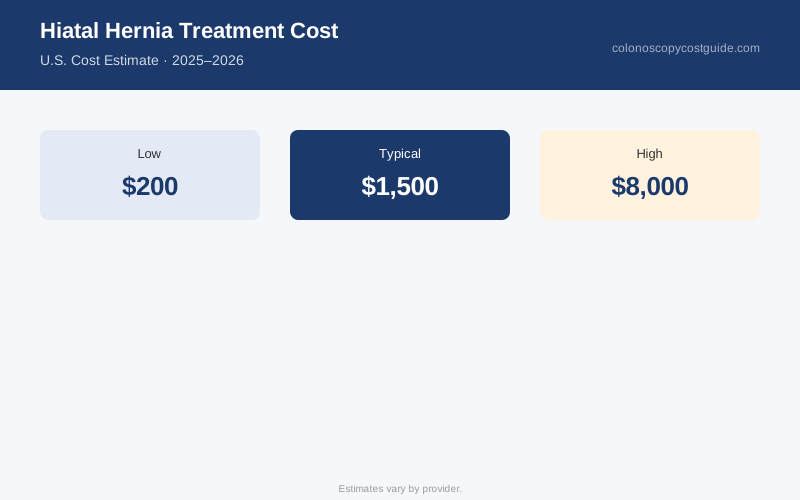
What does a hiatal hernia actually cost to treat? That depends entirely on whether it’s causing symptoms — and whether those symptoms respond to medication or require surgery. For most people, it’s a $20-a-month problem. For others, it’s a $20,000 surgery.
Here’s how to know which category you’re in, and what you’ll pay either way.
Two Types, Two Very Different Cost Profiles
A hiatal hernia occurs when part of the stomach pushes through the diaphragm into the chest. There are two main types:
Type I (Sliding hiatal hernia): Accounts for 95% of all hiatal hernias, according to the American College of Surgeons. Often asymptomatic. When symptomatic, it typically causes GERD (acid reflux). Treatment: medication, lifestyle changes. Surgery rarely needed.
Type II–IV (Paraesophageal hernias): Less common, more serious. Part of the stomach rolls up beside (rather than through) the esophageal opening. Can cause severe reflux, chest pain, difficulty swallowing, or emergency complications like gastric volvulus. Surgery is more often recommended.
The type you have determines whether you’re looking at $20/month in generic PPIs or a $15,000+ surgical repair.
Medical Management Costs (First-Line)
Most sliding hiatal hernias are managed non-surgically. The American Gastroenterological Association (AGA) recommends lifestyle modification plus proton pump inhibitor (PPI) therapy as the standard first approach.
| Treatment | Monthly Cost (Generic/OTC) |
|---|---|
| Omeprazole 20–40mg (OTC generic) | $10 – $20 |
| Pantoprazole 40mg (generic Rx) | $10 – $25 |
| Esomeprazole 40mg (generic Rx) | $15 – $40 |
| Lansoprazole 30mg (OTC generic) | $12 – $22 |
| H2 blockers (famotidine, generic) | $8 – $18 |
| Alginate antacids (Gaviscon) | $15 – $30 |
Annual medication cost for well-controlled GERD: $120–$360. Add GI office visits (1–2 per year at $200–$400 each) and you’re looking at $500–$1,200 annually for managed medical care.
Diagnostic Costs (When Surgery Is Considered)
If symptoms persist or surgery is being evaluated, your GI team or surgeon will order imaging to characterize the hernia.
| Diagnostic Test | Typical Cost (Uninsured) |
|---|---|
| Upper GI barium swallow (esophagram) | $300 – $900 |
| Upper endoscopy (EGD) | $800 – $3,500 |
| CT scan of chest/abdomen | $500 – $2,500 |
| Esophageal manometry | $500 – $1,500 |
| 24-hour pH monitoring (ambulatory) | $400 – $1,200 |
| Surgeon consultation | $200 – $500 |
A full pre-surgical workup typically runs $2,500–$8,000 uninsured. With insurance and a met deductible, out-of-pocket is usually $300–$1,500 depending on your plan.
Surgical Repair Costs
Laparoscopic fundoplication (most commonly Nissen fundoplication) is the standard surgical treatment for symptomatic hiatal hernias that don’t respond adequately to medication. The stomach is repositioned below the diaphragm and the upper portion is wrapped around the lower esophagus to recreate the anti-reflux barrier.
Laparoscopic Nissen fundoplication with hiatal hernia repair:
- Hospital-based outpatient or overnight stay: $12,000 – $25,000 total (facility + surgeon + anesthesia)
- Freestanding surgery center (if eligible): $8,000 – $15,000
- Surgeon fee alone: $2,000 – $5,000
- Anesthesia: $1,000 – $2,500
LINX magnetic sphincter augmentation (a newer alternative using a ring of magnetic beads):
- Device + implantation: $18,000 – $30,000
- FDA-approved; insurance coverage expanding but not universal
Robot-assisted repair (da Vinci):
- Typically adds $1,500 – $4,000 over standard laparoscopic costs
- Some data suggests faster recovery; less clear cost-benefit for straightforward cases
Insurance Coverage for Hiatal Hernia Surgery
Most major insurers — Medicare, Aetna, BCBS, Cigna, UnitedHealthcare — cover hiatal hernia repair when medically necessary. Coverage requirements typically include:
- Documentation of GERD symptoms for 6+ months
- Evidence of failed adequate PPI therapy (typically twice-daily dosing for 8–12 weeks)
- Objective confirmation of reflux via pH monitoring or impedance testing
- Endoscopic or imaging confirmation of the hernia
Medicare Part A covers inpatient surgical repair. Part B covers outpatient procedure costs — you pay the Part B deductible ($240 in 2025) plus 20% coinsurance. Total out-of-pocket for Medicare patients for outpatient laparoscopic repair: typically $1,500 – $4,000.
With commercial insurance (met deductible, typical surgical copay): $1,000 – $4,000 out of pocket.
The Watch-and-Wait Math
For asymptomatic paraesophageal hernias, guidelines have shifted toward watchful waiting in low-risk patients rather than elective repair. A 2015 study in JAMA Surgery found annual risk of acute paraesophageal hernia symptoms requiring emergency surgery is only 1.1% — low enough that elective surgery is not automatically warranted.
Watchful waiting means periodic imaging (CT every 2–3 years: $500–$2,500 each) and ongoing GI follow-up ($400–$800/year). Compare that to $15,000–$25,000 in elective surgery costs, and watchful waiting often makes financial sense for asymptomatic patients who are elderly or have surgical risk factors.
Questions to Ask Your Surgeon Before Booking Surgery
- Is this Type I (sliding) or Type II–IV (paraesophageal)?
- Am I a candidate for laparoscopic repair, or would this require open surgery?
- What are your personal outcomes data for this procedure?
- Have I truly failed adequate medical therapy, or should we adjust the medication approach first?
- Will the procedure be inpatient or outpatient? What facility are you using?
Finding Affordable Care
If you’re uninsured or under-insured:
- Community health center GI referrals can connect you with lower-cost specialists
- University surgical programs often perform laparoscopic fundoplication at lower rates than private hospitals
- Hospital financial assistance programs: most nonprofit hospitals have charity care covering patients at 200–400% of federal poverty level
For most people with a hiatal hernia, the real cost is a box of generic PPIs each month. If surgery enters the picture, understanding your insurance coverage and getting a second surgical opinion can save you thousands.