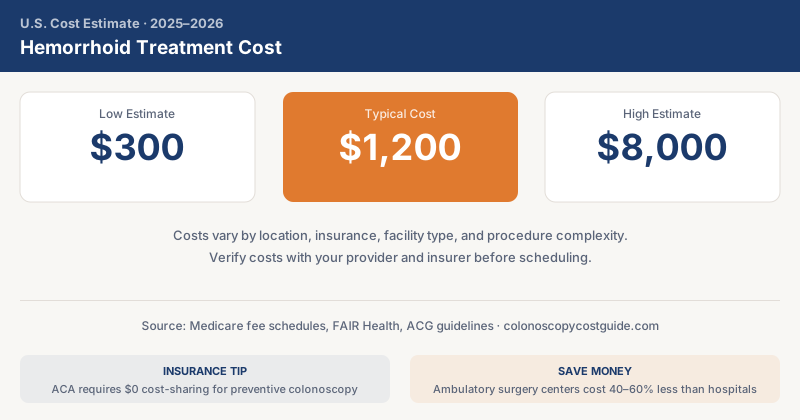
Hemorrhoid Treatment Cost: Banding, Sclerotherapy, and Surgery Prices
{ if eq .Lang "zh" }{ else }{ end }Myth: hemorrhoid surgery is your only option when hemorrhoids become a problem. Wrong. Most hemorrhoids respond to office-based procedures that cost a fraction of surgery — and many resolve with conservative treatment at home.
Hemorrhoids affect an estimated 75% of Americans at some point in their lives, according to the National Institute of Diabetes and Digestive and Kidney Diseases (NIDDK). Most don’t require anything beyond dietary changes, sitz baths, and over-the-counter creams. But for Grade III and Grade IV hemorrhoids — the ones that prolapse and don’t retract on their own — office-based procedures or surgery become necessary.
Here’s what each level of treatment actually costs.
At-Home and Conservative Treatment: $10 – $80
Before any medical procedure, most GI doctors and colorectal surgeons recommend a trial of:
- Stool softeners (Colace, Miralax): $12 to $20/month
- Sitz baths (warm water soaks): Free, or $20 to $40 for a sitz bath basin
- Topical OTC creams (Preparation H, Tucks): $15 to $30
- Increased dietary fiber: $15 to $25/month for psyllium supplements
This approach resolves most Grade I and Grade II hemorrhoids within 2 to 4 weeks. Total cost: $50 to $100 for supplies.
Office-Based Procedures: $500 – $2,500
For internal hemorrhoids that don’t respond to conservative treatment, several in-office procedures are available:
Rubber Band Ligation (Banding)
The most common office procedure for internal hemorrhoids. A small rubber band is placed at the base of the hemorrhoid, cutting off its blood supply. The tissue dies and falls off in 7 to 10 days.
Cost: $500 to $1,500 per session. Multiple sessions are often needed (most practices treat one to two hemorrhoids per session).
CPT code: 46221 (rubber band ligation, single; additional codes for each additional)
Insurance coverage: Typically covered when medically necessary (Grade II–III hemorrhoids documented). Prior authorization may be required. Patient owes deductible + coinsurance.
Sclerotherapy (Injection Therapy)
A chemical solution is injected into the hemorrhoid tissue, causing it to shrink. Less commonly used than banding in the US. Generally reserved for patients on blood thinners who aren’t candidates for banding.
Cost: $400 to $1,200 per session
CPT code: 46500
Insurance coverage: Generally covered when medically indicated.
Infrared Coagulation (IRC)
A beam of infrared light cauterizes the blood supply to the hemorrhoid. Quick and nearly painless. Less effective than banding for larger hemorrhoids.
Cost: $400 to $1,200 per session
CPT code: 46930
| Procedure | CPT Code | Typical Total Cost | Insurance Coverage |
|---|---|---|---|
| Rubber band ligation | 46221 | $500 – $1,500 | Usually covered |
| Sclerotherapy | 46500 | $400 – $1,200 | Usually covered |
| Infrared coagulation | 46930 | $400 – $1,200 | Usually covered |
| Cryotherapy | 46999 | $300 – $900 | Limited coverage |
Hemorrhoidectomy Surgery: $3,000 – $8,000+
Hemorrhoidectomy — surgical removal of hemorrhoids — is reserved for Grade III and IV hemorrhoids that don’t respond to office procedures, or for patients with multiple symptomatic hemorrhoids.
This is a same-day surgical procedure performed under anesthesia in an ASC or hospital operating room. Recovery is typically 2 to 4 weeks, and it’s considered one of the more painful recoveries in elective colorectal surgery.
| Cost Component | Typical Range |
|---|---|
| Facility fee (ASC) | $1,500 – $3,500 |
| Facility fee (hospital OR) | $2,500 – $5,000 |
| Colorectal surgeon fee | $1,000 – $2,500 |
| Anesthesia | $400 – $1,200 |
| Total (ASC) | $3,000 – $6,500 |
| Total (hospital) | $4,500 – $9,000 |
CPT code: 46260 (hemorrhoidectomy, internal and external, complex) or 46255 (hemorrhoidectomy, internal and external, simple)
Insurance coverage for hemorrhoidectomy is generally strong when Grade III or IV disease is documented and conservative therapy has failed. Most insurers require documentation of prior conservative treatment before authorizing surgery.
Stapled Hemorrhoidopexy: A Newer Surgical Option
Insurance Coverage: What to Expect
Most insurance plans cover hemorrhoid procedures when they’re medically necessary — meaning the hemorrhoids are symptomatic (bleeding, prolapse, pain) and conservative measures have been tried first. “Cosmetic” or elective hemorrhoid treatment is not covered.
Documentation matters. Your provider needs to document:
- Hemorrhoid grade and symptoms
- Trial of conservative measures (diet, sitz baths, OTC treatments) and duration
- Failure to improve with conservative care
- Clinical indication for the specific procedure recommended
The Colonoscopy Connection
Rectal bleeding is the symptom most people assume is hemorrhoids — but it can also be a sign of colorectal cancer or polyps. The ACG guidelines recommend that rectal bleeding in adults over 45, or in any adult with a family history of colorectal cancer, be evaluated with colonoscopy before attributing symptoms to hemorrhoids.
If you’re treating rectal bleeding and haven’t had a colonoscopy cost workup to rule out more serious pathology, talk to your doctor. Treating hemorrhoids when the bleeding is actually from a polyp or cancer means missing a critical window for early detection.
For most people, hemorrhoids aren’t dangerous — but the symptom of rectal bleeding warrants a thorough evaluation regardless of what you suspect the cause is.
{ if eq .Lang "zh" }