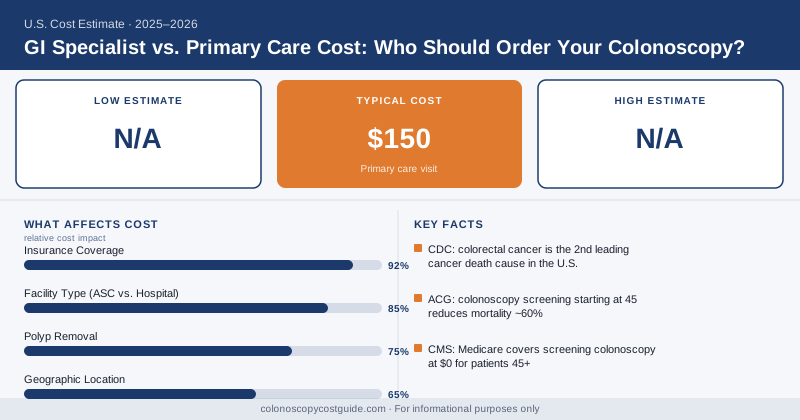
GI Specialist vs. Primary Care Cost: Who Should Order Your Colonoscopy?
{ if eq .Lang "zh" }{ else }{ end }Most patients assume they need to see a gastroenterologist before a colonoscopy. For routine screening, that’s often wrong — and that mistaken assumption can add a $250-to-$500 specialist consult fee you didn’t need to pay.
Who orders your colonoscopy affects your bill before the scope is even scheduled. The two common paths — through your primary care physician or through a GI specialist — carry different upfront costs. Here’s how to pick the cheaper one without cutting a corner that matters.
The Consult Cost Difference
| Path | Typical Visit Cost | When It Applies |
|---|---|---|
| Primary care visit | $150 – $300 | Average-risk screening, no symptoms |
| GI specialist consult | $250 – $500 | Symptoms, history, complex cases |
| Direct-access scheduling | $0 extra consult | Some systems skip the consult entirely |
The cheapest route is often “direct access” or “open access” colonoscopy, where your primary care doctor refers you straight to the procedure with no separate specialist visit. That eliminates an entire consult fee. Many U.S. health systems offer this for average-risk patients specifically to reduce cost and wait time.
Key Takeaway
Why the Path Matters Beyond the Consult Fee
The consult fee isn’t the only cost in play. How your visit is coded affects whether the colonoscopy itself is billed as preventive or diagnostic. The U.S. Preventive Services Task Force recommends routine screening starting at age 45 for average-risk adults, and that screening is covered at $0 under ACA preventive rules. If you walk into a GI specialist describing symptoms, the visit and the resulting colonoscopy may be coded diagnostic instead — which can trigger cost-sharing you’d have avoided with a clean preventive referral.
So for a truly average-risk, symptom-free screening, the primary care path tends to be both cheaper and more likely to preserve the $0 preventive coding. Our colonoscopy cost guide explains how preventive versus diagnostic billing changes your total.
When the GI Specialist Is Worth It
Don’t skip the specialist to save money if your situation calls for one. A GI consult earns its fee when you have:
- Symptoms like rectal bleeding, persistent changes in bowel habits, or unexplained anemia
- Family history of colorectal cancer or polyps
- Prior polyps requiring surveillance
- Inflammatory bowel disease or other complex GI history
In these cases, the ACS notes that proper risk assessment changes the screening interval and approach. A specialist’s upfront evaluation can prevent a misordered or miscoded procedure that costs far more to fix later.
How to Choose Without Overpaying
- If you’re average risk with no symptoms, ask your primary care doctor about open-access colonoscopy referral.
- If your PCP offers direct scheduling, take it — you skip the specialist consult fee.
- If you have symptoms or risk factors, see the GI specialist; the consult is worth it.
- Either way, confirm the colonoscopy’s billing code so a screening doesn’t get coded diagnostic by accident.
For more on protecting that preventive coding, see our how to lower your colonoscopy bill guide, and if you’re uninsured, our colonoscopy cost without insurance page.
The Bottom Line
For routine screening, let your primary care doctor order the colonoscopy — ideally through open-access scheduling — and save the $250-to-$500 GI consult for when symptoms or history actually warrant it. The right referral path saves you a consult fee and helps keep your screening coded as free preventive care. To understand the procedure costs behind that referral, read our colonoscopy cost breakdown.
{ if eq .Lang "zh" }