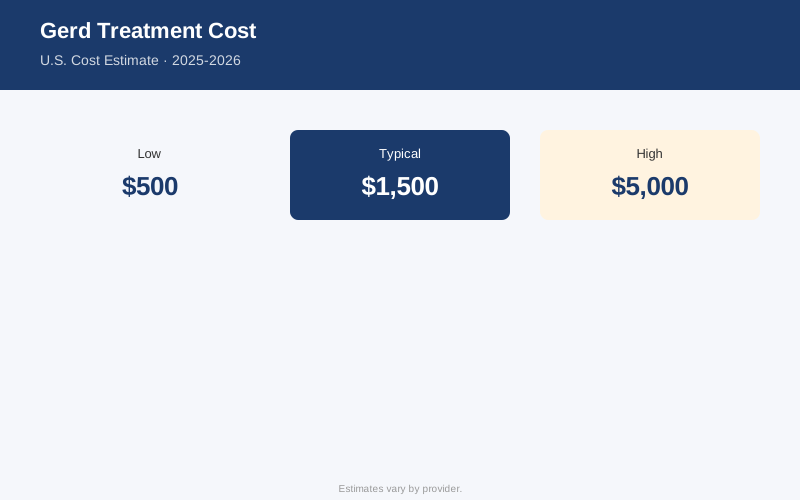
GERD Treatment Cost: PPIs, Procedures, and Surgery Prices
Most people assume GERD is just heartburn — pop an antacid and move on. But the American College of Gastroenterology (ACG) estimates that 20% of Americans experience GERD symptoms at least weekly, and for a significant portion, basic antacids don’t cut it. When GERD escalates from occasional discomfort to a chronic condition requiring prescription meds, endoscopy, or surgery, costs climb fast — from $10/month to $15,000 or more.
Here’s a realistic breakdown of what GERD treatment actually costs at each level of severity.
GERD Treatment: The Cost Ladder
GERD is treated progressively. You start with the cheapest interventions and escalate only if symptoms persist or complications develop.
| Treatment Level | Typical Cash Cost | Notes |
|---|---|---|
| Lifestyle changes only | $0 – $50 | Diet changes, elevating head of bed, weight loss |
| OTC antacids (Tums, Rolaids) | $5 – $15/month | Symptomatic relief only |
| OTC H2 blocker (famotidine/Pepcid) | $10 – $25/month | Reduces acid production; good for mild GERD |
| OTC PPI (omeprazole/Prilosec 28-day) | $10 – $30/month | Most effective medication class for GERD |
| Prescription PPI (esomeprazole, pantoprazole) | $15 – $300/month | Generic vs. brand makes a huge difference |
| GI specialist office visit | $200 – $600 | Initial evaluation or follow-up |
| Upper endoscopy (EGD) diagnostic | $800 – $3,500 | Checks for esophagitis, Barrett’s, strictures |
| pH monitoring (ambulatory, 24-hour) | $600 – $2,500 | Confirms GERD diagnosis, measures acid exposure |
| Bravo pH capsule test | $1,000 – $3,500 | 48–96 hour wireless monitoring |
| LINX procedure | $8,000 – $20,000 | Minimally invasive magnetic sphincter augmentation |
| Nissen fundoplication (laparoscopic) | $10,000 – $25,000 | Surgical gold standard; highly effective |
| TIF (transoral incisionless fundoplication) | $7,000 – $18,000 | Endoscopic, no incisions; newer technique |
The Real Cost Driver: Prescription PPIs
For most GERD patients, the long-term cost is dominated by prescription proton pump inhibitors. The variance here is enormous:
- Generic omeprazole (OTC, 42-cap): ~$15 at Walmart or Costco — one of the best values in American pharmacy
- Generic esomeprazole or pantoprazole (Rx): $15–$40/month with GoodRx
- Brand-name Nexium or Dexilant: $200–$350/month without insurance — the same active molecules, dramatically marked up
If you’re paying full price for brand-name PPIs, you’re almost certainly overpaying. The ACG’s own guidelines state that generic PPIs are therapeutically equivalent to brands for most patients. Ask your GI doctor before assuming the expensive version is necessary.
When Does GERD Require Endoscopy?
An upper endoscopy (EGD) is indicated for GERD patients with:
- Symptoms that don’t respond to 8 weeks of PPI therapy
- “Alarm symptoms”: difficulty swallowing, unexplained weight loss, vomiting blood, or dark stools
- Age 50+ with longstanding symptoms (screening for Barrett’s esophagus)
- Prior Barrett’s esophagus requiring surveillance
The EGD itself is an outpatient procedure, typically 15–30 minutes. At a hospital outpatient department, cash prices run $1,500–$3,500. At an ambulatory surgery center, expect $800–$2,000. If biopsies are taken (to check for Barrett’s or esophagitis), add $300–$600 in pathology fees.
Barrett's Esophagus: The Surveillance Cost You Need to Budget For
If your endoscopy reveals Barrett’s esophagus — a pre-cancerous change in the esophageal lining affecting an estimated 5.6% of American adults per ACG data — you’ll need surveillance endoscopies every 1–5 years depending on dysplasia grade.
- No dysplasia: every 3–5 years ($800–$3,500 per procedure)
- Low-grade dysplasia: every 6–12 months, or ablation therapy
- High-grade dysplasia: radiofrequency ablation or endoscopic resection, $3,000–$8,000 per session
Barrett’s surveillance is covered by insurance as diagnostic (not preventive), so deductibles and coinsurance apply. Budget for it as a recurring cost if it applies to you.
Surgical GERD Treatment: When Medication Isn’t Enough
About 20–30% of GERD patients don’t get adequate symptom relief from medications, or they prefer not to take lifelong PPIs. For them, surgical or procedural options exist:
Laparoscopic Nissen fundoplication is the gold standard. The surgeon wraps the top of the stomach around the lower esophagus to strengthen the valve. It’s performed under general anesthesia, typically a 1–2 night hospital stay. GERD symptoms resolve in 85–90% of patients long-term. Cash cost: $10,000–$25,000. With commercial insurance post-deductible: $2,000–$6,000.
LINX procedure implants a magnetic bead bracelet around the lower esophagus to prevent reflux while still allowing swallowing. It’s FDA-approved and less invasive than fundoplication. Cash cost: $8,000–$20,000.
TIF (transoral incisionless fundoplication) is performed entirely through the mouth — no external incisions. Results are good for patients with moderate GERD and small hiatal hernias. Cash cost: $7,000–$18,000.
Does Insurance Cover GERD Treatment?
Yes — all clinically indicated treatments are covered, but what you pay depends on the level:
- PPIs: Almost always Tier 1 or 2 on formularies. With insurance, generic PPIs often cost $0–$15/month.
- EGD: Covered as a diagnostic procedure when medically indicated. You’ll pay deductible/coinsurance — typically $200–$800 with average commercial insurance.
- Surgery: Covered when conservative treatment has failed and is documented. Pre-authorization required. Plan for $1,000–$5,000 out of pocket depending on your deductible and plan design.
Total Cost by Severity Scenario
| Patient Scenario | Estimated Annual Cost |
|---|---|
| Mild GERD, managed with OTC omeprazole | $120 – $360/year |
| Moderate GERD, Rx PPI + annual GI visit | $400 – $1,500/year |
| GERD with EGD (diagnostic) + PPI management | $1,500 – $5,000 (year 1), $400–$800 ongoing |
| GERD with Barrett’s, surveillance endoscopies | $2,000 – $5,000 every 3–5 years |
| GERD requiring fundoplication surgery | $10,000 – $25,000 cash; $2,000 – $6,000 insured |
How to Control GERD Costs
- Generic OTC omeprazole first. If you haven’t tried a full 8-week course of OTC omeprazole 20mg daily, start there before booking a GI appointment. It costs under $15/month and works for the majority of GERD patients.
- Ask your GI for generic Rx PPIs. Pantoprazole and esomeprazole generics are therapeutically equivalent to brands and cost $15–$40/month vs. $200–$350 for brand.
- Don’t skip the lifestyle interventions. Losing 10% of body weight, eliminating alcohol, avoiding eating 3 hours before bed, and elevating your bed head can reduce GERD severity enough to lower or eliminate medication needs.
- Use your HSA/FSA. All GERD medications — including OTC PPIs — are HSA/FSA eligible under current IRS guidance.
- If surgery is likely, compare surgical centers. An ASC for TIF or LINX can be significantly cheaper than a hospital setting.
GERD is highly manageable and doesn’t have to be expensive. The key is matching your treatment intensity to your actual symptom severity — and not skipping straight to expensive testing when cheaper options haven’t been tried.