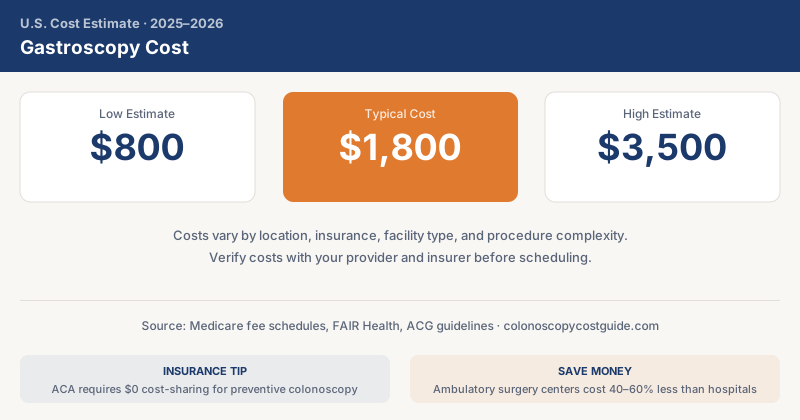
Gastroscopy Cost: What You'll Pay for an Upper GI Scope in 2025–2026
{ if eq .Lang "zh" }{ else }{ end }“Gastroscopy” is the term your doctor might use. Your insurance company calls it an “upper GI endoscopy” or “EGD.” The CPT code is 43235 or 43239. The bill reads differently depending on who’s sending it and what they found.
Gastroscopy — the examination of the esophagus, stomach, and upper small intestine with a flexible scope — is one of the most commonly performed GI procedures in the US. The ASGE estimates approximately 7 million upper GI endoscopies are performed annually in the United States. Most are straightforward diagnostic procedures with a predictable cost range. But “predictable” doesn’t mean “cheap.”
What Gastroscopy Costs in 2025–2026
| Facility Type | Facility Fee | Physician Fee | Anesthesia | Total |
|---|---|---|---|---|
| Freestanding GI center / ASC | $400 – $900 | $200 – $450 | $250 – $600 | $850 – $1,950 |
| Hospital outpatient | $800 – $2,200 | $200 – $450 | $300 – $800 | $1,300 – $3,450 |
| Academic medical center | $1,000 – $2,800 | $300 – $600 | $400 – $900 | $1,700 – $4,300 |
The variation is primarily driven by the facility setting. The procedure itself — a gastroenterologist threading a scope down your throat and examining your stomach — is the same regardless of whether it happens at a freestanding ASC or a hospital. The overhead charges around it are not.
FAIR Health data for 2024 shows the 50th percentile billed charge for CPT 43239 (gastroscopy with biopsy) at a hospital outpatient department runs approximately $2,100 to $2,600 nationally, before any insurance adjustments.
When Insurance Covers Gastroscopy
Gastroscopy doesn’t have a preventive benefit the way colonoscopy does. It’s covered as a medically necessary diagnostic procedure — meaning you need a documented clinical reason that justifies it.
Common insurance-covered indications:
- GERD / acid reflux: Persistent symptoms not responding to medication, evaluation for Barrett’s esophagus
- Dysphagia: Difficulty swallowing, especially if progressive
- Upper GI bleeding: Hematemesis (vomiting blood), coffee-ground emesis, melena (black stool)
- Unexplained anemia: Iron-deficiency anemia without clear cause
- Peptic ulcer disease: Confirmation or monitoring
- Chronic nausea and vomiting: When cause is not identified by other means
- Surveillance for Barrett’s esophagus: Every 3 to 5 years depending on grade
If your indication is on this list and documented in your chart, your insurer will typically cover the procedure subject to your normal deductible and coinsurance.
Prior Authorization: When You Need It
Medicare Coverage for Gastroscopy
Medicare Part B covers gastroscopy as a medically necessary service when the clinical indication is documented. The beneficiary pays:
- Part B deductible (if not yet met for the year): $257 in 2025
- 20% coinsurance on the Medicare-approved amount
Medicare’s approved amount for CPT 43239 (gastroscopy with biopsy) at an ASC is approximately $380 to $450 for the facility component plus $200 to $250 for the physician component — so the total Medicare-approved amount runs roughly $580 to $700. The beneficiary’s 20% share is approximately $116 to $140 (plus deductible if applicable).
At hospital outpatient rates, Medicare’s approved amounts are higher — facility alone is approximately $700 to $1,100 — meaning your 20% share increases to $140 to $220.
Medicare does cover Barrett’s esophagus surveillance gastroscopy as medically necessary at standard Part B cost-sharing rates. The surveillance interval (every 3 to 5 years for non-dysplastic Barrett’s, more frequently for dysplastic) is supported by Medicare coverage guidelines.
Cash Pay and Uninsured Pricing
If you’re paying out of pocket, here’s what to expect and how to approach the conversation:
| Setting | Typical Cash Price Range | Negotiated Rate with Ask |
|---|---|---|
| Freestanding ASC (no ask) | $1,200 – $1,800 | N/A |
| Freestanding ASC (cash-pay ask) | $700 – $1,200 | Often 30–40% off list |
| Hospital outpatient | $1,800 – $3,500 | 10–30% off list (harder to negotiate) |
| FQHC (sliding scale) | $0 – $300 | Income-based |
The self-pay rate at a freestanding GI center is your best starting point. Call directly, ask for “your self-pay or cash-pay rate for a gastroscopy,” and offer to pay in full upfront. Most scheduling staff have authority to offer a 20 to 40% discount from the standard self-pay rate for upfront payment.
For a broader comparison of cash prices across all endoscopy procedures, see endoscopy cost without insurance.
Common Reasons Gastroscopy Is More Expensive Than Expected
Biopsies taken: Any tissue sample adds pathology charges — typically $150 to $350 per specimen. If your doctor biopsied for H. pylori and also took samples from two esophageal locations, that’s three specimens and three pathology bills. See endoscopy biopsy cost for the full breakdown.
Therapeutic procedures during the scope: Esophageal dilation, removal of polyps, control of bleeding — each adds to the procedure code complexity and cost.
Hospital setting: Choosing a hospital over a freestanding ASC for a routine gastroscopy can add $800 to $1,500 to the facility fee alone.