Gallstones Treatment Cost: From Watchful Waiting to Surgery in 2026
{ if eq .Lang "zh" }{ else }{ end }About 1 in 10 American adults has gallstones, according to the NIDDK, and most of them will never feel a thing. That’s the strange part about gallstones. You can carry them for decades and pay nothing, or you can end up in the ER at 2 a.m. facing a $20,000 surgery. The difference comes down to whether they start causing trouble.
Let’s walk through what each scenario costs.
The “do nothing” option (and why it’s often right)
If your gallstones are silent, found by accident on an ultrasound for something else, the standard medical advice is often to leave them alone. No treatment, no surgery, no cost beyond the occasional check. Roughly 80 percent of people with gallstones never develop symptoms, so doctors don’t operate just because stones exist.
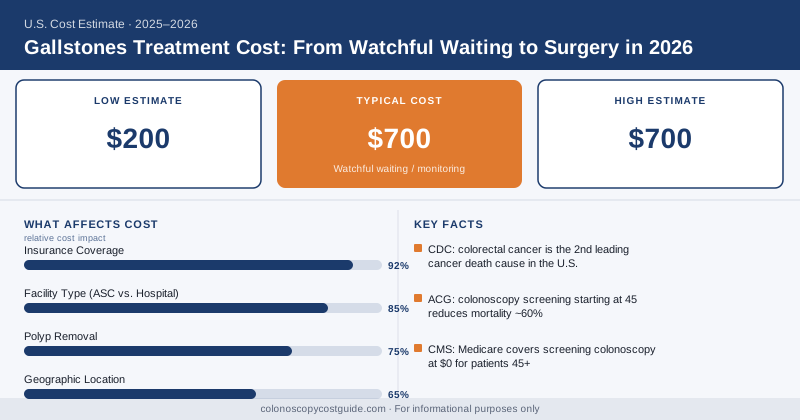
That makes watchful waiting the cheapest “treatment” on the list. Your only cost is the imaging that found them, usually an abdominal ultrasound running $200 to $700 uninsured.
When treatment becomes necessary
Once gallstones cause pain, inflammation, or block a duct, the math changes fast.
| Treatment | Cost (Uninsured) | With Insurance |
|---|---|---|
| Watchful waiting / monitoring | $0 – $700/yr | $0 – $200/yr |
| Diagnostic ultrasound | $200 – $700 | $50 – $200 |
| Oral dissolution medication | $50 – $300/mo | $10 – $80/mo |
| Laparoscopic gallbladder removal | $8,000 – $17,000 | $1,500 – $5,000 |
| Open gallbladder surgery | $12,000 – $20,000+ | $2,500 – $6,000 |
| ERCP for blocked duct | $3,000 – $15,000 | $800 – $3,500 |
Surgery: the most common real treatment
When gallstones cause repeated attacks, surgery to remove the gallbladder is the go-to fix. The CDC and surgical data show cholecystectomy is one of the most common operations in the U.S., with hundreds of thousands performed yearly. Most are done laparoscopically, which is cheaper and has a faster recovery than open surgery.
We’ve got a full breakdown of the operation itself in our gallbladder removal cost guide, but the short version: expect $8,000 to $17,000 uninsured, or $1,500 to $5,000 out of pocket with coverage.
Key Takeaway
Dissolution medication: cheaper but slow
For people who can’t have surgery, oral bile acid medications can slowly dissolve certain cholesterol stones. The catch? It only works on small, non-calcified stones, takes 6 to 24 months, and stones often come back after you stop. At $50 to $300 a month, the cumulative cost can rival surgery, and it’s far less reliable.
When a stone blocks a duct
If a gallstone escapes into the common bile duct, you’ve got a more serious, more expensive problem. This often requires an ERCP to retrieve the stone, and sometimes triggers pancreatitis, which adds hospital costs of its own.
How to lower your gallstone costs
- Choose an outpatient surgery center over a hospital when your case is uncomplicated.
- Ask for a cash or self-pay rate if you’re uninsured. Many facilities discount 30 to 50 percent.
- Get itemized quotes before scheduling, surgeon, facility, and anesthesia are billed separately.
- Confirm it’s truly needed. Silent stones rarely require treatment, so a second opinion can save you a whole surgery.
The bottom line
Gallstones are unique in that the right treatment is often no treatment at all. If yours are silent, you may pay nothing for years. But once they cause symptoms, surgery is usually the answer, and that means $1,500 to $6,000 out of pocket with insurance, or $8,000 to $20,000 without. Knowing whether you actually need treatment is the first and most valuable cost-saving step.
{ if eq .Lang "zh" }