Gallbladder Removal (Cholecystectomy) Cost: Surgery Prices Explained
Gallbladder surgery is one of the most commonly performed abdominal operations in the United States — approximately 1.2 million cholecystectomies are performed annually, according to data from the American College of Surgeons. If you’ve been told you need your gallbladder out, you’re in well-trodden territory. The question is what it’s going to cost you.
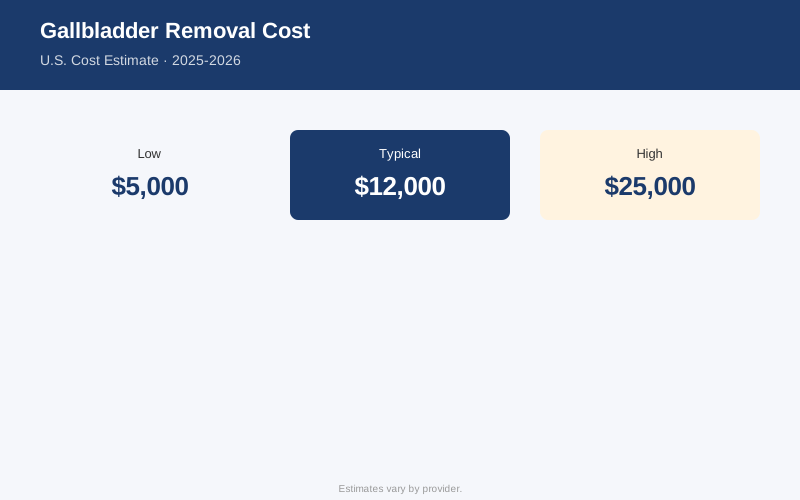
The range is wide: $3,500 to $20,000+ depending on whether you’re going to a hospital or an ambulatory surgery center, whether complications arise, and what your insurance covers. Here’s the full picture.
Surgery Type and Costs
| Procedure | Setting | Typical Cash Cost | Notes |
|---|---|---|---|
| Laparoscopic cholecystectomy | Ambulatory surgery center | $3,500 – $9,000 | Outpatient; most common; 3–4 small incisions |
| Laparoscopic cholecystectomy | Hospital outpatient | $7,000 – $15,000 | Same procedure, higher facility fees |
| Laparoscopic cholecystectomy | Hospital inpatient | $10,000 – $20,000+ | Required if complications; overnight stay |
| Open cholecystectomy | Hospital inpatient | $15,000 – $30,000 | For complex cases, scar tissue, or conversion |
| Robotic-assisted cholecystectomy | Hospital or ASC | $8,000 – $18,000 | No proven advantage over standard laparoscopic |
What’s Included in the Price (and What Isn’t)
The cholecystectomy price quote you receive typically includes:
- Surgeon’s fee
- Facility fee (ASC or hospital OR)
- Anesthesia (sometimes separate — see below)
What may NOT be included:
- Pre-operative testing: CBC, metabolic panel, EKG, chest X-ray — $200–$600
- Imaging: Abdominal ultrasound ($200–$600), HIDA scan ($500–$1,200), CT scan ($500–$1,500) for diagnosis before surgery
- Anesthesiologist fee: Often a separate bill; $400–$1,200 for a laparoscopic case
- Pathology: The removed gallbladder is typically sent for pathological examination — $100–$300 additional
- Post-operative follow-up visit: $150–$400
Factor these into your total when comparing quotes. An ASC quote of $5,000 for the surgery itself may be $6,500–$7,500 all-in with ancillary costs.
Elective vs. Emergency Surgery: The Cost Difference
This distinction matters enormously:
Elective surgery (scheduled when you’re symptom-free between attacks): You can comparison-shop, use an ASC, and negotiate. This is the financially smart approach when your surgeon and GI doctor agree the surgery can wait.
Emergency surgery (acute cholecystitis with fever, severe pain, or perforation risk): You’re going to whatever hospital treats you. Emergency inpatient cholecystectomy commonly results in a 1–3 night stay, adding $1,500–$4,000 per night in hospital room fees. The total bill for emergency laparoscopic cholecystectomy with a 2-night stay often runs $18,000–$35,000 before insurance.
The ASC Advantage: Real Numbers
For an elective laparoscopic cholecystectomy, choosing an ambulatory surgery center over a hospital outpatient department can save $4,000–$10,000 in facility fees alone.
According to FAIR Health data, the average facility fee for laparoscopic cholecystectomy at a hospital outpatient department in 2024 was approximately $9,800, compared to $4,200 at an ASC.
The procedure itself is identical. Recovery outcomes for uncomplicated laparoscopic cholecystectomy at an ASC are equivalent to hospital outcomes. Most general surgeons have ASC privileges. If your surgeon doesn’t, ask if they can refer you to a colleague who does.
What Insurance Covers
Cholecystectomy is covered by all commercial insurance, Medicare, and Medicaid when medically indicated (symptomatic gallstones, acute cholecystitis, choledocholithiasis, etc.).
Commercial insurance: You’ll pay toward your deductible plus coinsurance. For a patient with a $3,000 deductible and 20% coinsurance up to a $6,000 out-of-pocket max, the total exposure for an elective laparoscopic cholecystectomy is usually $3,000–$5,000. Once your OOP max is hit, the rest is covered at 100%.
Medicare: Part A covers inpatient hospitalization. Part B covers outpatient surgery including at ASCs. For a laparoscopic cholecystectomy at a Medicare-participating ASC, you’d pay 20% coinsurance under Part B after the deductible — typically $400–$900 total.
Medicaid: Covers cholecystectomy at Medicaid-participating facilities. Cost-sharing is minimal (often $1–$4 per service depending on the state).
Costs Without Insurance
If you’re uninsured, the self-pay cholecystectomy market has evolved significantly. Options:
Negotiated cash pay with a surgeon and ASC: Many ASCs offer bundled cash prices for uninsured patients. Bundled all-inclusive rates (surgeon + facility + anesthesia) for laparoscopic cholecystectomy at an ASC run $4,500–$8,000 in most markets. Ask specifically for the “self-pay bundled rate” — the sticker price and the cash rate are very different.
Surgery centers that specialize in uninsured patients: Some ASCs have formal self-pay programs with transparent pricing. Shopping Networks like Surgery Center of Oklahoma or regional equivalents post their prices publicly.
Medical bill negotiation: If you’ve already received hospital bills, you can negotiate. Hospitals commonly reduce bills by 30–60% for uninsured or underinsured patients who ask. Request an itemized bill first, then engage the financial assistance office.
Diagnostic Costs Before Surgery
The road to a cholecystectomy typically starts with imaging. If you’ve been having right upper quadrant pain, expect:
- Abdominal ultrasound ($200–$600): First-line imaging; detects gallstones with 95% sensitivity
- HIDA scan ($500–$1,200): Tests gallbladder function when ultrasound is inconclusive or symptoms suggest biliary dyskinesia (poorly functioning gallbladder without stones)
- CT abdomen/pelvis ($500–$1,500): Used if complications like abscess or perforation are suspected
- ERCP ($2,000–$5,000): If a gallstone is suspected in the common bile duct; this is both diagnostic and therapeutic
These diagnostic costs add up — often $800–$3,000 before surgery is even scheduled. Factor them into your total cost of illness picture.
Recovery Costs to Budget For
Recovery from laparoscopic cholecystectomy is typically 1–2 weeks of limited activity. Costs:
- Pain medication (1–2 weeks): $20–$80 depending on whether opioids are prescribed
- Follow-up visit (1–2 weeks post-op): $150–$400
- Possible low-fat diet transition foods: Variable; most people resume normal diet within weeks
- Return to work: Most desk jobs resume in 1 week; physical labor may require 3–4 weeks
The gallbladder is one organ you genuinely don’t need — and once it’s out, symptoms typically resolve completely. The upfront cost is worth it.