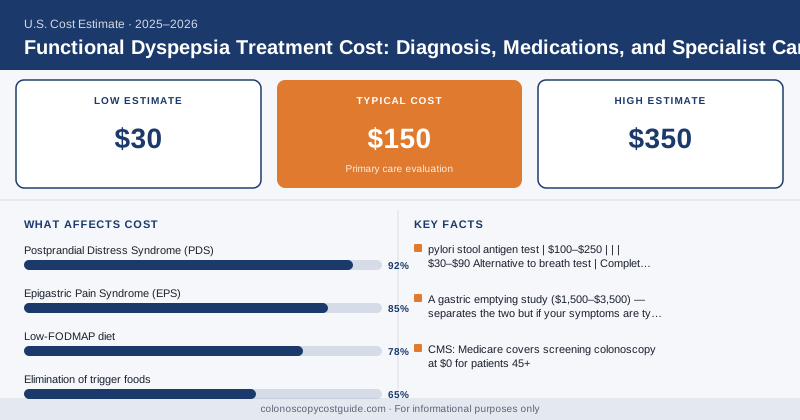
Functional Dyspepsia Treatment Cost: Diagnosis, Medications, and Specialist Care
What does it cost to find out there’s nothing structurally wrong with your stomach? For functional dyspepsia patients, the diagnostic odyssey can run $3,000–$8,000 before a definitive diagnosis — and that’s just to rule out what it isn’t. Ongoing treatment adds another $1,200–$5,000 per year depending on your medication regimen and specialist involvement. Here’s the real financial picture for one of gastroenterology’s most common — and commonly misunderstood — diagnoses.
About 10–20% of the U.S. population has functional dyspepsia, according to Rome IV criteria estimates published in the American Journal of Gastroenterology in 2021. It’s one of the most prevalent functional GI disorders, yet it’s frequently misdiagnosed as GERD, gastroparesis, or peptic ulcer disease — each of which triggers different (and often unnecessary) testing.
Understanding What You’re Paying to Diagnose
Functional dyspepsia is a diagnosis of exclusion — you have to rule out structural and organic causes first. That’s what drives the initial cost.
| Diagnostic Test | Cost Without Insurance | With Insurance (OOP) | Purpose |
|---|---|---|---|
| Primary care evaluation | $150–$350 | $30–$120 | Initial workup |
| H. pylori breath test | $200–$400 | $50–$150 | Rule out H. pylori infection |
| H. pylori stool antigen test | $100–$250 | $30–$90 | Alternative to breath test |
| Complete blood count, metabolic panel | $150–$400 | $40–$120 | Screen for anemia, organ dysfunction |
| Upper endoscopy (EGD) | $2,500–$5,500 | $500–$2,500 | Rule out ulcer, cancer, esophagitis |
| Abdominal ultrasound | $300–$800 | $100–$300 | Rule out gallbladder, pancreatic disease |
| Gastric emptying study | $1,500–$3,500 | $300–$1,200 | Rule out gastroparesis |
| Endoscopic biopsy (if EGD done) | $300–$900 | $100–$400 | Biopsy for H. pylori, celiac, other |
Not every patient needs every test. For patients under 60 with no alarm features (weight loss, dysphagia, bleeding, family history of GI cancer), many guidelines recommend a test-and-treat H. pylori strategy first — test for H. pylori, treat if positive, then reassess. This approach can keep initial costs under $1,000 for straightforward cases.
Upper endoscopy is often prompted when alarm symptoms are present or when the patient is over 60 (the “prompt endoscopy” threshold recommended by the ACG). The upper endoscopy (EGD) cost represents the largest single expense in the diagnostic workup.
Rome IV Subtypes and Their Treatment Implications
Functional dyspepsia has two subtypes under Rome IV criteria, and the subtype affects which treatment is most likely to help:
Postprandial Distress Syndrome (PDS): Fullness, early satiation after eating. Often responds to prokinetics (metoclopramide, domperidone) and dietary modification.
Epigastric Pain Syndrome (EPS): Epigastric pain/burning not relieved by defecation. Often responds better to PPIs, H2 blockers, or low-dose tricyclic antidepressants.
Some patients have overlap. The distinction matters for treatment selection and therefore cost — prokinetics, neuromodulators, and PPIs have very different price points.
Medication Costs for Functional Dyspepsia
| Medication | Class | Monthly Cost (Generic) | Monthly Cost (Brand) | Notes |
|---|---|---|---|---|
| Omeprazole 20mg | PPI | $10–$25 OTC | N/A | First-line trial for EPS |
| Pantoprazole 40mg | PPI | $15–$35 Rx | $200–$400 (brand) | Commonly prescribed |
| Famotidine 20–40mg | H2 blocker | $10–$25 OTC | N/A | Alternative to PPIs |
| Amitriptyline 10–25mg | TCA neuromodulator | $15–$30 | N/A | Low-dose; highly generic |
| Nortriptyline 10–25mg | TCA neuromodulator | $15–$35 | N/A | Fewer side effects than amitriptyline |
| Mirtazapine 7.5–15mg | NaSSA neuromodulator | $20–$40 | N/A | Especially for nausea/weight loss |
| Buspirone | Anxiolytic/prokinetic | $20–$50 | N/A | Small evidence base for FD |
| Metoclopramide | Prokinetic | $25–$60 | $150–$300 (Gimoti nasal) | Use limited to 12 weeks due to tardive dyskinesia risk |
| Acotiamide | Prokinetic (Japan/EU) | Not available in US | N/A | Widely used abroad; US trials ongoing |
The good news: most functional dyspepsia medications are inexpensive generics. A patient doing well on low-dose amitriptyline and omeprazole might spend $30–$60/month on medication. The cost driver for functional dyspepsia isn’t typically the drugs — it’s the specialist visits, repeated testing, and years of trial-and-error before effective treatment is established.
Why Low-Dose Antidepressants Are Used for Functional Dyspepsia
Low-dose tricyclic antidepressants (TCAs) like amitriptyline 10–25mg work for functional dyspepsia NOT because patients are depressed (though anxiety and depression commonly co-occur) but because TCAs modulate the enteric nervous system — the gut’s own neural network.
At psychiatric doses, amitriptyline is $0.50–$1/day. Insurance covers it under any pharmacy benefit without prior authorization in most plans. The challenge: patients often resist the idea of an antidepressant for a stomach problem. Gastroenterologists who take time to explain the mechanism — it’s a gut neuromodulator at this dose — get better adherence and better outcomes.
Specialist Visits and Their Costs
Most functional dyspepsia patients end up seeing multiple providers before getting the right answer:
| Provider | Visit Cost (No Insurance) | With Insurance (OOP) | Notes |
|---|---|---|---|
| Primary care physician | $150–$350 | $30–$120 | Entry point; manages basic cases |
| Gastroenterologist (new patient) | $300–$600 | $60–$200 | Performs EGD; diagnoses FD |
| Gastroenterologist (follow-up) | $200–$450 | $40–$150 | Ongoing management |
| GI motility specialist | $350–$700 | $80–$250 | Complex/refractory FD |
| Registered dietitian | $150–$350 | $50–$150 | Dietary modification guidance |
| GI-focused psychologist/therapist | $150–$300 | $50–$150 | CBT, gut-directed hypnotherapy |
For straightforward cases managed by primary care, annual specialist costs are minimal. For refractory functional dyspepsia — patients who fail initial therapy and require a GI motility workup, multiple medications, and multidisciplinary care — annual specialist costs can run $3,000–$8,000.
The Hidden Cost: Years to Diagnosis
The ACG estimates that functional GI disorders cost the U.S. healthcare system over $30 billion annually in direct and indirect costs. A significant portion is unnecessary testing — endoscopies, imaging, and repeat labs — driven by diagnostic uncertainty.
A 2023 study in Clinical Gastroenterology and Hepatology found that functional dyspepsia patients averaged 3.2 gastroenterologist visits and 2.1 endoscopic procedures before receiving a confident FD diagnosis. At current prices, those 2.1 endoscopies alone represent $5,000–$11,500 in facility charges.
This isn’t to say those tests are wrong — ruling out organic disease is medically necessary. But once functional dyspepsia is confirmed by a complete workup, the goal shifts from more testing to effective symptom management. Many patients don’t get that message clearly and continue cycling through repeated tests.
Dietary Approaches: Real Costs
Dietary modification is recommended for all functional dyspepsia patients. Common approaches:
- Low-FODMAP diet (reducing fermentable carbohydrates): Best studied for IBS but used for FD overlap; requires registered dietitian guidance for 4–8 weeks. Cost: $600–$2,800 for initial dietitian engagement.
- Elimination of trigger foods (fat, caffeine, spicy food, alcohol): Free on its own; requires patient education.
- Small frequent meals, eating pace modification: Free; behavioral coaching helps adherence.
Dietitian visits are covered under most ACA-compliant commercial plans when referred for a medically necessary condition. Medicare covers Medical Nutrition Therapy (MNT) for specific conditions (diabetes, kidney disease) but not typically for functional dyspepsia — general dietitian visits may be out-of-pocket under Medicare Part B for FD patients.
Mind-Gut Approaches: Cognitive Behavioral Therapy (CBT) and Hypnotherapy
Gut-directed hypnotherapy and CBT have the strongest evidence base among non-pharmacological treatments for functional GI disorders. A Cochrane meta-analysis found psychological therapies significantly reduce dyspepsia symptoms compared to control.
- Individual CBT (GI-focused): $150–$300/session; typically 6–12 sessions recommended
- Gut-directed hypnotherapy: $150–$250/session; 7–12 sessions standard protocol
- Digital CBT programs: $50–$200/month (apps like Nerva, Mahana — IBS-focused but applicable to FD)
Mental health benefits under the ACA require parity with medical/surgical benefits. If your plan covers other types of therapy, it must cover CBT for functional GI disorders at the same cost-sharing level. Some insurers require documentation that the therapy is medically necessary and being performed by a licensed provider.
Realistic Annual Cost Scenarios
| Scenario | Annual Cost (No Insurance) | With Insurance (OOP) |
|---|---|---|
| Managed by PCP with PPI alone | $500–$1,500 | $200–$600 |
| GI diagnosis, single EGD, PPI + TCA | $4,500–$9,000 (year 1) | $1,500–$4,000 |
| Ongoing GI follow-up, 2 visits/year | $1,500–$3,500 | $400–$1,200 |
| Refractory FD with motility specialist + CBT | $8,000–$18,000 | $2,500–$8,000 |
For patients also dealing with overlapping IBS symptoms, the IBS treatment cost article covers shared cost elements. Many of the diagnostic tests and medication categories overlap significantly between functional dyspepsia and IBS.
The Bottom Line
Functional dyspepsia is chronically undertreated because it’s a “functional” diagnosis in a healthcare system that rewards testing and procedures over thoughtful clinical management. The patients who do best — both medically and financially — are those who receive a confident diagnosis after a complete but focused workup, then commit to a multimodal treatment plan: appropriate medication, dietary modification, and mind-gut therapy. Chasing new tests after a clear diagnosis is made doesn’t improve outcomes and adds thousands to the annual cost burden.