Flexible Sigmoidoscopy Cost: Why It Fell Out of Favor and Where It's Still Used
{ if eq .Lang "zh" }{ else }{ end }In 2005, flexible sigmoidoscopy was one of the most common colorectal cancer screening procedures in the United States. By 2025, most gastroenterologists rarely offer it at all. Here’s what changed — and what it still costs when it’s appropriate.
Flexible sigmoidoscopy uses a shorter scope (60 cm, vs. 140 cm for a colonoscopy) to examine only the lower third of the colon — the sigmoid colon and rectum. It doesn’t require full sedation in most cases, doesn’t need the same extensive bowel prep as a colonoscopy, and takes about 10 to 20 minutes. It’s also considerably cheaper.
So why did it fall out of favor? Because it misses approximately 65 to 70% of the colon — and that’s where a significant percentage of advanced adenomas live. A 2021 randomized trial published in the New England Journal of Medicine found that flexible sigmoidoscopy reduced colorectal cancer incidence by about 26%, compared to an estimated 40 to 60% reduction with colonoscopy. Better scope, better outcomes.
Still, it has a role. And it’s significantly cheaper.
Flexible Sigmoidoscopy Cost
| Setting | Facility Fee | Physician Fee | Total |
|---|---|---|---|
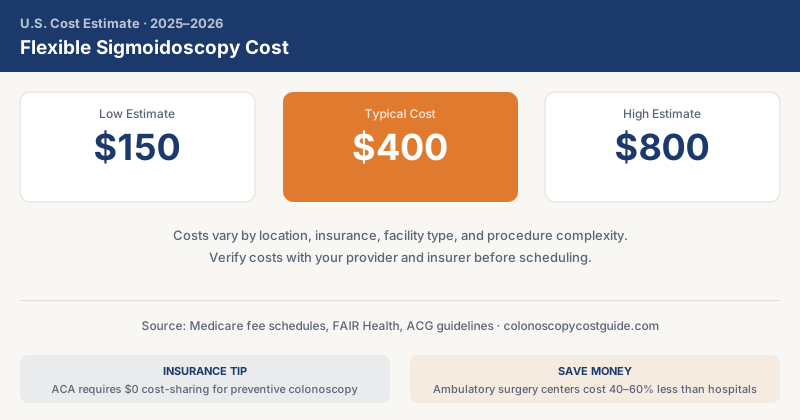
| Gastroenterologist’s office | $0 – $100 | $150 – $400 | $150 – $500 |
| Ambulatory surgery center | $150 – $500 | $150 – $400 | $300 – $900 |
| Hospital outpatient | $400 – $1,200 | $150 – $400 | $550 – $1,600 |
The cost range is wide because it depends so heavily on where the procedure is performed. A sigmoidoscopy done in a GI physician’s office — with no sedation, minimal prep, and the physician using a basic flexible scope — can run $150 to $500 all-in. The same procedure scheduled as an ASC outpatient event costs more. A hospital outpatient sigmoidoscopy can cost as much as a colonoscopy at an ASC.
Rigid vs. Flexible Sigmoidoscopy: A Quick Distinction
Rigid sigmoidoscopy — using a metal instrument to examine the last 15 to 20 cm of the rectum — is still occasionally performed in some primary care and colorectal surgery offices for targeted rectal evaluation. It’s inexpensive ($50 to $200) but examines very little of the colon. It’s not a cancer screening tool.
Flexible sigmoidoscopy, using the 60 cm scope, is the version relevant for colorectal cancer screening discussions.
Medicare Coverage for Flexible Sigmoidoscopy
Medicare Part B covers flexible sigmoidoscopy as a preventive benefit:
- Average-risk adults: Every 4 years (48 months)
- High-risk adults: Covered more frequently, though colonoscopy is typically preferred for high-risk patients
At $0 cost-sharing for Medicare beneficiaries when used as a preventive screening — same as colonoscopy. This is a surprisingly strong benefit, and it makes sigmoidoscopy a legitimate low-cost option for Medicare patients who want an alternative to colonoscopy.
If a polyp is found during flexible sigmoidoscopy and a biopsy is taken, the procedure is converted to a diagnostic code and cost-sharing applies. If the sigmoidoscopy is normal but your doctor wants to follow up with full colonoscopy, that colonoscopy is typically billed as diagnostic (deductible applies), not as a preventive screening.
The Annual FIT + Sigmoidoscopy Combo
Where Flexible Sigmoidoscopy Is Still Used
Despite the shift toward colonoscopy, sigmoidoscopy remains appropriate in specific situations:
When full colonoscopy isn’t tolerable or available: Patients who are medically frail, can’t tolerate full bowel prep, or have contraindications to deep sedation may be better candidates for no-sedation sigmoidoscopy with a brief prep.
Rectal evaluation: For patients with rectal bleeding, rectal pain, or suspected rectal pathology where full colonoscopy may be deferred, sigmoidoscopy provides rapid, targeted evaluation of the rectum and lower sigmoid.
Post-treatment surveillance for rectal cancer: After rectal cancer surgery or radiation, flexible sigmoidoscopy is sometimes used for surveillance of the anastomosis or radiation field — a more targeted scope than a full colonoscopy.
Low-resource or access-limited settings: In federally qualified health centers or other safety-net settings where scheduling a full colonoscopy involves a 3 to 6 month wait, sigmoidoscopy may be used as a bridge or alternative.
| Comparison Factor | Flexible Sigmoidoscopy | Colonoscopy |
|---|---|---|
| Colon coverage | 30–35% (lower third) | 100% |
| Sedation needed | Usually not | Yes (typically) |
| Prep required | Enema only | Full liquid diet + laxative |
| Procedure time | 10–20 minutes | 20–45 minutes |
| Medicare interval | Every 4 years | Every 10 years (average risk) |
| Average total cost | $200 – $800 | $1,200 – $3,500 |
| Cancer detection rate | Lower | Higher |
Insurance Coverage for Flexible Sigmoidoscopy
Under ACA-compliant plans, flexible sigmoidoscopy is covered as preventive colorectal cancer screening at $0 cost-sharing, following USPSTF recommendations. The ACA mandates coverage for all USPSTF Grade A and B recommendations — and the 2021 USPSTF guidelines include flexible sigmoidoscopy every 5 years (alone or with annual FIT) as an acceptable screening strategy.
Confirm with your insurer that your plan classifies it as preventive. As with colonoscopy, billing errors can lead to preventive procedures being coded as diagnostic. If you receive a cost-sharing bill for a preventive sigmoidoscopy, verify the billing code used and appeal if it was miscoded.
For a full comparison of screening options and their 10-year costs, see colon cancer screening comparison. The sigmoidoscopy is cheaper per procedure but requires pairing with annual FIT to achieve comparable cancer detection rates over time.
{ if eq .Lang "zh" }