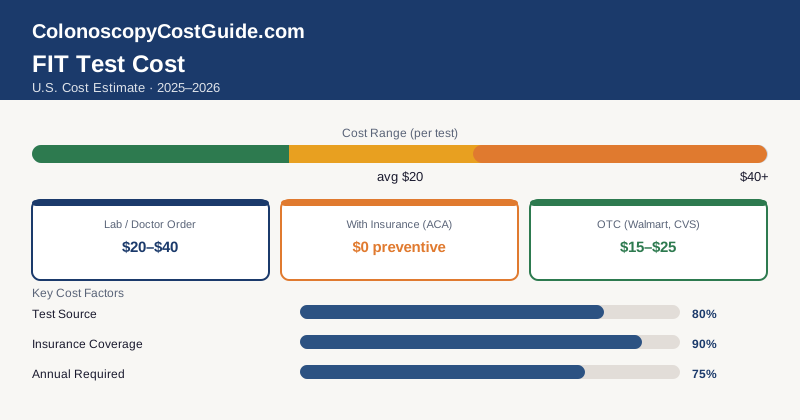
FIT Test Cost: Fecal Immunochemical Test Pricing and What a Positive Result Means
42% of Americans over 50 have never had any colorectal cancer screening. For many of them, the barrier isn’t fear of the colonoscopy prep — it’s cost. A FIT test changes that math entirely.
What Is a FIT Test?
The fecal immunochemical test (FIT) detects hidden blood in your stool using antibodies specific to human hemoglobin. Unlike the older guaiac-based test, it doesn’t react to food or medications, which means fewer false positives and no dietary restrictions before testing.
You collect a small stool sample at home using a kit, return it to the lab, and get results within a few days. The whole process takes about two minutes.
FIT Test Cost Breakdown
| Where You Get It | Cost |
|---|---|
| Doctor’s office (lab send-out) | $20–$60 |
| At-home kit (retail / OTC) | $25–$45 |
| Medicare Part B coverage | $0 (annual benefit) |
| Private insurance (ACA preventive) | $0 in-network |
| Community health clinic / FQHC | Often free or sliding scale |
FIT is genuinely cheap. Medicare covers it annually for beneficiaries at no cost under the colorectal cancer screening benefit. Most private insurance plans cover it with no cost-sharing as a preventive service under ACA guidelines — the USPSTF gives annual FIT testing a Grade B recommendation for average-risk adults ages 45–75.
FIT vs. Colonoscopy: Sensitivity and Specificity
This is where you need realistic expectations. FIT detects colorectal cancer well — but polyp detection is a different story.
| Metric | Annual FIT | One-Time Colonoscopy |
|---|---|---|
| Sensitivity for CRC | ~79–80% | ~95% |
| Sensitivity for advanced adenoma | ~24–40% | ~90%+ |
| Specificity | ~95% | ~99% |
| Polyp removal capability | None (follow-up needed) | Yes, same session |
| Patient burden | Very low | Moderate (prep, sedation) |
A 2022 study published in NEJM comparing FIT to colonoscopy (the NordICC trial) found no significant difference in colorectal cancer mortality over 10 years — though participation rates, not test performance, were a major factor in that finding. The ASGE and ACG continue to support both approaches while emphasizing colonoscopy’s advantage in polyp detection.
Annual Testing: The Real Commitment
FIT isn’t a once-every-10-years test. It’s annual. That’s a meaningful difference from colonoscopy’s once-per-decade cadence for average-risk adults.
The annual cost stays low — $0 to $45 per year with insurance — but the commitment to actually doing it every year is real. Studies consistently show FIT’s effectiveness depends heavily on adherence. Skipping a year or two significantly reduces its protective benefit.
What to Know About Annual FIT Adherence
What Happens If Your FIT Test Is Positive?
A positive FIT result means blood was detected — which can indicate polyps, colorectal cancer, or other GI conditions including hemorrhoids, diverticular disease, or inflammatory bowel disease. A positive FIT is not a diagnosis.
What happens next, cost-wise:
- Diagnostic colonoscopy required — and here’s the critical thing to know: it will likely be billed as diagnostic, not screening. That means your deductible and coinsurance apply.
- Typical out-of-pocket for diagnostic colonoscopy: $500–$2,000 depending on your plan
- If polyps are found: polypectomy and pathology fees added — see colonoscopy cost for polyp removal
- If cancer is found: treatment costs are substantial — surgery, chemotherapy, radiation can run $150,000–$300,000+
The Lifetime Cost Calculation
Over a 30-year screening window (ages 45–75), annual FIT testing costs roughly:
- Insurance covered: essentially $0 per year for the test itself
- Cash pay: $20–$45/year = $600–$1,350 total for tests alone
- Plus any positive-result colonoscopies: potentially $500–$2,000 each occurrence
For context, a single positive result requiring colonoscopy can exceed the entire 30-year cost of the FIT tests themselves. That’s not a reason to skip FIT — it’s a reason to budget realistically and understand what you’re signing up for.
The bottom line: FIT is the most accessible entry point to colorectal cancer screening for uninsured and cost-sensitive patients. Combined with consistent annual testing, it’s a legitimate, evidence-based choice.