Anal Fistula Surgery (Fistulotomy) Cost
What does anal fistula surgery actually cost? That depends almost entirely on which procedure your surgeon recommends — and fistula surgery has more options than almost any other colorectal procedure. A simple fistulotomy might run $3,000–$5,000. A LIFT procedure or advancement flap pushes into $6,000–$10,000 territory. And if you have Crohn’s disease complicating the picture, you could be managing a fistula with staged procedures over years.
Here’s a clear breakdown of what each approach costs and why your fistula’s anatomy drives the decision.
What Is an Anal Fistula?
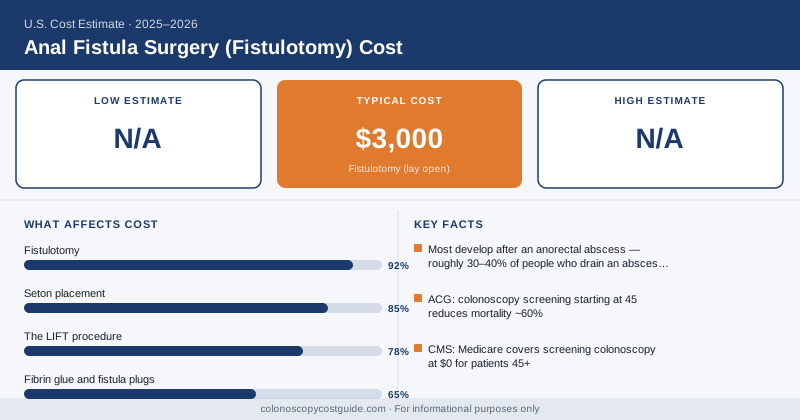
An anal fistula is an abnormal tunnel that forms between the inside of the anal canal and the skin around the anus. Most develop after an anorectal abscess — roughly 30–40% of people who drain an abscess go on to develop a fistula, according to the ACG (American College of Gastroenterology). Crohn’s disease is the other major risk factor, causing complex, branching fistulas that are notoriously difficult to treat definitively.
Fistulas don’t heal on their own. Once the tract is established, surgical treatment is almost always required to cure it. The challenge: the anal sphincter muscle often runs through or near the fistula tract — and cutting through it risks fecal incontinence.
Surgical Options and Their Costs
| Procedure | Typical Cash Cost | Best For |
|---|---|---|
| Fistulotomy (lay open) | $3,000 – $8,000 | Simple, superficial fistulas not crossing sphincter |
| Seton placement (staging) | $2,000 – $5,000 | High or complex fistulas; used before definitive repair |
| LIFT procedure (ligation of intersphincteric fistula tract) | $4,000 – $10,000 | Transsphincteric fistulas; sphincter-preserving |
| Advancement flap repair | $5,000 – $11,000 | Complex fistulas; mucosal or rectal advancement |
| Fibrin glue injection | $2,500 – $6,000 | Less invasive option; lower success rate (30–55%) |
| Anal fistula plug (bioprosthetic) | $3,000 – $7,000 | Moderate complexity; variable success rates |
Understanding Each Technique
Fistulotomy is the gold standard — when it’s safe. The surgeon literally opens (“lays open”) the entire fistula tract, allowing it to heal from the bottom up. Cure rates exceed 90% for simple fistulas. But this procedure cuts through any sphincter muscle involved in the tract. For simple (low) fistulas that barely touch the external sphincter, the risk of incontinence is very low. For high (transsphincteric) fistulas, it’s unacceptably high — which is why other approaches exist.
Seton placement involves passing a suture or silicone thread through the fistula tract and tightening it slowly over several office visits, cutting through the sphincter gradually so scar tissue forms and maintains continence. It’s often used as a first stage before a definitive repair. At $2,000–$5,000, it’s not cheap — and it typically isn’t the last procedure you’ll need.
The LIFT procedure (Ligation of Intersphincteric Fistula Tract) is the most widely adopted sphincter-preserving technique. The surgeon accesses the space between the internal and external sphincters, ties off the fistula tract, and removes the infected tissue. ASGE-cited data puts success rates at 57–94% depending on fistula complexity and surgeon experience. Cash cost runs $4,000–$10,000 at an ambulatory surgery center.
Fibrin glue and fistula plugs are minimally invasive approaches — no cutting of sphincter muscle at all. The glue seals the tract; the plug provides a scaffold for tissue ingrowth. These are appealing for their low risk of incontinence, but success rates are lower (30–55% for fibrin glue, 40–70% for plugs). Many colorectal surgeons reserve them for patients with Crohn’s disease or poor wound-healing capacity, where sphincter-cutting procedures carry higher risk.
Does Insurance Cover Fistula Surgery?
Yes — anal fistula surgery is covered by commercial insurance, Medicare, and Medicaid as a medically necessary procedure. It’s not categorized as elective. However, the specific technique may affect coverage:
- Standard fistulotomy, LIFT, seton: Covered routinely; no prior authorization issues in most cases
- Biological fistula plugs: Some insurers require prior authorization; document prior treatment failures
- Fibrin glue: Generally covered when used for complex or Crohn’s-related fistulas
With insurance, expect to pay:
- Surgeon’s fee: $300–$900 after deductible and coinsurance
- ASC or hospital facility fee: $500–$2,500
- Anesthesia: $200–$700
- Post-op visits (4–6): $30–$75 copay each
Most insured patients pay $800–$2,500 total for a first fistulotomy or LIFT procedure.
Crohn's Disease Changes Everything
If you have Crohn’s disease, expect a fundamentally different treatment approach — and significantly higher lifetime costs. Crohn’s fistulas are complex, often branching, and respond poorly to standard surgical techniques. Treatment typically involves a combination of biologics (infliximab, adalimumab — $15,000–$40,000/year with insurance), staged seton placement, and possible diverting colostomy.
The ASGE recommends a multidisciplinary approach for Crohn’s-related fistulas: a gastroenterologist managing the Crohn’s medically, plus a colorectal surgeon for the fistula itself. Separating these care streams leads to worse outcomes and higher total costs.
Full Cost Comparison by Scenario
| Scenario | Estimated Cash Cost | Estimated OOP (Insured) |
|---|---|---|
| Simple fistulotomy, outpatient ASC | $3,000 – $6,000 | $800 – $1,800 |
| LIFT procedure, ambulatory surgery center | $4,500 – $8,000 | $1,000 – $2,500 |
| Complex advancement flap, hospital outpatient | $7,000 – $12,000 | $1,500 – $4,000 |
| Staged seton + LIFT (two procedures) | $6,000 – $15,000 | $2,000 – $5,000 |
| Crohn’s fistula: seton + biologics (annual) | $20,000 – $50,000+ | $3,000 – $8,000+ |
How to Keep Costs Down
- Seek a colorectal surgeon, not a general surgeon. Fistula surgery outcome depends heavily on surgical experience. A colorectal specialist who performs dozens of fistula repairs per year will have better outcomes — and fewer repeat procedures — than a general surgeon doing two per year. Fewer revisions means lower lifetime cost.
- Ask specifically about the LIFT procedure if your fistula is transsphincteric. Some surgeons default to seton or advancement flap out of habit; LIFT has comparable success rates with a simpler recovery for many patients.
- Get surgery at an ASC when possible. Hospital outpatient facility fees for the same procedure routinely run $2,000–$4,000 more than an ASC. Confirm your surgeon operates at an ASC before scheduling.
- Don’t delay. Untreated fistulas don’t improve on their own — they tend to develop secondary tracts and become more complex, which drives surgical complexity and cost upward.
- If you have Crohn’s, optimize your medical therapy first. Starting a biologic before surgery improves fistula closure rates and may reduce the number of procedures you ultimately need.
Anal fistula surgery is one of the more nuanced procedures in colorectal surgery — technique selection matters enormously, and the right choice depends on your anatomy, risk factors, and surgeon’s skill set. Get at least one opinion from a colorectal specialist before committing to any approach.