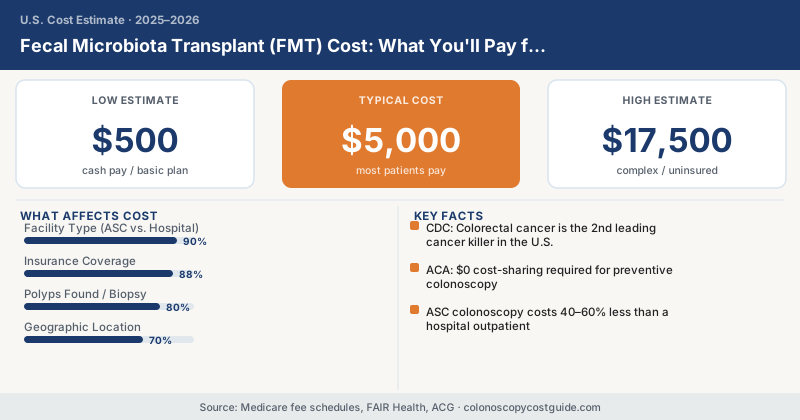
Fecal Microbiota Transplant (FMT) Cost: What You'll Pay for C. diff Treatment
The idea sounds strange. The results are remarkable. Fecal microbiota transplant — FMT — has become the standard of care for recurrent Clostridioides difficile (C. diff) infection, with cure rates exceeding 90% in clinical trials compared to about 30–40% for repeat antibiotics alone, according to the American Gastroenterological Association (AGA).
What you actually pay depends on the delivery method. Two FDA-approved products and a traditional colonoscopic delivery method all have different price tags — and different insurance coverage situations.
FMT Delivery Methods and Their Costs
FMT can be delivered several ways. Since 2023, two FDA-approved products have changed the landscape significantly:
| Method | What It Is | Typical Cost Without Insurance |
|---|---|---|
| Rebyota (fulgancimab-ebsl) — FDA approved 2022 | Single-dose enema, administered in clinic | $8,000 – $12,000 (drug list price) |
| Vowst (SER-109) — FDA approved 2023 | Oral capsules (4 days), self-administered | $9,000 – $17,500 (drug list price) |
| Colonoscopic FMT (investigational, off-label) | Colonoscopy with donor stool infusion | $2,500 – $8,000 (procedure cost) |
| Nasogastric/nasoduodenal FMT (off-label) | Via tube through nose into small intestine | $1,500 – $5,000 |
| Upper endoscopy FMT delivery (off-label) | Via upper endoscope | $2,000 – $6,000 |
Rebyota and Vowst are the only FDA-approved FMT products in the United States. Both are biologics derived from processed human donor stool — they’re technically microbiome restoration therapies, not transplants in the surgical sense. FDA approval means they have established NDC codes and can be billed through pharmacy benefits.
Colonoscopic FMT remains common at academic medical centers and many GI practices, particularly for patients who’ve already failed antibiotics multiple times. It’s currently used off-label in the US because FDA approval was granted to the commercial products, not the procedure itself — though the FDA has exercised enforcement discretion.
What Insurance Covers (and the Problem With FMT Coverage)
Insurance coverage for FMT is evolving rapidly:
Rebyota and Vowst (the FDA-approved products): Major commercial insurers including UnitedHealthcare, Aetna, BCBS, and Cigna have added coverage policies for both products as of 2024. You’ll typically pay your specialty drug copay or coinsurance — often $500–$3,000 depending on your plan and whether you’ve met your OOP maximum. Manufacturer copay assistance programs can reduce costs to as low as $0 for commercially insured patients.
Colonoscopic FMT: Coverage varies widely. Many insurers cover the colonoscopy procedure component but not the stool preparation fee. Some academic medical centers include FMT as part of a clinical protocol at no charge. Call your insurer with CPT code 44705 (preparation of fecal microbiota for instillation, including assessment of donor specimen) and ask about your specific benefit.
Medicare: CMS granted Medicare coverage for Rebyota in early 2024 under Part D (pharmacy benefit). Vowst also carries a Part D billing pathway. Colonoscopic FMT may be covered under Part B when billed as a colonoscopy (CPT 45378) with a separate charge for the FMT material — coverage is plan-dependent.
Copay Assistance Programs for Rebyota and Vowst
Both manufacturers offer significant financial assistance:
- Rebyota (Ferring Pharmaceuticals): Ferring Cares program — $0 copay for eligible commercially insured patients; patient assistance for uninsured or underinsured
- Vowst (Seres Therapeutics): SeresCares program — copay assistance available, income-based free product program for uninsured
These programs can make FDA-approved FMT essentially free for many patients. Contact the manufacturer directly or ask your pharmacist.
Colonoscopic FMT: The Procedure Cost Breakdown
For patients receiving traditional colonoscopic FMT, expect these charges:
| Component | Typical Cost (Uninsured) |
|---|---|
| Donor stool screening and preparation | $500 – $1,500 |
| Colonoscopy facility fee | $1,200 – $4,000 |
| Gastroenterologist physician fee | $400 – $1,200 |
| Anesthesia (propofol) | $500 – $1,200 |
| Pre-procedure vancomycin antibiotic course | $20 – $60 |
| Total (colonoscopic FMT) | $2,500 – $8,000 |
The donor stool component — whether obtained from a stool bank like OpenBiome or screened in-house — is typically a separate charge from the colonoscopy itself. Some academic centers include the stool preparation in a clinical fee; others bill it separately.
FMT for Recurrent C. diff: Why Cost Is Usually Worth It
C. diff recurrence is expensive to mismanage. Each recurrence typically means:
- Another antibiotic course (vancomycin: $400–$800; fidaxomicin/Dificid: $3,000–$5,000)
- More GI office visits ($200–$600)
- Possible hospitalization if severe ($8,000–$30,000+)
The AGA’s 2023 clinical guidelines recommend FMT for patients with a second or greater recurrence of C. diff. If you’ve had two recurrences and are facing a third antibiotic course vs. FMT, the cost comparison usually favors FMT — especially if you’re looking at fidaxomicin or the risk of hospitalization.
FMT Beyond C. diff: Still Experimental (and Mostly Not Covered)
Researchers are studying FMT for IBS, IBD, metabolic syndrome, and other conditions. These applications are investigational — not covered by insurance, not FDA-approved for these indications, and not available outside clinical trials at reputable institutions. Be cautious about clinics outside the US or online programs offering FMT for conditions other than C. diff — these are not evidence-based.
The Bottom Line on FMT Costs
If you have recurrent C. diff and are commercially insured, the FDA-approved oral capsule (Vowst) or enema (Rebyota) is likely your cheapest and most convenient option — with copay assistance potentially bringing your cost to $0–$500. If you’re on Medicare, Part D coverage for both products is now established.
For uninsured patients, colonoscopic FMT at an academic medical center — some of which offer it at no cost through clinical protocols — may be the most accessible route. Call your regional academic GI center and ask about their FMT program and financial assistance.
Don’t pay for multiple rounds of fidaxomicin ($3,000–$5,000 per course) if you’re a FMT candidate. Two C. diff recurrences is the threshold where your GI doctor should be discussing it.