External Hemorrhoid Banding Cost: Why It's Not the Right Treatment
{ if eq .Lang "zh" }{ else }{ end }Most patients assume any hemorrhoid can be “banded” away in a quick office visit. Wrong — and this misunderstanding sends people searching for a treatment that doesn’t actually exist for their condition. Rubber band ligation only works on internal hemorrhoids. If yours are external, banding isn’t an option, and it’s worth understanding what actually is.
Why External Hemorrhoids Can’t Be Banded
Internal hemorrhoids form above the dentate line, a boundary inside the anal canal where the tissue transitions from the type that lines your intestines (no pain-sensing nerve endings) to true skin (dense with nerve endings). That’s why a band can be placed around an internal hemorrhoid with minimal discomfort — the tissue simply can’t register sharp pain the way skin does.
External hemorrhoids sit below that line, in true perianal skin. Attempting to band this tissue would cause severe, unbearable pain, which is why the American Society of Colon and Rectal Surgeons doesn’t recommend or perform banding for external hemorrhoids. If someone offers you “banding” for an external hemorrhoid, get a second opinion — it’s not standard practice.
What External Hemorrhoid Treatment Actually Costs
| Treatment | Typical Cost | When It’s Used |
|---|---|---|
| OTC creams and suppositories | $10 – $30 | Mild symptoms, itching, irritation |
| Prescription topical steroid | $20 – $60 | More significant inflammation |
| Sitz bath equipment | $10 – $25 (one-time) | Supportive care, all severity levels |
| In-office thrombosed hemorrhoid excision | $300 – $800 | Acute clot causing severe pain |
| Surgical excision (non-acute, recurrent) | $1,200 – $2,500 | Large, chronically symptomatic external hemorrhoids |
When External Hemorrhoids Need a Procedure
Most external hemorrhoids are managed without any procedure at all — fiber, hydration, sitz baths, and time resolve the majority of flares. The clear exception is a thrombosed external hemorrhoid, where a blood clot forms inside the swollen tissue, causing sudden, severe pain that doesn’t respond to home treatment.
Timing Matters for Thrombosed Hemorrhoid Excision
Insurance Coverage
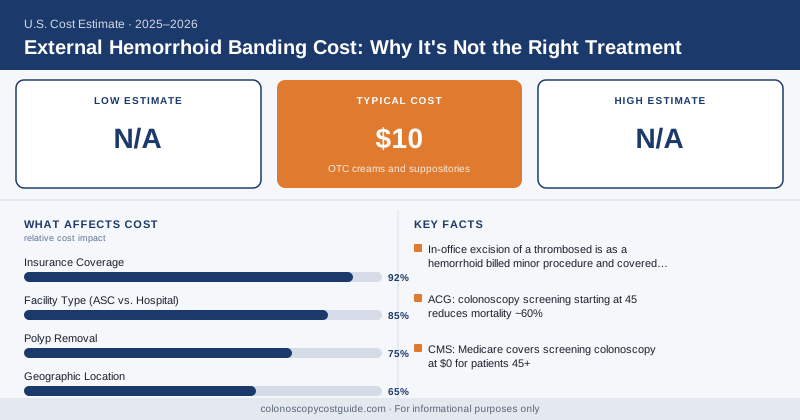
Insurance covers external hemorrhoid treatment when medically necessary. Topical prescriptions typically carry a standard pharmacy copay ($10–$30). In-office excision of a thrombosed hemorrhoid is billed as a minor procedure and covered similarly to an office visit with a procedure add-on — expect $50–$150 out of pocket with commercial insurance after your deductible, or standard Part B coinsurance with Medicare.
What If Symptoms Keep Recurring?
Some patients develop recurrent external hemorrhoid flares, often with a persistent skin tag left behind after a previous thrombosis resolves. If this becomes a chronic problem, a colorectal surgeon may recommend elective surgical excision — different from the emergency in-office procedure — to remove the redundant tissue permanently. This is a more involved procedure than acute excision, generally performed with local or regional anesthesia, and costs $1,200–$2,500.
The Bottom Line
If you’ve been told you need “external hemorrhoid banding,” that’s likely a mix-up in terminology — banding is reserved for internal hemorrhoids. External hemorrhoids are managed with topical treatment for mild cases ($10–$60) or in-office excision for an acute, painful clot ($300–$800). Understanding which category your hemorrhoids fall into helps you get the right treatment the first time, without wasting money chasing a procedure that isn’t appropriate for your condition.
{ if eq .Lang "zh" }