Esophageal Manometry and pH Test Cost: What You'll Pay
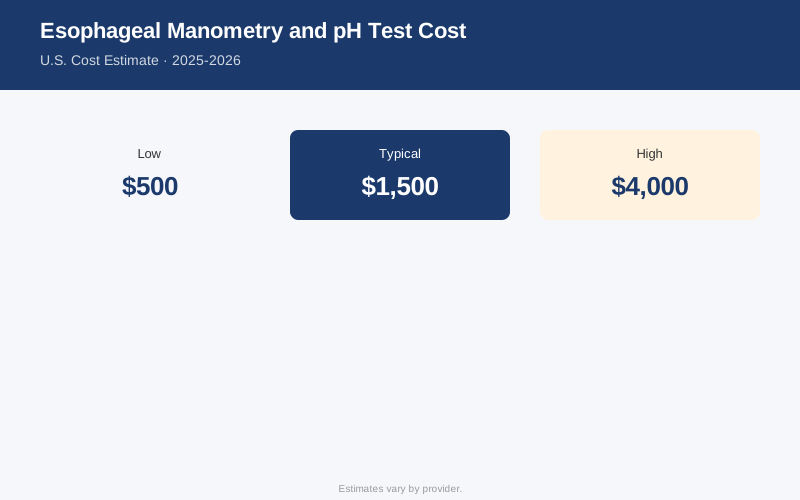
Here’s a scenario that plays out in GI offices every day: a patient has been on a proton pump inhibitor for months, still has symptoms, and their GI doctor orders “esophageal testing.” The patient gets a bill for $1,500–$4,000 and has no idea what they paid for or whether it was necessary.
Esophageal manometry and pH monitoring are two distinct tests, often ordered together, that together paint a complete picture of how the esophagus and its sphincters are functioning. Understanding what each test costs — and when each is actually necessary — can save you from paying for testing you don’t need.
The Two Tests Explained
Esophageal manometry measures the pressure and coordination of muscle contractions in the esophagus. It identifies conditions like achalasia, esophageal spasm, and ineffective esophageal motility.
pH monitoring measures how much acid (and sometimes non-acid reflux) is reaching the esophagus over 24–96 hours. It’s the most direct way to confirm a GERD diagnosis and measure treatment effectiveness.
They answer different questions. Manometry tells you how the esophagus is working mechanically; pH testing tells you how much acid is refluxing. Your GI doctor may order one or both depending on your symptoms.
Cost Breakdown
| Test | Typical Cash Cost | Notes |
|---|---|---|
| GI specialist visit (pre-test evaluation) | $200 – $600 | Usually required before ordering |
| High-resolution esophageal manometry (HRM) | $800 – $2,500 | Standard of care; catheter-based, 30–60 min |
| Standard esophageal manometry | $500 – $1,500 | Older technique; still used at some centers |
| 24-hour pH-impedance monitoring (catheter) | $600 – $2,000 | Catheter stays in nose overnight |
| Bravo pH capsule test (48–96 hours) | $1,000 – $3,500 | Wireless capsule clipped to esophagus; more comfortable |
| Combined HRM + pH (same session) | $1,200 – $4,500 | Bundled pricing at many academic centers |
| Impedance testing (add-on to pH study) | $200 – $600 | Detects non-acid reflux; often bundled |
When Is Esophageal Manometry Ordered?
Not every heartburn patient needs manometry. The ACG and ASGE (American Society for Gastrointestinal Endoscopy) recommend it for:
- Before anti-reflux surgery (fundoplication or LINX) — manometry is required to confirm adequate peristalsis before tightening the lower esophageal sphincter. If the esophagus can’t propel food properly, surgery can make swallowing worse.
- Diagnosing achalasia — a motility disorder where the lower esophageal sphincter fails to relax. Affects approximately 1 in 100,000 Americans per year and is definitively diagnosed only by manometry.
- Evaluating unexplained dysphagia (difficulty swallowing) when endoscopy is normal
- Assessing esophageal spasm or nutcracker esophagus (now called hypercontractile esophagus)
- Persistent reflux symptoms despite PPI therapy — to assess motility before considering surgery
If you have straightforward GERD symptoms that respond well to medications, you almost certainly don’t need manometry.
When Is pH Monitoring Ordered?
The Three Situations That Justify pH Monitoring
Per ACG clinical guidelines, ambulatory pH monitoring is appropriate when:
- GERD symptoms persist despite twice-daily PPI therapy — to determine if persistent symptoms are truly acid-related or from a different cause
- Pre-operative GERD evaluation — to objectively confirm GERD before committing to surgery
- Unclear diagnosis — patients with atypical symptoms (chronic cough, hoarseness, chest pain) where GERD is suspected but not confirmed
What pH monitoring is NOT needed for: a classic GERD patient with heartburn and regurgitation who responds well to once-daily PPI therapy. In that case, the clinical diagnosis is sufficient and pH testing adds cost without changing management.
Catheter-Based vs. Bravo pH Testing: Cost vs. Comfort
The traditional pH study uses a thin catheter inserted through the nose that stays in place for 24 hours. It’s accurate but uncomfortable. Cost: $600–$2,000 cash.
The Bravo pH capsule is a wireless system — a small capsule is clipped to the esophageal wall during upper endoscopy and transmits data to a pager-sized receiver for 48–96 hours. No catheter through the nose. Patients report significantly better tolerability and less dietary restriction during the study. Cost: $1,000–$3,500 cash.
The Bravo test generates more data (longer recording period) and is more patient-friendly, but the capsule itself is disposable and adds hardware cost. If the catheter-based study has been inconclusive or the patient can’t tolerate a nasal catheter, Bravo is worth the premium. Otherwise, catheter-based pH monitoring produces equivalent clinical data at lower cost.
Does Insurance Cover These Tests?
Yes — both tests are covered when ordered for appropriate clinical indications:
CPT codes: Esophageal manometry is billed under 91020 (standard) or 91037/91038 (high-resolution). pH monitoring uses 91034 (catheter) or 91035 (Bravo/wireless).
Commercial insurance: With a met deductible, expect 10–30% coinsurance. Out-of-pocket typically runs $100–$400 per test. Without met deductible, you’ll pay the full negotiated rate — usually $400–$1,500.
Medicare Part B: Covers both tests at 80% after the annual deductible. Bravo pH monitoring is covered but requires documentation that catheter-based testing was either performed or contraindicated.
Prior authorization: Often required, especially for Bravo. Call your insurer before scheduling to confirm requirements.
What to Ask Your GI Doctor Before These Tests
- Do I actually need both tests, or just one? If you’re being evaluated for a pre-surgical workup, both are standard. If your question is purely “do I have GERD?”, pH monitoring alone may answer it.
- Can both tests be done in the same visit? Combined manometry + pH catheter placement in one session reduces facility fees significantly.
- Is a hospital outpatient facility fee being added? Ask whether the test is being billed with a hospital facility fee or a standard physician/office fee — the difference can be $500–$1,500.
- What will I actually owe? Ask the GI office to run a pre-procedure insurance estimate before scheduling.
These tests aren’t cheap, but they’re highly targeted — when ordered correctly, they change clinical management. That’s worth paying for. When ordered reflexively as part of a “workup package,” they may not be.